Answering the need for accurate radio frequency measurements, these devices help ham radio operators verify transmitter output, troubleshoot interference, and validate channel assignments. The best options suit different use cases—from portable field work to lab-grade testing. This guide highlights five top picks, clarifies who each device is best for, and explains what to consider before buying.
| Product | Best For | Why It Stands Out |
|---|---|---|
| Surecom SF401 Plus 27Mhz-3000Mhz | Portable field work | Wide range coverage and included antennas make it versatile for walkie-talkies and two-way radios |
| Anysecu SF-103 A-SF103 | Maintenance and testing | Compact, reliable CW counter with easy range selection |
| Surecom SF401 Plus (CTCCSS/DCS) | Two-way radio tuning | CTCSS/DCS decoding enhances signal identification |
| VQP High Precision 8-Digit | High-precision testing | Multiple measurement functions and high-resolution display |
| Acxico 1 MHz-500 MHz Module | Ham radio kit builds | Compact module for integration into DIY projects |
Surecom SF401 Plus 27Mhz-3000Mhz Frequency Counter

The Surecom SF401 Plus covers 27 MHz to 3000 MHz for continuous carrier signals, with a built-in signal strength indicator. It is best for field use where quick checks of walkie-talkie or two-way radio frequencies are needed. The kit typically includes multiple antennas and a power adapter, simplifying on-site measurements. This device is suited for ham operators who need portable, broad-range frequency counting and straightforward operation.
- Best for: field technicians and hobbyists measuring standard two-way radio frequencies.
- Why selected: broad range and portability meet common ham-use cases.
- Caution: not designed for wideband spectrum analysis beyond its stated ranges.
Anysecu SF-103 A-SF103 Portable Frequency Counter

The Anysecu SF-103 is a compact counter designed for two-way radio applications, with a signal strength indicator and CW measurement capability. It is a solid choice for maintenance personnel and wireless enthusiasts who need a dependable tool for checking frequency and signal strength. The device emphasizes ease of use and range coverage suitable for common radio channels.
- Best for: on-site maintenance and field testing of two-way radios.
- Why selected: portable and user-friendly for quick checks.
- Caution: limited emphasis on ultra-high-frequency testing beyond its target range.
Surecom SF401 Plus 27Mhz-3000Mhz With CTCCSS DCS
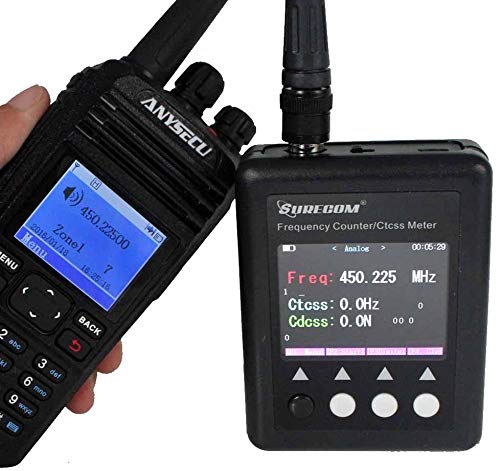
This version adds decoding for CTCCSS and DCS, helping users distinguish encoded sub-audible signals during field tests. It remains best for ham operators who need quick, readable frequency readouts while identifying correct CTCSS/DCS tones in go/no-go setups. It shares the same CW counting fundamentals as other SF401 models but adds a decoding layer for tone-based signaling.
- Best for: ham radio users who must interpret CTCSS/DCS alongside frequency.
- Why selected: decoding capability improves signal identification in noisy environments.
- Caution: decoding features depend on compatible tones and settings; verify compatibility before relying on results.
VQP High Precision Frequency Counter

The VQP 8-Digit High Precision Counter measures frequencies from 10 Hz to 2.7 GHz and supports direct counting up to 10 MHz plus proportional counting from 10 MHz to 100 MHz. It combines high accuracy with a broad feature set, including period measurement, cumulative count, and self-check functionality. The 8-digit LED display enhances readability for precise lab or bench work.
- Best for: advanced hobbyists and small labs needing high-precision frequency data.
- Why selected: wide range, multiple measurement modes, and clear display.
- Caution: higher-precision units may require careful handling and calibration in busy environments.
Acxico 1 Pcs High Accuracy 1~500 MHz Counter

The Acxico module targets 1–500 MHz with a compact form factor suitable for integration into ham radio kits or DIY projects. It uses a digital LCD display and notes that accuracy can be adjusted to the second decimal place. This makes it a practical choice for builders seeking a precise, self-contained counter to embed in a radio setup or test rig.
- Best for: DIY builds and compact measurement tasks in hobby projects.
- Why selected: small footprint with straightforward digital display.
- Caution: precision may be limited to decimal precision tied to the board’s design; verify decimal resolution for your needs.
Buying Guide for Frequency Counters in Ham Radio
Key factors to weigh when selecting a frequency counter for ham radio use include range, portability, and measurement features. Consider the following questions:
- What frequency range do you need? Choose a model that covers your typical ham bands and common two-way radios.
- Do you require decoding features? If you often work with CTCSS or DCS, a model with decoding can simplify identification.
- Will you use the counter in the field or at a bench? Portable units should be lighter with simple interfaces; bench units may offer more measurement modes.
- What display and readout do you prefer? High-contrast, multi-digit displays aid readability in various lighting conditions.
- Are additional functions important? Period measurement, cumulative counts, and self-check features improve testing workflows.
Frequently Asked Questions
- What is a frequency counter used for in ham radio?
A frequency counter measures the carrier frequency of transmitted signals, helping validate correct channel use and troubleshoot frequency drift.
- Can frequency counters decode CTCSS or DCS tones?
Some models include decoding for CTCSS or DCS, which assists in identifying tone-based signals during tests.
- Is a higher MHz range always better?
Not necessarily. Choose a range that matches your typical operating bands to maximize accuracy and usability.
- Should I opt for a portable or a benchtop counter?
Portable units are ideal for field work, while benchtop models offer more features and higher precision for lab testing.
- What should I look for in a display?
Look for a clear, large LED or LCD with enough digits to show precise values and quick reference during operation.