Answering the right search query starts with selecting versatile flight controllers that support hexacopter builds, provide strong firmware options, and offer reliable sensor suites. This guide highlights five top picks ideal for hexacopters, ranging from established Pixhawk platforms to robust STM32-based boards. Best for hobbyists and professionals building multi-rotor drones who want open-source flexibility and solid connectability.
Overview at a glance: the table summarizes how these controllers fit typical hexacopter needs, from advanced autopilot capabilities to modular firmware support and power integration.
| Product | Best For | Key Benefit |
|---|---|---|
| Pixhawk PX4 PX 2.4.8 Flight Controller (SoloGood) | serious hobbyists and developers | 32-bit autopilot with comprehensive sensor integration |
| HGLRC F405 8S V1 FC | FPV racing hexacopters | ICM42688P gyro for stability, plug-and-play modular design |
| QWinOut V2.3 KK Flight Control Circuit Blackboard | budget builds and custom setups | simple structure, easy maintenance |
| Pixhawk PX4 2.4.8 Flight Controller (HAWK’S WORK) | autopilot starters and researchers | open-source, rich module ecosystem |
| STM32 BF H743 Flight Controller Board (X HobbyWdiy) | Betaflight/INAV/PX4 fans | high-end processor with integrated power distribution |
Pixhawk PX4 PX 2.4.8 Flight Controller Kit
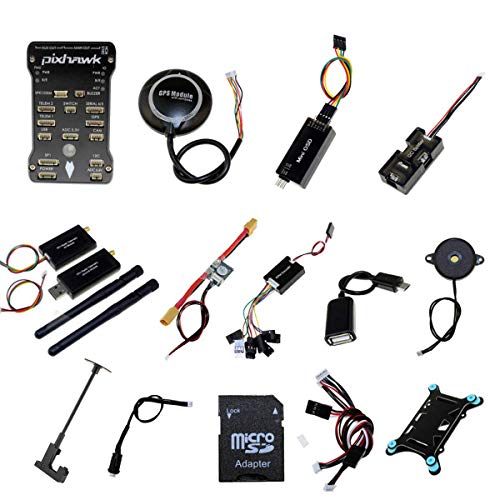
The Pixhawk PX4 platform uses a 32-bit processor with integrated sensors, designed to replace older 8-bit controllers. It supports Mission Planner for connection and calibration, streamlining setup for hexacopter builds. The kit typically includes connectors pre-installed for easier assembly, aiding those who want a reliable autopilot with broad module support.
Best for: developers and mid-to-advanced builders who want a mature open-source autopilot with extensive documentation and community support. This controller suits hexacopters that require robust flight stability, mission planning, and expansion via PMs and OSD modules.
Caution: setup guidance relies on Mission Planner workflow; misconfigurations may affect stabilization if the system isn’t properly calibrated.
HGLRC F405 8S V1 FC Flight Controller
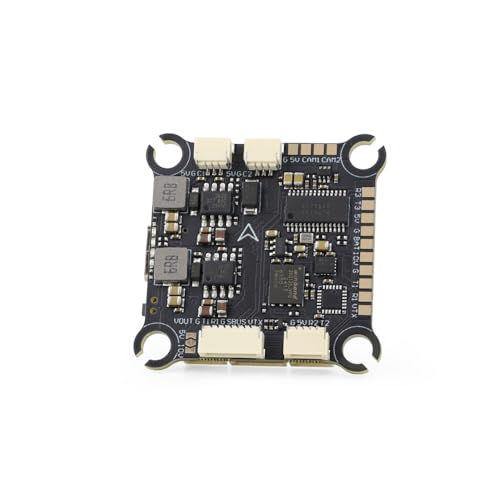
This F405 board emphasizes high performance with the ICM42688P gyro and reserved MPU6000 pads, offering strong stability for hexacopter platforms. Its modular design supports plug-and-play operation without excessive soldering, and it includes a sizeable black box memory to log flight data for later analysis.
Best for: builders prioritizing stability and modularity in FPV or freestyle hexacopters, who want easy field upgrades and reliable data capture. Choose this if you value a clear separation between flight control and data logging hardware.
Caution: the board’s strength lies in stability, but beginners may need time to learn sensor calibration and modular connections.
QWinOut V2.3 KK Flight Control Circuit Blackboard V5.5
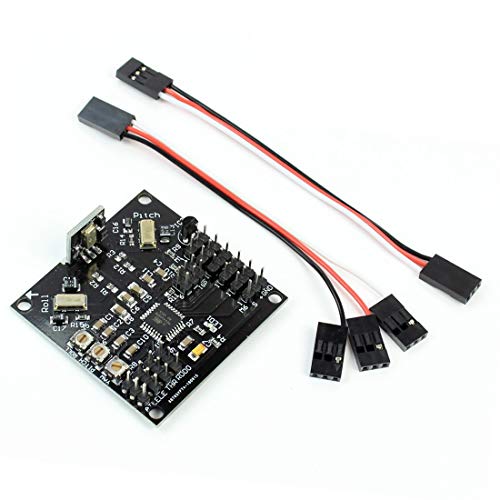
The KK flight control system offers a simple, easy-to-maintain structure with adjustable gyro sensitivity via potentiometer. It supports a range of firmware options, making it a flexible choice for those who want to experiment with different autopilot configurations.
Best for: budget-conscious hexacopter builders or learners who want a straightforward controller to prototype diverse firmware setups. It’s useful for evaluating different autopilot approaches without heavy investment.
Caution: default firmware may not match your exact flight mode needs; plan to load appropriate firmware for your hexacopter’s flight philosophy.
Pixhawk PX4 2.4.8 Open-Source Autopilot

Another Pixhawk-based option emphasizes a stable autopilot with a 32-bit ARM Cortex-M4 processor and a dedicated co-processor for fail-safety. It supports a wide ecosystem of modules, including power modules, safety switches, buzzers, SD cards, and vibration damping. Note that GPS integration can be separate depending on your build.
Best for: advanced hobbyists and researchers who require a flexible, open-source autopilot capable of multi-rotor, fixed-wing, and other autonomous configurations. It’s well-suited for hexacopters that may evolve into more complex platforms.
Caution: GPS not included by default; plan to pair with an external GPS module if you need global positioning in flight data.
STM32 BF H743 Flight Controller Board

This board uses the Betaflight H743 processor with integrated power distribution, combining precise control with streamlined installation. It features USB-C connectivity and multiple ports to simplify receiver and peripheral integration.
Best for: builders who want a high-performance Betaflight-compatible controller with robust power distribution for hexacopter builds. The included power management helps reduce additional wiring complexity and potential noise on flight signals.
Caution: ensure your firmware setup matches the board’s high-end capabilities to avoid configuration conflicts with other modules in a multi-rotor system.
AERO SELFIE H743 Flight Controller With 60A ESC
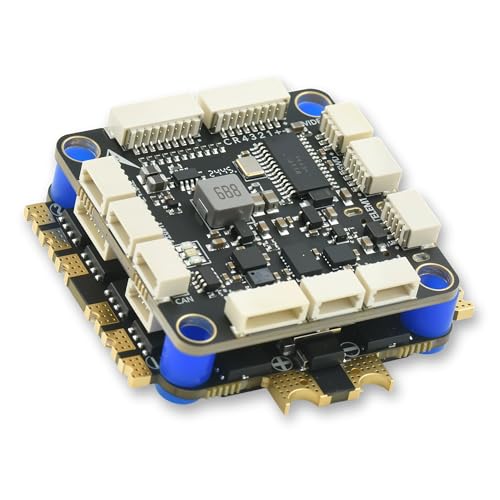
This kit couples a dual-IMU capable H743 flight controller with a 60A 4-in-1 ESC, designed for 2S–6S LiPo batteries. It supports Betaflight, PX4, INAV, and Ardupilot, making it a flexible option for racing, aerial photography, and mixed-use hexacopters.
Best for: users seeking a compact stack with high ESC power, suitable for lightweight to mid-weight hexacopters that require strong motor control and firmware versatility. Choose this if you want a ready-to-run stack with broad firmware support.
Caution: high ESC current capability demands careful wiring and safeguards to prevent power-related issues in the build area.
AERO SELFIE H743 30×30 FC

This H743-based controller emphasizes dual IMU sensing, barometer, and a built-in compass, offering compatibility with Betaflight, INAV, PX4, and Ardupilot. The 7 UARTs and 10 PWM outputs support complex hexacopter configurations that require multiple serial connections and channel control.
Best for: hexacopters that demand a robust sensor suite and extensive UART/ PWM options for advanced payloads, such as cameras, gimbals, and additional navigation gear. It’s a solid choice for developers exploring multi-system autonomy.
Caution: ensure firmware compatibility across Betaflight, PX4, and Ardupilot if you plan to switch flight stacks mid-build.
Buying Guide: Key Considerations for Hexacopter Flight Controllers
- Firmware compatibility: decide between Betaflight, PX4, INAV, or ArduPilot depending on your project goals and programming comfort.
- Processing power: prioritize 32-bit processors for complex stabilization, autonomous functions, and future feature expansion.
- Sensor suite: look for dual IMUs, barometer, compass, and GPS options to ensure reliable flight stability and acutely accurate positioning.
- Power management: ensure the controller’s power distribution design aligns with your ESCs and battery configuration to minimize voltage dips and noise.
- Expansion and modularity: check for plug-and-play connectors, PMs, OSD, and telemetry options that fit your hexacopter’s payload and mission needs.
- Documentation and community support: open-source platforms with active communities can simplify troubleshooting and firmware updates.
- Build alignment: confirm compatibility with hexacopter frame, motor count, and ESC ratings to avoid overloading the controller or power system.
- GPS and navigation: plan GPS inclusion if you require waypoint missions or geofencing; some kits exclude GPS by default.
FAQ
- What is the main advantage of a 32-bit flight controller for hexacopters? Answer: It enables more complex flight algorithms, better stability, and advanced autopilot features compared to older 8-bit controllers.
- Do I need GPS to get autonomous flight features? Answer: GPS is typically required for waypoint navigation and stable position hold, but some basic stabilization can work without GPS depending on firmware.
- Is Betaflight compatible with Pixhawk controllers? Answer: Betaflight is common on STM32-based boards, while Pixhawk devices typically use PX4 or ArduPilot firmware, but some setups allow cross-compatibility with limited features.
- Should I choose a modular board for a hexacopter? Answer: Yes, modular boards simplify upgrades, maintenance, and troubleshooting, especially for complex multi-rotor configurations.
- What should I consider when choosing a flight controller for a racing hexacopter? Answer: prioritize low latency, high processing speed, robust PWM outputs, and reliable ESC communication to handle rapid throttle changes.
- Can I reuse a controller across different drone types? Answer: Open-source autopilots support multiple vehicle types (multirotor, fixed-wing, etc.), but ensure firmware and hardware match the intended use case to avoid performance issues.