Finding a reliable flatbed scanner for photos helps families protect memories with crisp color, accurate detail, and easy software options. This guide highlights five standout models that balance image quality, ease of use, and value. Each option supports photo scanning, with features like high optical resolution, built-in photo enhancement, and smooth integration with cloud or digital workflows. Read on to see how these scanners compare for archiving old prints, enlarging favorites, or digitizing albums.
Summary table of selected products
| Product | Brand | Max Optical Resolution | Notable Feature |
|---|---|---|---|
| Epson Perfection V39 II | Epson | 4800 dpi | Removable lid; scan to cloud; compact design |
| Epson Perfection V19 II | Epson | 4800 dpi | USB power; one-touch scanning |
| Canon CanoScan Lide 400 | Canon | 4800 x 4800 dpi | USB-C; fast scans; image enhancements |
| Canon Canoscan Lide 300 | Canon | Not specified (auto scan features) | Auto Scan Mode; lightweight |
| Plustek Photo Scanner ePhoto Z300 | Plustek | Up to 600 dpi (photo sizes) | Fast 2-second 4×6 scans; auto crop/deskew |
Epson Perfection V39 II

The Epson Perfection V39 II is a compact flatbed scanner designed for photo enthusiasts who value high resolution and easy operation. It delivers 4800 dpi optical resolution, enabling detailed enlargements and faithful color capture of prints and artwork. A removable high-rise lid helps you scan thicker media, while the ScanSmart software streamlines processing and cloud uploads. This model excels in home archives where space is limited and portability matters, offering reliable performance for scanned photographs, artwork, and documents.
Key features include crisp color reproduction, a straightforward USB-powered setup, and seamless integration with cloud storage. For families digitizing a mix of photos and documents, the V39 II provides a balanced set of capabilities without requiring a large footprint. It’s particularly suited for users who want sharp results with minimal fuss and a compact footprint that fits small offices or desks.
Plustek Photo Scanner ePhoto Z300

The Plustek ePhoto Z300 is a fast, dedicated photo scanner that handles 3×5 to 8×10 inch prints with a CCD sensor and quick processing times—about 2 seconds for a 4×6 photo and 5 seconds for an 8×10 at 300 dpi. It’s designed to be more efficient than traditional flatbeds for large photo batches, making it a strong fit for families with extensive photo libraries. While it supports multiple photo sizes, it’s especially advantageous when digitizing larger groups of prints in a shorter period and sharing digital copies with relatives.
Its auto crop and deskew features help ensure consistent alignment, and the device works across Mac and PC platforms. The ePhoto Z300 emphasizes speed and convenience, reducing the manual handling typically associated with scanning photo collections. Users who prioritize rapid digitization of physical photos will find it a compelling option within this category.
Epson Perfection V19 II

The Epson Perfection V19 II focuses on simplicity and affordability while delivering 4800 dpi optical resolution for photo reproduction and document scanning. Its compact body fits easily on most desks, and USB power simplifies setup—no separate power adapter required. The inclusion of Epson ScanSmart software enables easy scanning of photos, artwork, illustrations, books, and documents, with seamless cloud integration for archiving and sharing. The V19 II is a practical choice for users who want reliable image quality without a steep learning curve.
With its one-touch scan functionality and streamlined workflow, this model is suitable for households and small offices seeking dependable results. While it may lack some advanced features found in higher-end models, its performance in photo reproduction and everyday documents makes it a dependable all-rounder for photo enthusiasts on a budget.
Canon CanoScan Lide 400

The Canon CanoScan Lide 400 is a slim, user-friendly option that combines quick scan speeds with high-resolution results. It offers 4800 x 4800 dpi resolution for sharp photo reproductions and provides image enhancements like color restoration and dust removal to keep prints looking their best. A notable convenience is the USB-C connectivity, which simplifies modern setups by delivering data and power through a single cable. The Lide 400 also includes EZ Buttons for easy auto-scan and saving to PDFs or image formats, making it approachable for families digitizing albums or teachers scanning classroom materials.
For users who value speed, practical software, and a compact design, the Lide 400 delivers a well-rounded package. It’s particularly suitable for those upgrading from older scanners or integrating daily photo scanning into a small home office workflow. While not the absolute fastest in the category, its combination of color accuracy and ease of use remains appealing for everyday photo archiving.
Canon Canoscan Lide 300

The Canon Canoscan Lide 300 emphasizes automatic scanning with an Auto Scan Mode that detects content type to optimize settings. It is a compact, energy-efficient option designed for light-duty photo and document scanning. While it may not boast the highest optical resolution of some peers, its simplicity and automatic features make it a practical choice for households that want straightforward digitization without extensive manual adjustments. This model is well-suited to casual photo archiving and basic document scanning tasks.
For users who want a no-fuss entry into digital photo libraries, the Lide 300 provides dependable performance with minimal setup. It’s a good match for students, hobbyists, and families who prefer automatic adjustments and a compact footprint over more feature-dense professional devices.
Epson 550 Series (Photos Vision)
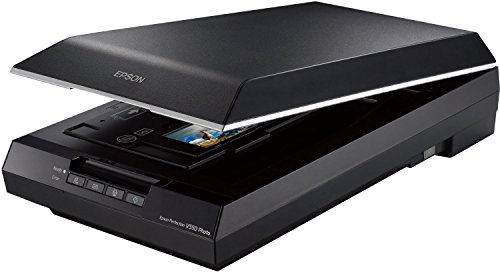
The Epson Perfection V550 is a versatile option notable for its high optical resolution and film scanning capabilities, including a built-in transparency unit that supports slides and negatives. This model is ideal for users who want to digitize film alongside photos, enabling expansive image restoration workflows. It offers robust software support and features designed for detailed photo restoration, including Digital ICE technology to reduce dust and scratches on film. For dedicated photo historians and serious hobbyists, the V550 provides a compelling blend of depth and flexibility, albeit at a larger footprint than entry-level models.
Note: This article highlights five strong flatbed and near-flatbed options focused on photo scanning. When choosing, consider the balance between optical resolution, speed, media handling, and software ecosystem to fit your photo archiving goals and workspace constraints.
Buying Guide: Key Considerations For Photo Scanners
- Resolution and color fidelity: Look for at least 4800 dpi optical resolution for photos; consider 6400 dpi or higher if you plan large enlargements or archival work. Check color depth and dynamic range as well.
- Media handling: Flatbeds with removable lids or thicker media support help with bulky prints and artwork. For speedier batch work, consider scanners that support automatic cropping or a fast scanning pipeline.
- Software and workflow: Strong software suites (such as Epson ScanSmart or Canon imaging software) simplify color restoration, dust removal, and cloud uploads. Compatibility with your operating system (Windows, macOS, or both) is essential.
- Connectivity and power: USB-powered models are convenient, but ensure USB-C compatibility if you’re using newer laptops. Cloud integration can expedite digital archiving and sharing across devices.
- Size, footprint, and durability: If desk space is limited, opt for compact models with a stable base. For hobbyists preserving large photo collections, consider models that can handle larger formats or faster batch processing.
- Cost of ownership: While upfront price matters, factor in restocking consumables (if any) and the value of software features that aid restoration, color management, and long-term archiving.
In evaluating options, balance the need for high-resolution image capture with practical considerations like size, speed, and ease of use. For most households, a model with 4800 dpi, strong photo software, and straightforward cloud output offers the best combination of value and performance. More advanced units that handle film, larger formats, or higher resolutions are ideal for dedicated photo archivists and professional hobbyists who require expansive restoration tools.