Finding a reliable financial calculator for MBA work is essential for solving time-value-of-money problems, cash flow analyses, and complex investment scenarios. This guide highlights five top options that balance functionality with ease of use for students, finance professionals, and analysts. Each entry explains who benefits most, why it stands out, and any practical limitations to consider. A quick comparison table is included to help you decide at a glance.
| Product | Best For | Key Benefit | Limitations |
|---|---|---|---|
| Texas Instruments BA II Plus Financial Calculator, Black Medium | MBA students and finance pros | Strong PV/NPV/IRR, uneven cash flow handling | Basic display; fewer advanced statistical features |
| HP 10bII+ Financial Calculator | College students and professionals | 100+ functions; algebraic input; statistics | Smaller screen, learning curve for some keys |
| CATIGA Financial Calculator CF-300 | Real estate and business analysts | Comprehensive cash flow and amortization; portable | Brand familiarity may vary |
| HP 10bII+ Financial Calculator (Standard) | General finance calculations | Dedicated keys; easy access to functions | Basic feature set compared to premium models |
| Texas Instruments BA II Plus Professional | Advanced users and scenario modeling | Up to 32 uneven cash flows; multiple financial metrics | More complex interface |
Texas Instruments BA II Plus Financial Calculator, Black Medium

This model emphasizes profitability calculations and robust cash flow support, including NPV and IRR for uneven cash flows. It is well suited for MBA students and managers who regularly model pensions, loans, and mortgages. It offers time-value-of-money and amortization keys to facilitate standard financial analysis without external software. The device remains a practical choice when you need dependable, on-the-go calculations in class or in the office.
Best for: MBA students and finance professionals who prioritize dependable NPV/IRR calculations and straightforward amortization tools. Why selected: It combines essential TVM features with practical cash-flow analysis in a compact package.
Caution: While feature-rich for finance workflows, it lacks some advanced statistical functions present in higher-end models, which may limit its use in broader analytics tasks.
HP 10bII+ Financial Calculator – 100+ Functions

The HP 10bII+ is designed for both students and professionals who need quick answers on time value of money, interest rates, loan payments, NPV, IRR, and cash flows. It also includes probability distributions for statistics, a useful feature for MBA coursework that touches on data analysis. Its algebraic input with dedicated keys allows efficient keystrokes and familiar feel for most users.
Best for: Learners and professionals who value a broad function set in a single device with quick access to financial and statistical tools. Why selected: It balances extensive capabilities with an approachable keyboard layout.
Caution: The display is smaller, which can make reading long results more challenging during lengthy calculations or exams.
CATIGA Financial Calculator CF-300

The CATIGA CF-300 focuses on professional cash flow and amortization needs, with built-in TVM, IRR, and NPV. It’s ideal for real estate investors, accountants, and MBA candidates who require accurate break-even analysis and bond pricing capabilities. The calculator is portable and designed for daily professional use, including an included flip-open case for protection.
Best for: Real estate and finance professionals who need advanced cash flow tools in a compact device. Why selected: It offers professional cash-flow analysis and amortization in a portable form.
Caution: As with many niche financial calculators, some advanced features may require practice to use efficiently, and it may not cover every statistical need on a single screen.
HP 10bII+ Financial Calculator

This entry is a straightforward financial calculator option with a focus on essential business, finance, and statistics functions. It is easy to carry and provides dependable performance for daily financial modeling, debt calculations, and budgeting tasks. The dedicated keys accelerate routine tasks, making it a strong choice for both classroom use and professional practice.
Best for: General finance calculations and students seeking a reliable, no-nonsense tool. Why selected: It emphasizes quick, dedicated access to common functions in a familiar layout.
Caution: It offers a more basic feature set than premium models, which might limit advanced modeling needs in complex projects.
Texas Instruments BA II Plus Professional

The BA II Plus Professional expands on the standard model with more advanced cash-flow analysis capabilities, supporting up to 32 uneven cash flows and four-digit frequencies. It also lists a suite of functions including NPV, IRR, and various payback calculations, making it suitable for scenario modeling in MBA programs and financial analysis work.
Best for: Advanced users who need comprehensive cash-flow analytics and multiple financial metrics. Why selected: It enables sophisticated modeling and detailed financial comparisons.
Caution: The more complex interface can require a learning curve for new users or those switching from basic models.
HP 17bII+ Financial Calculator

The HP 17bII+ stands out with 250+ operations for financial modeling, including TVM, IRR, NPV, amortization, forecasting, and bond pricing. It supports two-variable statistics, percentages, and list-based data entry, making it a strong fit for advanced MBA coursework, investment analysis, and corporate finance projects. It also offers dual entry modes (RPN and algebraic) for user flexibility.
Best for: Experienced finance professionals and MBA students needing deep modeling capabilities. Why selected: It delivers a breadth of operations suitable for complex financial scenarios.
Caution: Its breadth of features may feel overwhelming to beginners and can require more time to learn.
Texas Instruments BAII Plus Financial Calculator, Black
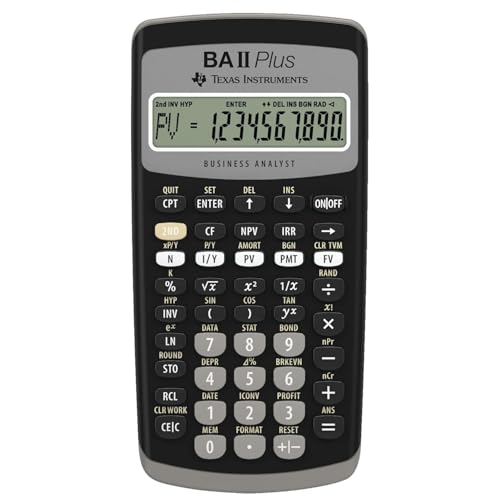
This standard BA II Plus focuses on the time value of money and related calculations, offering up to 24 uneven cash flows with four-digit frequencies. It also supports NPV and IRR calculations and provides bond pricing with current or 30/360 day-count conventions. It is a reliable, compact option for everyday MBA finance work and exam prep.
Best for: Students and professionals who need dependable core financial functions in a compact form. Why selected: It balances essential math with practical features for everyday financial modeling.
Caution: It may lack some of the advanced analytics found in higher-tier or specialized models.
Buying Guide: Choosing the Right MBA Financial Calculator
What features matter most for MBA coursework?
Key features to prioritize include time-value-of-money (TVM) calculations, NPV, IRR, and cash-flow analysis. If your program involves real estate, bonds, or depreciation, ensure the calculator supports amortization, bond pricing, and various payback calculations. For statistics or data-heavy courses, consider a model with built-in probability distributions or robust statistical functions.
Algebraic vs. RPN input
Algebraic input mirrors standard calculators, making it easier for most users to learn quickly. RPN (Reverse Polish Notation) can be faster for users who memorize stacks, but it has a steeper learning curve. Some students prefer mixed options, such as models offering both modes.
Display and portability
Look for a clear display that fits long financial results on screen. A compact, durable design is important for on-the-go study sessions or fieldwork. If you frequently work with long cash-flow series, a larger display can reduce errors and eye strain.
Durability and exam eligibility
Check whether the calculator is allowed on your course exams (SAT, AP, etc.). Durable construction and protective cases help during travel between classes, internships, or client meetings.
Price vs. capability
Premium models offer extensive features, but the right choice depends on your coursework. For many MBA tasks, a solid standard model with TVM, NPV, IRR, and cash-flow support is sufficient. Reserve higher-end models for specialized careers in real estate, corporate finance, or investment banking.
Practical tips for use
- Practice entering uneven cash flows accurately to avoid miscalculations in NPV or IRR.
- Create a quick-reference sheet of keystrokes for your most-used functions.
- Test bond pricing and amortization with example problems before exams.
- Keep a protective case and spare batteries or charging options in your bag.
FAQ
- Which calculator is best for MBA students focusing on finance? A model with TVM, NPV, IRR, and cash-flow analysis is most suitable, such as the BA II Plus Professional or standard BA II Plus models.
- Do I need advanced statistical functions? If your MBA program includes statistics or data analysis, consider a calculator with probability distributions or statistical capabilities, like the HP 10bII+.
- Can I use these calculators on exams? Most of these models are exam-appropriate, but verify with your institution or instructor for specific guidelines.
- Is RPN necessary? Not necessary for most MBA students, but some users prefer RPN for speed and precision if they are comfortable with it.
- How many uneven cash flows should a calculator support? Models typically support up to 24 to 32 uneven cash flows, with four-digit frequencies, depending on the model.
- What should I consider for real estate Finance? Look for features like IRR, NPV, amortization, and bond pricing, plus the ability to handle complex cash-flow schedules.