The right electronic flight computer streamlines navigation, wind calculations, time, fuel planning, and weight & balance for pilots, students, and instructors. This guide highlights top models that are FAA and Canadian exam-friendly, plus practical tools for real-world flight planning. Explore five leading options with features designed to ease complex aviation calculations and exam prep.
| Product | Brand | Link |
|---|---|---|
| ASA CX-3 Flight Computer | ASA | Amazon |
| Sporty’s Electronic E6B Flight Computer | Sporty’s | Amazon |
| EntireFlight E6B Flight Computer | EntireFlight | Amazon |
| ASA E6B Metal Flight Computer | ASA | Amazon |
| Jeppesen Student Flight Computer (CSG) | Jeppesen | Amazon |
The following sections detail each product’s core capabilities, focusing on how they support accurate flight planning, exam readiness, and day-to-day navigation.
ASA CX-3 Flight Computer – Advanced E6B

The ASA CX-3 is designed for FAA and Canadian exam approval, allowing use on pilot, mechanic, and dispatcher knowledge tests. It supports comprehensive aviation calculations including time, speed, distance, heading, wind, fuel, altitude, and weight & balance, which helps streamline flight planning. Its color LCD and intuitive menus reflect the natural flow of flight planning, reducing keystrokes and increasing efficiency during preflight work and simulated exams.
Sporty’s Electronic E6B Flight Computer

This electronic flight computer provides essential flight information and is FAA approved for use on tests. Its black color scheme offers high-contrast visibility, and the device is designed to deliver quick wind, time, and fuel calculations to support both training and exam scenarios. It combines ease of use with built-in regulatory compliance, making it a practical choice for student pilots and aviation test prep.
EntireFlight E6B Flight Computer

The EntireFlight E6B Flight Computer combines an E6B calculator, aviation plotter, and a compact manual set, supporting IFR and VFR planning. It aims to simplify course plotting on charts, provide a step-by-step guide, and serve as a core tool in flight training and pilot bags. This all-in-one approach helps pilots practice wind correction, fuel burn, and time calculations in a single, portable package.
ASA E6B Metal Flight Computer
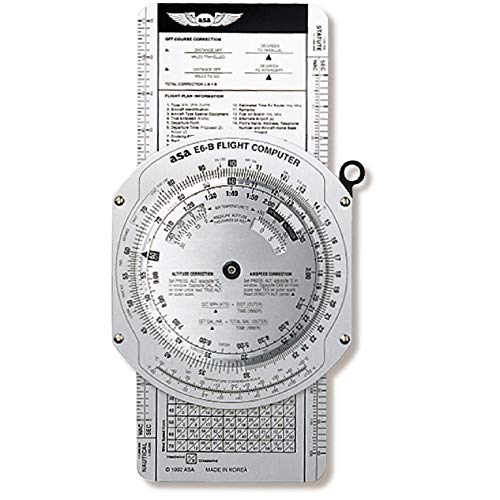
The ASA E6B Metal Flight Computer provides a robust mechanical option with a 6-inch diameter. This classic tool is favored for manual flight planning, wind triangle calculations, and weather-related computations. While it lacks digital features, its precision and portability remain appealing for pilots who prefer hands-on navigation work or seek a durable, non-electronic backup.
Jeppesen Student Flight Computer (CSG) JS514101

The Jeppesen Student Flight Computer is designed for pilots-in-training, offering a reliable platform for early navigation calculations. It supports basic E6B-style computations and study aids that align with aviation education standards, making it a practical learning companion during flight training and exam preparation.
Buying Guide
- Purpose and context: Choose electronic models if you need quick on-screen calculations, exam compliance, and integrated planning tools. Mechanical tools are durable, battery-free backups for hands-on practice and chart work.
- Exam compatibility: Confirm that the model is approved for FAA and, if applicable, Canadian tests. This can prevent issues during official examinations.
- Feature set: Evaluate wind calculations, fuel burn, time, speed, weight & balance, and plotting capabilities. Some devices pair with charts or include built-in plotters for seamless planning.
- Ease of use: A color LCD, intuitive menus, and minimal keystrokes can significantly reduce the learning curve during high-stakes scenarios.
- Portability and durability: Consider size, weight, and construction. Mechanicals offer ruggedness, while electronics provide speed and versatility in compact form factors.
- Learning resources: Some options include step-by-step guides or training aids that help with wind triangles and IFR/VFR planning, which can support both study and practical tests.
- Budget and value: Balance upfront cost with long-term usefulness for training, exams, and routine flight planning. A multipurpose tool often yields greater value for aspiring pilots.
In selecting an electronic flight computer, consider how you balance speed, accuracy, exam readiness, and physical durability. For exam-focused pilots, models with FAA and Canadian test approval are essential. For ongoing flight training, tools offering step-by-step guides or plotting capabilities can enhance comprehension and confidence during navigation planning and performance checks.