Choosing the right ecig battery charger matters for speed, safety, and battery longevity. This guide highlights seven reliable chargers that support a wide range of Li‑ion and Ni‑MH/Ni‑Cd batteries commonly used in vapes, flashlights, and other devices. Each option is suitable for different buyer needs—from fast charging and multi‑bay versatility to compact travel chargers. Use the product snapshots below to identify the best fit for your battery lineup and charging goals.
| Product | Best For | Key Strength |
|---|---|---|
| IMREN 18650 Battery Charger, 4 Bay | Users with mixed Li‑ion and Ni‑MH batteries | Flexible charging, automatic detection |
| Snado Intelligent Charger | Two‑slot display and wide battery compatibility | Real‑time LCD, multi‑battery support |
| BWIETE 4 Bay Charger | On‑the‑go charging with USB power | Worldwide voltage, auto temp cutoff |
| MIEKLALE 8+2 Bays Charger | Heavy battery users needing multiple channels | Eight plus two bays with LCD |
| Nitecore UMS2 Dual‑Slot | Fast, organized charging for two batteries | High total amperage, clear LCD |
IMREN 18650 and 21700 Battery Charger

The IMREN charger is a versatile four‑bay unit designed to handle 18650 as well as a broad range of Li‑ion and Ni‑MH/Ni‑Cd cells, including 10400, 14500, 14650, 16340, 17335, 17500, 18500, 18350, 18650, 18700, 20700, 21700, 22650, and 26650, plus 1.2V Ni‑MH/Ni‑Cd A/AA/AAA. It automatically detects battery type and adjusts charge current, with a default 1A per slot and an option to switch to 2A fast charging. Best for hobbyists who work with mixed cell sizes and appreciate single‑battery charging convenience. A caveat: the device relies on user navigation to select 2A mode, which may be less intuitive for beginners.
Best for: Vapers or gadget enthusiasts who switch between many battery sizes and want single‑battery flexibility without pairing constraints.
Why selected: It supports multiple chemistries, auto‑identification, and separate charging for each bay, reducing cross‑battery interference and helping battery life when used per cell’s needs.
Limitations: Some users may prefer a dedicated 21700 only unit for maximum simplicity or a more compact travel charger for portability.
Snado Intelligent 2‑Slot LCD Charger

The Snado charger supports a broad mix of Li‑ion and Ni‑MH/Ni‑Cd cells across two slots, including 18650, 18490, 18350, 17670, 17500, 16340 (RCR123), 14650, 14500, 10440, and more. It features a real‑time LCD display and dual LEDs to show charging progress and battery status, with automatic cutoffs at full charge for safety. This model is ideal for users who value clear monitoring and easy reading during charge cycles. A potential drawback: while two slots handle most needs, large battery collections might require a multi‑bay charger for greater throughput.
Best for: Users who want immediate visibility into charge status and a reliable two‑battery solution for daily use.
Why selected: Its LCD readout and smart management help prevent overcharge and protect battery health, especially when managing diverse battery types in one household.
Caution: The two‑slot limit means higher volume charging requires additional devices or adapters if you have many batteries.
BWIETE 4 Bay USB‑C Battery Charger

The BWIETE charger offers four bays and USB charging with integrated temperature protection and worldwide voltage compatibility. It supports a wide range of Li‑ion and Ni‑MH/Ni‑Cd batteries, including 26650 and 21700, with a focus on portability and convenience. For travelers or users with multiple devices, this model simplifies charging via USB‑C and car adapters. A limitation to note is the need for a USB power source in most setups; without a reliable USB supply, charging speed and availability may vary.
Best for: On‑the‑go charging for people who carry multiple battery types or travel frequently.
Why selected: Its broad compatibility and USB power options make it a practical all‑in‑one charger when wall outlets aren’t convenient.
Caution: If you rely on wall outlets only, this charger depends on USB power availability and may be slower than wall‑powered options with higher current outputs.
MIEKLALE 8+2 Bays Smart Charger
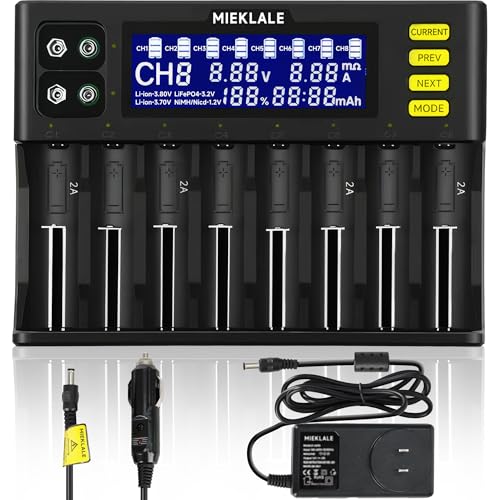
The MIEKLALE charger features eight plus two bays, making it a robust choice for heavy battery users. It supports Li‑ion, LiFePO4, RCR123, and Ni‑MH/Ni‑Cd batteries up to 72 mm in length, including 18650, 26650, 10440, 14500, 16340, 18500, 18350, 18700, and more. An LCD displays voltage, current, charging time, capacity, energy percentage, and internal resistance, providing detailed insight during charging. Best for households with multiple devices and a broad battery inventory. Limitation: the model note emphasizes that batteries are not included, so purchases must be planned for your specific needs.
Best for: Users who need to manage many batteries at once and want comprehensive battery health data during charging.
Why selected: Its high bay count and informative display support advanced organization and battery care for power users.
Nitecore UMS2 Dual‑Slot USB‑C Charger

The Nitecore UMS2 focuses on speed and organization with two slots capable of delivering up to 4000 mA total when using a high‑output USB source (QC2.0+ 9V, plus 5V/2A standard). It supports Li‑ion, Ni‑MH, Ni‑Cd, IMR, and related chemistries for a broad battery range, including 16340, 14500, 18650, 21700, 20700, AA, and AAA. The onboard LCD provides real‑time health, status, and mode readings, aiding safe charging. Best for quick, efficient charging in a compact form factor. Limitation: the two‑slot design means less throughput compared with higher‑bay models used in pro setups.
Best for: Users who need fast, high‑current charging in a compact, organized package.
Why selected: The smart power management and USB‑C interface make it a practical choice for quick top‑ups and travel use.
Ledorr LCD Universal Battery Charger

The Ledorr two‑port charger is designed for 3.7V Li‑ion and 1.2V Ni‑MH/Ni‑Cd batteries across multiple sizes like 10440, 14500, 16340, 18650, 21700, 26650, and standard A/AA/AAA. It features an LCD display showing current, voltage, battery type, and charging status, making it straightforward to monitor progress. It offers adjustable charging currents (0.5A, 1A, 2A) for Li‑ion cells and a fixed 0.5A for Ni‑MH/Ni‑Cd cells. Best for users who want clear, per‑cell information with flexible current control. Limitation: it is a two‑slot charger, which may be slower for large battery kits compared to four‑bay models.
Best for: Users who value clear, ongoing visibility of charging status and adjustable current for Li‑ion cells.
Why selected: The LCD readout and adjustable currents help balance charging speed with battery longevity, especially for mixed chemistries at home or in a workshop.
IMREN 26650 and More Battery Charger

This IMREN model supports 2 bays tailored to 26650 batteries, with a wider design to accommodate two 26650 cells simultaneously. It also handles a wide list of Li‑ion and Ni‑MH/Ni‑Cd cells, including 10440, 14500, 14650, 16340, 17335, 18500, 17670, 18350, 18650, 18700, 20700, 21700, 26650, 25500. The charger offers 1A slow charge by default with a 2A fast charge option via a middle button. Best for users who own multiple 26650 cells and need faster top‑ups without swapping chargers. Caution: battery not included, ensure correct sizing to avoid fit issues in two‑bay slots.
Best for: 26650 battery owners who want a compact companion charger with 2‑slot capability for simultaneous support.
Why selected: Its 2×26650 capacity and selectable charge modes make it a practical choice for high‑capacity cells used in powerful flashlights or vape mods.
Buying Guide: How to Choose the Right Ecig Battery Charger
What matters most when selecting an ecig battery charger is compatibility, charging speed, safety features, and the number of bays you need. Evaluate these questions to find the best match.
- What battery sizes do I own? If you use many formats (18650, 21700, 26650, Ni‑MH AA/AAA), a multi‑bay charger with broad compatibility is ideal.
- Do I need fast charging? Chargers with 2A or higher per bay will top up batteries quicker, but may generate more heat. Choose models with temperature monitoring if you frequently use high currents.
- How many batteries do I charge at once? For households with many devices, a charger with more bays saves time and space.
- Is display readout important? A model with an LCD/LED display helps monitor charging status and battery health in real time.
- Do I need portability? USB‑C or car‑adapter compatible units suit travel or field work better than wall‑plug formats.
- Will I charge Ni‑MH and Li‑ion together? If yes, ensure the charger clearly supports both chemistries with separate bays to avoid cross‑charging issues.
FAQs
- Can I charge different battery chemistries in the same charger? Yes, many models identify battery type and charge separately, preventing cross‑chemistry charging.
- What is the risk of high charging currents? Excessive current can increase heat buildup and shorten battery life if the cell is not rated for high C‑rates.
- Do all chargers come with batteries? No; most listings show empty chargers. Always verify battery compatibility and include the cells you own.
- Is a display necessary? Not required, but an LCD/LED display helps track progress and health for safer charging.
- How do I know when charging is complete? Look for a full charge indicator on the charger or a steady per‑cell charge status on the display.
- Should I unplug after charging? Removing batteries promptly after completion minimizes heat exposure and helps extend life.