For makers, designers, and engineers, a dual-color 3D printer opens up new possibilities. This guide highlights five top options capable of multi-color or multi-material prints, high-speed performance, and reliable auto-leveling. Each model supports vibrant color workflows, whether you’re prototyping parts or creating colorful, eye-catching models. Read on to compare capabilities, setup features, and how they fit different workloads—from rapid prototyping to production-ready parts.
Summary of chosen products:
| Product | Key Color/Material Feature | Build Volume | Notable Benefit |
|---|---|---|---|
| FLASHFORGE AD5X Multi-Material 3D Printer (4-Color) | 4-color printing with IFS | 220x220x220 mm | High-speed, auto leveling, color flexibility |
| FLASHFORGE AD5X CoreXY 600mm/s | Vivid multi-color, up to 4 colors | 220x220x220 mm | Ultra-fast printing with precise bed leveling |
| FLASHFORGE AD5X with IFS, 600mm/s | 4-color with Intelligent Filament System | 220x220x220 mm | Automated filament handling for continuous runs |
| QIDI Q2C 3D Printer | Multi-color capable via advanced workflow | 270x270x256 mm | Auto leveling, high-speed capable, PPS-CF support |
| Creality K2 Combo | Multi-color via CFS units | 260x260x260 mm | Smart auto leveling, quiet operation, robust build |
FLASHFORGE AD5X Multi-Material 3D Printer

The AD5X offers robust multi-color printing with up to four colors simultaneously. Its high-speed performance reaches up to 600 mm/s with acceleration up to 20,000 mm/s², enabling rapid production of colorful prototypes while preserving detail. A full-auto leveling sensor ensures a consistent first layer, reducing setup time and improving print reliability across jobs. The Intelligent Filament System (IFS) adds convenient multi-material handling and color-switching, supporting PLA, TPU, PETG, SILK, and CF-filled variants to expand possible applications.
FLASHFORGE AD5X Multi-Color 3D Printer, CoreXY 600mm/s

Designed for high-output color work, this CoreXY variant delivers multi-color capability with up to four colors concurrently. Its 1-Click Auto Leveling simplifies setup, ensuring reliable first layers. The combination of CoreXY architecture and a high-speed motor system enables fast prints without sacrificing accuracy, making it well-suited for rapid prototyping cycles, product iterations, and batch runs where color variety matters.
FLASHFORGE AD5X Multi-Color 3D Printer with IFS
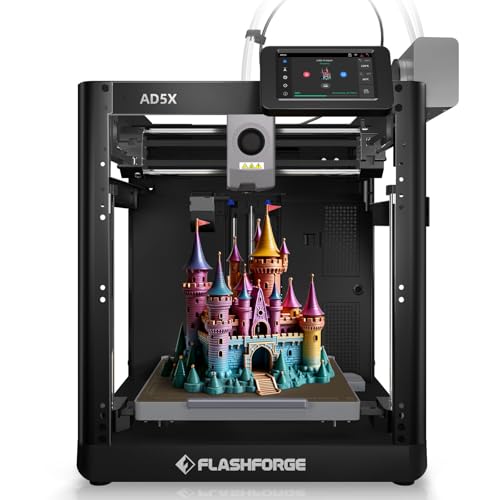
This AD5X model integrates the Intelligent Filament System (IFS) for automatic filament management and color switching, minimizing manual intervention. It supports four-color printing and a 300°C high-temperature direct extruder, enabling a broader range of materials, including CF-reinforced filaments. The printer’s fully auto leveling, all-metal CoreXY frame, and high-speed capabilities support both precise color details and efficient production workflows for complex multi-material prints.
QIDI Q2C 3D Printer

QIDI Q2C combines high-precision performance with user-friendly features suitable for both beginners and experts. It features a nozzle-integrated leveling sensor for automatic bed leveling, a robust full-metal CoreXY chassis, and precision rails to minimize vibration during high-speed printing at up to 600 mm/s. It supports PPS-CF and other advanced materials, with options for multi-color workflows through the QIDI BOX ecosystem, enabling flexible color and material combinations. Build volume is 270x270x256 mm, making it a versatile option for complex prints.
Creality K2 Combo 3D Printer
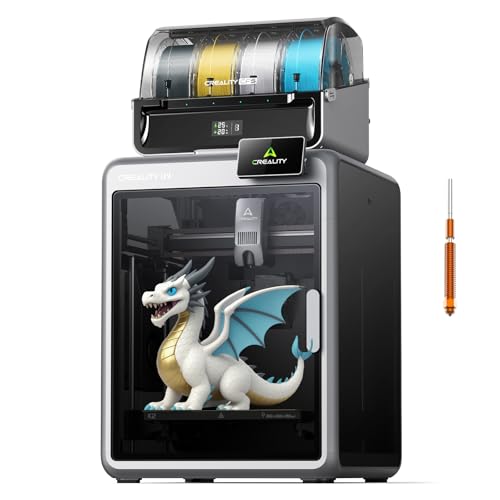
The K2 Combo enables multi-color capability through modular CFS units, supporting up to 16 colors when combined. It uses a smart auto-leveling system and a quiet, stable build, thanks to an aerospace-grade aluminum frame and a dual Z-axis design. The direct-drive extruder and 260x260x260 mm build volume provide a balanced combination of color versatility and print quality for everyday professionals and hobbyists seeking reliable multi-color output and straightforward operation.
Creality K2 Combo 3D Printer (Second Entry)

Note: The K2 Combo’s multi-color capacity is designed to scale with additional CFS units, enabling larger multi-color projects while maintaining quiet operation and stability. This option emphasizes fast throughput and smooth color transitions via an integrated color-feeding workflow, making it appealing for studios and classrooms where color-rich prototypes are routine.
Buying Guide: Key Considerations For Dual-Color 3D Printing
When selecting a dual-color or multi-color 3D printer, consider color handling, material compatibility, speed versus quality, and automation features. Multi-color capability varies by the number of color extruders or an intelligent filament system, so map your color needs to the device’s architecture (Independent extruders vs. color-switching systems).
Build volume should align with typical part sizes; higher speeds are valuable for rapid prototyping but may trade off detail on large parts. Auto leveling and bed adhesion features reduce manual setup and failure rates, especially for beginners. Filament handling systems, such as auto loading/unloading or desiccant storage, help maintain material quality for CF-filled and flexible filaments. Consider enclosure needs for high-temperature materials and safety considerations in shared spaces.
Materials support is critical. Look for nozzle temperatures and hotend design that accommodate PLA, PETG, ABS, TPU, and carbon-fiber-filled blends. If you plan multi-color printing across complex geometries, ensure the software ecosystem and firmware robustly support reliable color changes without filament jams.
Community, service, and replacement parts influence long-term reliability. A machine with accessible spare parts and a broad user base makes troubleshooting and upgrades easier. Finally, assess total cost of ownership, including maintenance, filament costs, and potential accessory expansions like extra CFS units for truly large multi-color workflows.