Whether you’re recording demos, rehearsals, or on-location performances, choosing the right digital recorder matters. This guide highlights five versatile options that cater to musicians, podcasters, and field recordists. Each pick emphasizes ease of use, audio quality, and dependable battery life. The top products range from compact handheld recorders to feature-rich multi-input devices, helping you capture studio-like sound in any setting.
Quick Reference: Selected products at a glance. (Links go to each product’s Amazon listing.)
| Product | Best For | Key Strength |
|---|---|---|
| Flyglory 160GB Digital Voice Recorder | Long sessions, field work | High capacity & long battery life |
| Sony ICD-PX370 | Portability, quick transfers | USB direct connection |
| Zoom H4 Essential | Multi-track needs, live recording | 2 XLR/TRS inputs, 4 tracks |
| Zoom H1 Essential | On-the-go stereo capture | 32-bit float, simple to use |
| Tonfarb 136GB / 64GB Recorders | Lectures, meetings, interviews | Noise reduction & one-click record |
Flyglory 160GB Digital Voice Recorder
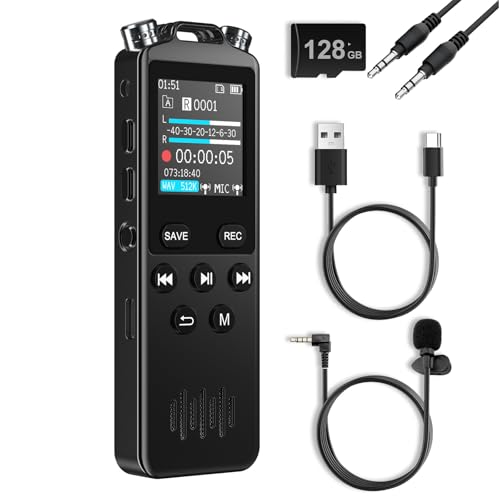
The Flyglory recorder is a high-capacity option designed for long sessions, such as conferences, rehearsals, or field work. It supports 1536Kbps stereo recording and uses dual microphones for balanced, clear sound. Best for musicians who need detailed playback and for content creators who require reliable, uninterrupted recording over extended periods.
Best for: Musicians and content creators who plan lengthy sessions and require substantial on-device storage. Its 68+ hour battery life makes it suitable for full-day shoots, lectures, or lengthy jam sessions. The device’s USB data transfer also supports easy file management.
Limitation: The large 160GB capacity is beneficial for many hours of audio, but the unit is larger than ultra-compact recorders, which may affect portability for some users.
Sony ICD-PX370 Mono Digital Voice Recorder

The Sony ICD-PX370 focuses on portability and straightforward file transfers. It records MP3 audio with long battery life and features a built-in USB connection for quick transfer to a PC. This model suits musicians who prioritize compact design and reliable USB file management for demos or practice notes.
Best for: Musicians who need a compact, reliable recorder for quick on-the-go sessions and easy computer transfer. The built-in USB connection streamlines workflow when moving recordings to a computer for editing or sharing.
Caution: Mono recording may be less ideal for stereo field recordings or ensemble sessions where stereo imaging matters.
Zoom H4 Essential Handheld Recorder

The Zoom H4 Essential is designed for musicians and filmmakers who need more than a simple voice recorder. It features two XLR/TRS inputs, four tracks of 32-bit float recording, and USB audio interface capabilities. This model is ideal for multi-instrument setups, small ensembles, or on-the-go field recording where multiple sources must be captured cleanly.
Best for: Musicians and podcasters who require multiple inputs and higher flexibility for live or rehearsal recordings. Its large mics and phase-coherent capture help preserve dynamic range across sources.
Limitation: As a multi-input device, it takes time to learn the controls and proper gain staging, especially in complex environments.
Zoom H1 Essential Handheld Recorder

The Zoom H1 Essential is built for pocket-level portability with advanced 32-bit float recording. Its X/Y stereo microphones reliably capture a wide range of sound sources, making it suitable for quick on-the-street interviews, practice sessions, and field recording. It records directly to an SD card at up to 96 kHz for detailed playback and editing later.
Best for: Musicians and content creators who need a compact, high-quality stereo recorder that’s easy to carry and quick to deploy for spontaneous sessions. The 32-bit float capability helps avoid clipping in unpredictable environments.
Caution: While very portable, it has fewer inputs than larger Zoom models, which may limit multi-source recording in complex setups.
Sony ICD-UX570 Digital Voice Recorder

The Sony ICD-UX570 emphasizes enhanced sound quality with a slimmer design and a built-in stereo microphone. It supports voice-activated recording for efficient capture, making it a practical choice for quick interviews, classes, or rehearsal notes. It’s a reliable, portable option for musicians who want an unobtrusive recorder with straightforward operation.
Best for: Musicians who value a slim profile and dependable VOX recording for practice, note-taking, or quick journaling. Simple controls and a compact form factor support fast setup in everyday scenarios.
Limitation: Fewer advanced multi-channel features compared to higher-end Zoom models; best used for single-source recordings or basic ensemble demos.
Buying Guide
What should you consider when choosing a digital recorder for musicians?
- Recording format and bit depth: Higher bit depth and sampling rate yield clearer, more detailed recordings. If you plan full-bandwidth capture or post-production, prefer devices offering 32-bit float or PCM options.
- Inputs and inputs quality: Depending on your needs, two XLR/TRS inputs or a simple built-in microphone can influence your setup. Musicians with multiple mics or instruments benefit from multi-input models.
- Storage and battery life: Large storage and long battery life reduce interruptions during sessions. Consider devices with extended playback times and easy USB data transfer.
- Portability vs. functionality: Ultra-portable recorders are convenient for practice and field use, while feature-rich devices serve studios or live setups.
- Noise reduction and audio processing: Built-in noise reduction and DSP features help improve clarity in noisy environments, useful for field recording, interviews, or rehearsal spaces.
- File transfer and compatibility: USB or USB-C transfer to a computer should be straightforward for quick editing and sharing with collaborators.
Additional Tips
- Test gain staging before important takes to avoid clipping or overly quiet signals.
- Label and organize recordings with clear filenames to simplify project workflows.
- Use stereo mics where possible to capture a fuller image of performance or ensemble sound.
Frequently Asked Questions
- What is the best digital recorder for field recording?
- Do I need 32-bit float recording?
- Is USB transfer important for musicians?
- Should I buy a multi-input recorder?
- Are built-in mics sufficient for professional work?
- What’s the advantage of a compact recorder?
Devices with long battery life, high-capacity storage, and dual microphones are well-suited for field work. The Flyglory model is a strong option for compact field use with extended recording time.
32-bit float helps prevent clipping in loud environments and is beneficial for live or unpredictable sessions. It’s especially useful for musicians who perform dynamic ranges that vary widely during takes.
Yes. Quick USB transfers speed up post-production and collaboration. Many models include direct USB connections for easy file management.
If you record multiple sources at once (vocals, instruments, ambient room sound), a multi-input device such as the Zoom H4 Essential provides flexibility beyond basic handheld recorders.
For solo practice or quick demos, built-in mics are often enough. For band or ensemble work, external mics or multi-input devices yield better results.
Compact recorders are easy to carry, quick to deploy, and ideal for spontaneous sessions, practice notes, or journaling on the go.
In summary, the best digital recorders for musicians blend high-quality capture, practical controls, and reliable battery life. Whether you need long-range storage, multiple inputs, or ultra-portable convenience, there is a model suited to your workflow. Use the Buying Guide questions to align a device with your typical session length, source types, and preferred editing pipeline.