This guide presents top digital recorders suited for qualitative interviews, focus groups, and field notes. The selections emphasize clear audio, long battery life, reliable storage, and easy playback for transcription. Best for researchers, journalists, students, and professionals who need crisp recordings in meetings, interviews, and lectures. Each entry highlights who it’s best for, why it was chosen, and a practical caveat to consider before purchase.
| Product | Best For | Why It Stands Out |
|---|---|---|
| Tonfarb 64GB Digital Voice Recorder | Researchers needing long storage and noise reduction | Large capacity, PCM up to 1536kbps, robust noise reduction |
| EVISTR 64GB L357 Digital Voice Recorder | Teachers and students for lectures and meetings | High-quality 360° capture, A-B repeat, compact metal body |
| EVISTR 128GB L357 Digital Voice Recorder | Professionals requiring extended recording and playback | Double memory, 1536kbps sound, versatile playback options |
| Sony ICD-PX370 Mono Digital Voice Recorder | On-the-go interviews with USB file transfer | Long battery life, simple MP3 recording, direct USB transfer |
| EVIDA 128GB Digital Voice Recorder | Researchers needing large archives and password protection | High-capacity storage, 1536kbps PCM quality, password option |
The following sections detail five top picks with practical notes to help selecting the right device for your interview workflows. Each choice balances audio quality, storage, battery life, and ease of use for transcription and analysis.
Tonfarb 64GB Digital Voice Recorder

The Tonfarb device offers a dedicated one-click recording feature for quick capture during interviews, lectures, and fieldwork. It stores up to 4,600 hours of audio on its built-in 64GB memory, and a 600mAh battery supports long hours of use, making it suitable for extended field sessions. PCM recording supports up to 1536kbps quality with automatic noise reduction for clearer playback. It’s best for professionals who require fast, reliable control and strong archival capacity in a portable form factor. A key caveat: the device relies on an external memory card and its interface may feel less intuitive to first-time users compared with premium brands.
Best for: Journalists and researchers conducting long interviews or field notes where quick one-touch capture and clear playback matter most.
Digital Voice Recorder 16GB by Sunlan
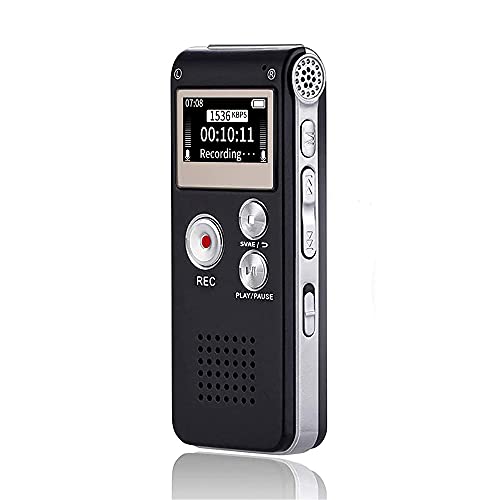
Sunlan’s compact unit emphasizes straightforward operation: a single REC button to start recording, STOP to end, PLAY to review, and A-B for repeating the important section. It includes a built-in speaker for quick checks and supports external playback. Its 16GB capacity suits shorter interviews or classroom use. The microphone is designed to capture clear voice in meeting rooms, yet it may require more frequent transfers for lengthy archives. Best for: students or researchers needing a simple tool for quick, repeatable segments during interviews or lectures.
Sony ICD-PX370 Mono Digital Voice Recorder

Sony’s ICD-PX370 focuses on reliable MP3 recording with up to 57 hours of battery life and a built-in USB connection for quick PC transfer. It’s a robust option for field interviews where ease of use and seamless data transfer are priorities. The device’s simplicity may limit advanced features like multi-format support or sophisticated noise reduction, which could matter for noisy environments. Best for: field reporters and researchers who need straightforward, dependable recording with fast file transfers.
EVISTR 64GB Digital Voice Recorder with Playback

The EVISTR L357 64GB model blends high-quality 360° recording with a dynamic noise reduction system, offering up to 1536kbps PCM sound. It includes A-B repeat and playback features for efficient review of interviews, lectures, or meetings. The metal build adds durability for frequent travel. Best for: professionals who want a high-quality capture with flexible playback options and stronger noise handling in variable environments. Limitation: battery life is strong but may vary with high bit-rate recording and features enabled.
EVISTR 128GB Digital Voice Recorder
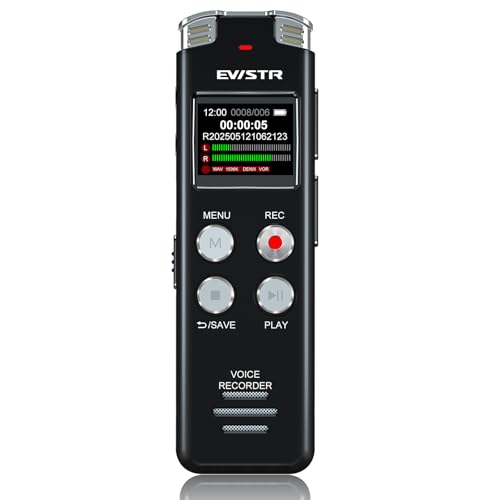
This 128GB EVISTR model doubles memory for longer interviews and lectures, with 1536kbps crystal-clear stereo sound and a metal chassis for durability. It supports multiple formats (wav/mp3) and offers A-B repeat, adjustable playback speeds, and time-slot recording. It’s well-suited for researchers and professionals who conduct long sessions and require extensive archives with reliable playback. Caution: battery life may be shorter when recording at the highest bitrates or while using power-hungry features.
EVIDA 128GB Digital Voice Recorder
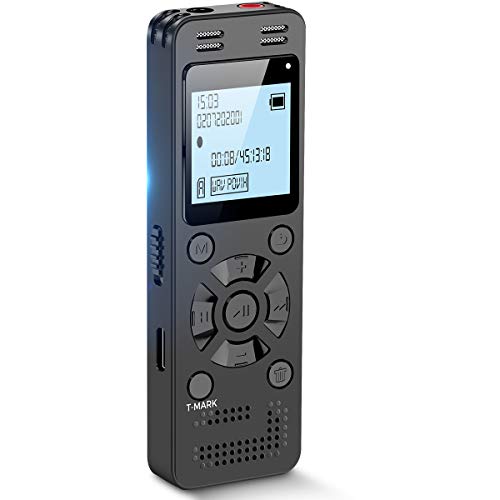
The EVIDA device offers a high-capacity 128GB storage option with password protection for sensitive recordings. It captures audio up to 1536kbps PCM quality and supports playback, making it suitable for interviews, meetings, and confidential discussions. It stores around 9,296 hours at lower bitrates, and its password option adds a layer of security for archived transcripts. Best for: researchers who handle sensitive data or need secure storage. Limitation: password protection details may require careful management to avoid lockouts or accessibility issues during transcription.
Buying Guide
What should you look for when selecting a digital recorder for qualitative interviews?
- Storage capacity and battery life: For long interviews or fieldwork, choose models with 64GB or more and long-lasting batteries. Consider devices with USB charging or fast-charging options to minimize downtime between sessions.
- Audio quality and noise handling: PCM or WAV formats at high kbps improve transcription accuracy. Look for noise reduction and 360° pickup to mitigate background disturbances in meetings or crowded spaces.
- Playback options and features: A-B repeat, variable playback speed, and time-slot recording help with efficient transcription and analysis. Two-button simplicity can be advantageous for quick captures in the field.
- Security and confidentiality: Password protection or encrypted storage is important for interviews containing sensitive information. Assess how securely the device stores and restricts access to files.
- Portability and durability: A compact, metal body can withstand travel and daily use. Consider weight, size, and build quality when you’ll be moving between locations.
- Compatibility and transfer: Ensure the device supports common formats (wav, mp3) and offers straightforward USB data transfer to PCs or transcription software.
Frequently Asked Questions
- What recording format should I prioritize for interviews?
– Prioritize WAV or PCM at high kbps for best transcription clarity, with MP3 as a convenient archival option. - How much storage do I need for a typical interview?
– A 64GB to 128GB device is usually sufficient for several hours of high-quality recording, depending on bitrate. - Is password protection necessary for field recordings?
– If you handle sensitive information, password protection adds a security layer to stored files. - Can these recorders be used for group conversations?
– Some models offer 360° capture and noise reduction, which helps capture multiple voices in a room, though acoustic conditions vary. - Do I need a separate microphone?
– Built-in mics are adequate for many interviews, but an external lavalier or tabletop mic can improve clarity in noisy environments. - How do I choose between the 64GB and 128GB options?
– If you routinely record long sessions or high-bitrate audio, choose 128GB for longer archives without frequent transfers.