Finding the right digital HDMI modulator or HDMI audio extractor depends on your setup, target outputs, and how you plan to route video and audio. This guide highlights five solid options across HDMI to HDMI with audio extraction, ATSC TV tuners, IPTV decoders, and DAC/ARC adapters. Each pick is described for typical buyers: home theater enthusiasts, small office displays, digital signage operators, and audio-focused setups. Read on to compare core capabilities, best-use cases, and any limitations you should know before buying.
| Product | Best For | Key Benefit |
|---|---|---|
| J-Tech Digital Premium Quality 1080P HDMI To HDMI + Audio Extractor | Home theaters needing HDMI audio extraction without ARC | Delivers both digital audio extraction and HDMI video up to 4K@30Hz |
| Digital Converter Box by OWERSLYN 2026 | TV watchers with ATSC antenna setups | Compact digital TV converter with HDMI/AV outputs |
| J-Tech Digital HDMI Video Decoder 4K 30Hz | IPTV or digital signage networks | IP video decoding with 4K input and 1080p HDMI output |
| 192KHz DAC Converter by MICROWARE | Audio-centric setups with ARC needs | Multifunction DAC with HDMI ARC, optical, coaxial, and stereo outputs |
Overview: The following sections describe each product’s strengths, typical user profiles, and any notable limitations. Use this as a quick-reference guide to decide which model best fits your system architecture and content distribution requirements.
J-Tech Digital Premium HDMI To HDMI + Audio Extractor
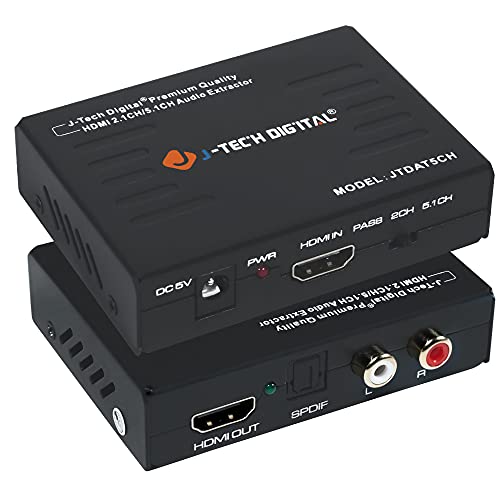
This device is designed for users who need to pull audio from an HDMI signal while preserving video output to an HDMI display. It supports 4K video at 30 Hz and outputs audio through either a 2-channel analog stereo or a 5.1-channel setup. It does not support ARC, making it a straightforward solution when your HDMI source and receiver don’t require return channel audio. It’s best for home theater setups where you want to feed an AVR or an external DAC with clean PCM or multi-channel audio without relying on ARC. A potential limitation is the lack of ARC functionality, which can be a factor for certain smart TVs or soundbars that rely on HDMI-ARC for channel return audio.
- Best for: Home theater enthusiasts who need simple HDMI audio extraction without ARC.
- Why selected: Solid 4K@30Hz HDMI pass-through with flexible audio outputs and plug-and-play installation.
- Limitations: No ARC support; verify your audio pipeline if you rely on ARC in your system.
Digital Converter Box by OWERSLYN 2026

This compact digital TV converter is designed for viewers using an antenna to receive ATSC broadcasts. It outputs to HDMI, 3RCA, or component, offering a simple path to larger screens or projectors. It’s notably small enough to tuck behind a TV and plugs into power via USB, making it suitable for hidden installations. A caveat is that CH3/CH4 channel switching isn’t supported, and it’s not compatible with TVs that only have RF inputs. It’s best for renters or minimalist setups where space and wiring simplicity are priorities, and where the TV can accept a modern HDMI or component input.
- Best for: Viewers with an over-the-air antenna looking for an easy HDMI or component TV output.
- Why selected: Compact footprint, multiple video output options, ready-to-use cables included.
- Limitations: No support for CH3/CH4 channel switching; not for RF-only TVs.
J-Tech Digital HDMI Video Decoder 4K 30Hz

This HDMI video decoder targets professional AV deployments and IPTV applications. It accepts up to 4K@30Hz input and outputs 1080p HDMI, making it suitable for systems where 4K capture or broadcast feeds must be downscaled for older displays or controlled environments. The device also supports USB media playback, enabling local video or signage playback from a USB drive. It’s best for networked displays, digital signage, or security monitoring applications where reliable IP video decoding is required. A limitation is that the downstream display’s bandwidth may cap output resolution to 1080p even if the source is 4K.
- Best for: IPTV networks, digital signage, or security monitoring that require reliable HDMI downscaling to 1080p.
- Why selected: Combines 4K input with easy 1080p output and USB media playback for versatile usage.
- Limitations: Downscaling to 1080p may be unavoidable if your display cannot handle 4K.
192KHz DAC Converter by MICROWARE

This multifunction DAC provides broad compatibility for audio-centric setups that require HDMI ARC, optical (Toslink), coaxial, and stereo outputs. It supports ARC to extract HDTV or projection audio and convert it to the desired formats. It includes options for PCM/LPCM output and is designed for users who need an all-in-one DAC and ARC adapter. Important note: it does not support reverse operation from Analog to Digital in some configurations, and some Dolby formats like Dolby Digital Plus may be unsupported. It’s best for audio-forward installations where HDMI ARC is essential, but you must ensure your source and display support ARC properly.
- Best for: Audio-intensive systems needing ARC extraction and multiple digital/analog outputs.
- Why selected: Flexible output options including optical, coaxial, and HDMI ARC audio extraction.
- Limitations: Not all multi-channel formats are supported; ensure PCM/LPCM alignment for your gear.
Buying Guide: Key Considerations for Digital HDMI Modulators and Audio Extractors
What matters most depends on your installation context. Consider these practical questions to choose wisely:
- What is your primary output? If you need to feed an AVR or a soundbar with independent audio, an extractor or DAC with multiple outputs is advantageous. If you simply want to route video and extract audio for a professional display, a decoder with USB playback may be preferable.
- Is ARC required? If your system uses HDMI ARC to return audio to a receiver or TV, ensure the device explicitly supports ARC and understands compatibility constraints with your TV model.
- Video resolution and frame rate Do you require 4K at 60Hz or 4K at 30Hz? Some devices cap at 4K@30Hz, which is common; verify whether your display or source needs higher bandwidth for smooth playback.
- Connectivity options Look for devices offering HDMI, optical, coaxial, and analog outputs. The more options, the easier it is to integrate with older and newer equipment alike.
- Panel compatibility and use case For signage, choose devices with USB playback or reliable IP decoding. For home theaters, prioritize audio extraction fidelity and latency characteristics that suit video playback.
- Ease of installation Plug-and-play devices reduce setup time, while remote controls and learning remotes can simplify day-to-day adjustments in living rooms or classrooms.
FAQ
- Do these devices support HDCP? Some models advertise HDCP compatibility in product features; verify HDCP version and compatibility with your HDMI sources to avoid handshake issues.
- Will ARC work with all TVs? ARC support varies by device and TV. If ARC is essential, confirm compatibility with your specific TV model and audio system.
- Can I use these for digital signage? Yes, some decoders and DACs support USB playback and IP video streams, making them suitable for signage and kiosk displays. Check format support before deployment.
- What about audio formats? Many adapters output PCM/LPCM and stereo, with some offering 5.1-channel or Dolby-capable output. If your setup requires specific formats, confirm support in the product specs.
- Are there compatibility caveats? Some devices do not support reverse conversion (Analog to Digital) in ARC paths, and certain channel or input-switching limitations may apply. Plan around these constraints.
Overall, the right digital HDMI modulator or audio extractor depends on your goals: preserving video fidelity, extracting audio for high-quality sound systems, or enabling flexible output formats for mixed-display environments. Use the product-specific insights above to guide your choice based on output needs, room layout, and equipment compatibility.