Whether you’re building a new mining operation or upgrading an existing rig, selecting the right crypto mining rigs can influence efficiency, noise levels, and scalability. This guide highlights a curated set of 5 mining rigs and frames designed to support popular coins like Ethereum, Ravencoin, Litecoin, Monero, Kaspa, and more. Each option offers varied power supplies, cooling solutions, and frame designs to fit different budgets and spaces. Read on to compare essential features and find a rig that matches your mining strategy.
Summary Table Of Featured Products
- 8GPU Mining Rig Complete Crypto Miner with Windows10 (VTRETU MINING) — 2000W PSU, 8 GPU support, open-frame style options
- SUOHUI 8 GPU Mining Rig Case — 1800W PSU, ultra-quiet design, 8 cooling fans
- Bomeiqee 12/6/8 GPU Open Air Frame — modular frame for multiple GPU configurations
- Kingwin 8 GPU Miner Rig Case — premium aluminum enclosure, stackable design
- Goldshell KA Box Pro — compact ASIC-like Kaspa mining solution with built-in PSU
8GPU Mining Rig Complete Crypto Miner

The VTRETU MINING 8GPU rig is designed for rapid deployment with a Windows 10-based setup that supports HiveOS and Linux. It ships with a 2U 2000W full-voltage power supply capable of handling multiple GPUs and demanding workloads. The system emphasizes a straightforward assembly process: install GPUs and drivers, power up, and start mining. The thermal management is addressed with a set of eight controllable cooling fans, four on each side, and an adjustable fan regulator to maintain stable GPU performance during extended sessions. This configuration aims to balance ease-of-use with scalable power for ETC, LTC, XHV, Monero, and Ravencoin mining scenarios.
Key considerations include ensuring adequate room for GPU risers and heat dissipation. The built-in power supply is compatible with a wide voltage range (110-220V), which helps in varying electrical environments. For operators exploring HiveOS or Linux-based monitoring, the rig offers flexibility in operating systems and remote management. While the setup is designed to simplify starting out, users should plan for proper cable management and airflow to maximize efficiency and longevity of the GPUs.
SUOHUI 8 GPU Mining Rig Case

The SUOHUI mining rig is built around an 8-GPU platform with a 4U 1800W full-voltage power supply designed for 110V-220V environments. It is configured for quick setup with Windows 10 English OS (unactivated) and supports HiveOS and Linux. A standout feature is its emphasis on quiet operation through noise-reduction design, enabling near-home mining without excessive sound. The rig employs eight cooling fans—four on the front and four on the rear—paired with a fan regulator to intelligently adjust airflow and maintain high GPU performance. This setup suits miners seeking a balance between performance and a quieter footprint.
Considerations for this model include verifying GPU clearance and ensuring the cooling airflow complements your room layout. The emphasis on silent operation makes it attractive for hobbyists and small offices. Like other multi-GPU rigs, plan for cable management and potential future expansion if you plan to add more GPUs or upgrade to higher-power cards.
Bomeiqee 12GPU Open Air Mining Frame

This open-air frame supports 6/8/12 GPU configurations and is designed to hold dual ATX power supplies. The stainless steel frame emphasizes durability and protection for GPUs and other components. The design prioritizes high airflow to maximize cooling, with ample spacing between cards to facilitate heat dissipation during long mining runs. Because the frame ships without GPUs, it’s suitable for builders who already own or plan to select specific GPUs and power arrangements. It’s a versatile base for building customized rigs or test benches for various algorithms and coin networks.
When planning a rack-style layout, consider room for cable routing, power distribution, and potential needs for additional fans or liquid cooling integrations. Open-frame designs can boost cooling efficiency but may require more attention to dust management and enclosure protection in busy environments.
Kingwin 8 GPU Miner Rig Case Frame
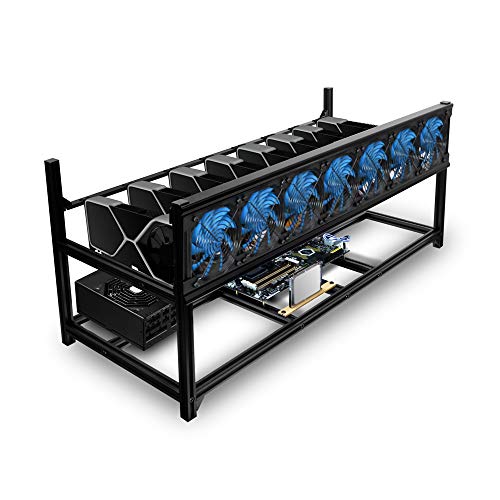
Kingwin offers a premium aluminum mining rig enclosure that supports up to 8 GPUs. The aluminum construction is aimed at durable operation with improved heat dissipation and chassis longevity in demanding mining environments. The design intentionally emphasizes airflow and structural integrity, supporting longer mining sessions without overheating. This enclosure is ideal for users seeking a compact, stackable solution that can be scaled by adding additional frames over time. The emphasis on efficient cooling helps maintain consistent hash rates and reduces thermal throttling during sustained workloads.
Important considerations include evaluating space planning for multiple stacked units and ensuring compatible power distribution across frames. For those expanding to larger operations, the lightweight yet sturdy design can simplify assembly and maintenance while preserving performance goals.
Goldshell KA Box Pro 1.6Th/s Kaspa Miner

The KA Box Pro is a compact Kaspa-focused miner with a maximum hash rate of 1.6 TH/s and a 600W power envelope. This Goldshell device is designed around the KHeavyHash algorithm and includes a 110V-240V PSU and a cord for straightforward integration into standard electrical outlets. It’s a box-style miner with a low noise profile (around 35 dB) and built-in dual fans to maintain stable operation in small-to-midsize setups. The device emphasizes compactness, making it suitable for space-constrained miners who want Kaspa exposure without a full multi-GPU rig.
Considerations for this device include the learning curve with ASIC-like devices and the need to align power supply with the rest of the rig’s infrastructure. While offering high efficiency in a small footprint, Kaspa’s algorithm-specific performance means evaluating network profitability and potential energy costs in your region before deployment.
Buying Guide
Key purchase considerations for crypto mining rigs include total power consumption, cooling strategy, and space requirements. Larger multi-GPU frames typically yield higher aggregate hash rates but also demand robust electrical infrastructure and effective ventilation. When choosing a frame or enclosure, weigh open-air designs for cooling against closed enclosures for noise control and theft protection.
Power supply quality and voltage compatibility matter. Opt for PSUs with headroom to accommodate future GPU upgrades while leaving room for motherboard and fans. If you plan to scale, consider modular frames or stackable enclosures that simplify expansion and cable management. Compatibility with preferred mining software (HiveOS, Linux, or Windows-based miners) is another important factor for monitoring and remote management.
Noise levels, maintenance needs, and dust exposure should influence your setup decisions, especially if mining at home or in shared spaces. ASIC-based options like the Goldshell KA Box Pro offer compact efficiency for specific coins but come with algorithm constraints. For hobbyist or small-office environments, open-frame rigs paired with quality cooling offer flexibility and upgrade paths. Always calculate total cost of ownership, including electricity costs, to determine long-term profitability for your chosen configuration.