Choosing the right coupling capacitors is crucial for preserving audio fidelity in amplifiers and signal paths. This guide highlights five options commonly used in audio gear, from film MKP/CBB20 types to precision-matched hi-fi capacitors. Each entry focuses on value, voltage rating, and typical use to help you compare performance and suitability for your project.
| Product | Capacitance | Voltage | Type |
|---|---|---|---|
| Cermant 5Pcs 10μF 250V MKP Capacitors | 10 μF | 250 V | CBB20 Polypropylene Film |
| Cermant 10Pcs 4.7μF 250V MKP Capacitors | 4.7 μF | 250 V | CBB20 Polypropylene Film |
| PATIKIL 3.3μF 250V MKP Capacitors | 3.3 μF | 250 V | CBB20 Polypropylene Film |
| PATIKIL 2.2μF 250V MKP Capacitors | 2.2 μF | 250 V | CBB20 Polypropylene Film |
| Mallory 0.01μF Axial Coupling Capacitor | 0.01 μF | 630 V | Axial |
Cermant 10μF 250V MKP Audio Capacitors — 5 Pack

The Cermant 10μF, 250V MKP capacitors use a polypropylene film (CBB20) dielectric, designed for clean audio signal paths. With a tolerance of ±5% and a compact axial lead design, they suit crossovers, coupling paths, and timing circuits in audio equipment. Operating from -40°C to 105°C, these capacitors balance stability and low distortion for hi-fi and midrange applications. They are well-suited for audio amplifiers and switching power supplies where stable low-loss coupling is important.
Key specifications include 10μF capacity, 250V rating, and 33 mm lead length. The axial form factor supports straightforward installation on PCBs or point-to-point wiring. In practice, their film construction helps minimize dielectric absorption and microphonic effects, which can influence subtle tone in high-fidelity systems.
Cermant 4.7μF 250V MKP Audio Capacitors — 10 Pack
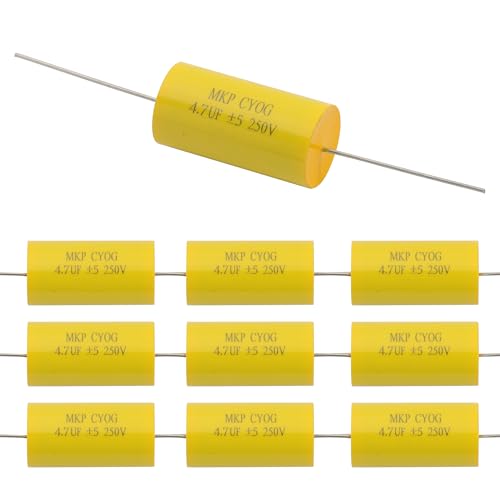
These 4.7μF MKP capacitors (CBB20) deliver stable performance for audio signal coupling and crossovers. The ±5% tolerance keeps channel balance predictable, which is important for stereo imaging. Rated at 250V, they tolerate modest voltage spikes in consumer electronics and audio equipment. Their temperature range supports consistent behavior in typical listening environments. The axial lead design makes them a practical drop-in replacement for many DIY or repair projects involving audio amplifiers and crossovers.
Applications emphasize audio equipment, signal path filtering, timing circuits, and switching power supply coupling. The film dielectric helps minimize dielectric losses and microphonics, contributing to cleaner high-frequency performance in hi-fi playback and guitar/bass preamps.
YEGAFE 0.47μF 630V Tube Amp Coupling Capacitor — Matched Pair
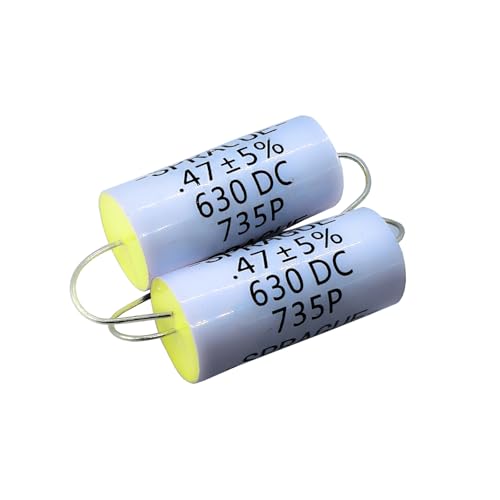
This two-pack of 0.47μF, 630V axial capacitors is designed for tube amplifiers and other high-end audio paths where precise matching matters. The model is described as precision matched to optimize channel balance across stereo setups, helping to minimize crosstalk and preserve imaging. With a high voltage rating, these capacitors can handle the voltage swings common in tube-based sound stages, while maintaining consistent performance in the signal chain.
Ideal uses include coupling between preamp stages, phase-inverting stages in hi-fi gear, and other signal-path applications where stability and sonic neutrality are prioritized. Although a smaller value than typical power-handling caps, 0.47μF at 630V is common in high-fidelity audio for preserving high-frequency detail without excessive low-frequency roll-off.
PATIKIL 3.3μF 250V MKP Audio Capacitors

Patikil’s 3.3μF, 250V MKP capacitors are offered in packs for audio crossover applications. The CBB20 dielectric promotes low dielectric loss and good self-healing properties, which can contribute to stable performance in high-frequency switching and audio paths. The axial 2-pin leads simplify mounting in hobbyist and professional builds alike, while the ±5% tolerance helps maintain consistent channel balance in multi-capacitor networks.
These capacitors excel in crossover networks, filter stages, and coupling circuits for speakers and amplifiers. They’re well-suited for those who value low-temperature rise and resistance to high-frequency AC stress, ensuring reliable operation in energy-intensive audio segments.
Cermant 3.3μF 250V MKP Audio Capacitors — 10 Pack

This set comprises 3.3μF, 250V MKP capacitors suitable for audio equipment, temperature compensation circuits, timing and oscillation applications, and switching power supply coupling. The -40°C to 105°C operating range supports dependable operation in diverse environments. The axial form factor with 33 mm pin length makes them easy to position in compact enclosures or on PCB traces in audio gear.
Representative uses include speaker crossover stages, filter networks, and signal-path coupling where stable capacitance and low distortion are desired. The film dielectric helps minimize noise and microphonics in sensitive audio paths, contributing to clearer highs and more accurate mids in calibrated systems.
DEWIN 4-Pack 10000μF 63V Electrolytic Capacitors

These electrolytic capacitors are designed for audio power supply filtering and coupling in demanding environments. The 10000μF value provides substantial energy storage for smoothing ripples and stabilizing voltage rails within amplifiers and audio processors. The 63V rating fits typical consumer audio gear, while the durable construction supports long-term reliability in fixtures and enclosures.
Applications include power supply decoupling, audio filtering stages, and general smoothing tasks where larger capacitance values are beneficial. They are not a direct substitute for film capacitors in signal paths, but they play a critical role in maintaining clean power to the audio chain, which indirectly affects sonic clarity and dynamics.
Mallory 150M Axial Coupling Capacitor — 0.01μF
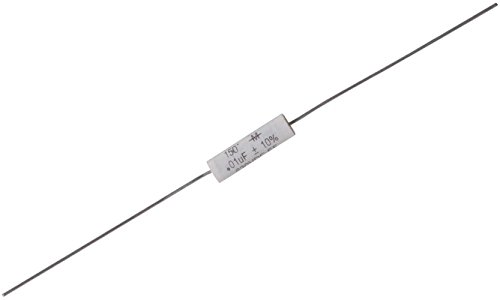
The Mallory 150M axial coupling capacitor provides a compact 0.01μF value at 630V, making it suitable for high-frequency signal paths and delicate coupling tasks in guitar amps or hi-fi gear. Mallory’s build focuses on reliable performance in audio circuits where precise impedance control matters for accurate high-frequency response and minimal phase shift.
Ideal use cases include coupling between preamp stages, small-signal pathways in audio gear, and tone-shaping networks requiring tight tolerance and stable audio characteristics. The axial package supports straightforward installation in retrofits and modern builds alike.
Buying Guide: Key Considerations For Audio Coupling Capacitors
- Capacitance value: Higher values like 4.7–10 μF are common for low-frequency coupling, while 0.01–0.47 μF suits high-frequency paths. Match the capacitor to the intended frequency response and impedance of the load.
- Voltage rating: Choose a voltage rating well above the circuit’s peak signal and supply voltage to avoid breakdown and distortion. In many audio applications, 250 V and 630 V types are available for flexibility.
- Dielectric material: Film dielectrics (MKP/CBB20) offer low loss and stable performance for audio signals. Compare film capacitors for lower distortion and better high-frequency behavior versus electrolytics, which are typically used for power supply filtering.
- Tolerance and matching: ±5% is common; for stereo imaging, precise matching across channels helps ensure balanced sound. For dedicated pairings, look for labeled matched or matched-pair sets.
- Temperature stability: A wide operating temperature range reduces performance drift in varying environments, preserving tonal consistency in both warm and cold listening rooms.
- Physical form and mounting: Axial leads are easy to install in traditional point-to-point builds and some PCBs. SMD variants are easier for compact or automated assemblies; ensure lead length and spacing suit your design.
- Application fit: Use film capacitors for signal paths and coupling to minimize distortion. Reserve electrolytics for power supply smoothing and decoupling tasks where large capacitance is needed but low-frequency loss is less critical to the audio path.
- Durability and reliability: Look for high-temperature ratings, robust encapsulation, and reputable brands to ensure long life in audio equipment and DIY projects.