Looking for the best conductive paint to power electroforming and related metal-plating projects? This guide highlights five top choices, explains who each product fits best, and shows practical trade-offs. Ideal buyers include hobbyists working on 3D-printed parts, resin models, DIY electronics builders, and professional artists exploring copper coatings or EM shielding. Below, find concise product highlights, key strengths, and clear buying guidance to help you choose confidently. A quick summary table follows the introduction for fast comparison.
| Product | Best For | Main Strength | Caution |
|---|---|---|---|
| Saho’s Graphite Conductive Paint | 3D-printed parts and resin models | Direct-from-bottle use, no thinning | Limited brand reach outside Canada |
| Generic Conductive Paint | Everyday repairs and simple circuits | Multipurpose and easy to apply | Consumer-grade info may vary |
| Faith Love Hope Graphite Paint | Electroforming and 3D prints | Graphite-based, copper-ready coating | 2 oz size may be bulkier |
| Nexalo rithu Graphite Conductive Paint | DIY electroforming and metal finishes | Detail preservation with graphite particles | Brand spelling in listing is inconsistent |
| YOTEBLE Guitar Shielding Paint | Guitar cavity shielding and EMI control | Graphene-based shielding with practical conductivity | Intended for shielding, not heavy plating |
Saho’s Graphite Conductive Paint for Electroforming and Electroplating

Best for: hobbyists shaping copper-plated finishes on 3D-printed parts or resin models. This graphite paint comes ready to use straight from the bottle, with no thinning required, and supports both brushing and air brushing. It is formulated for copper plating and is produced in Canada, making it a practical choice for makers building metal-toned surfaces quickly.
Why selected: The ease of application and direct-use formula reduce setup time for electroforming workflows. Its ability to be brushed or air brushed helps accommodate large surfaces or fine details. Users seeking a starter coating for copper plating often find this option convenient and predictable.
Limitations: Availability outside Canada may vary. For very large projects, ensure you have enough volume to complete the coating without interruptions.
Conductive Paint for EMF Shielding and Versatile Surfaces

Best for: general electrical repairs, DIY electronics, and multipurpose use. This paint is designed for broad compatibility across surfaces and offers a quick-drying, non-toxic formula suitable for homes and workshops. It is a flexible choice for makers who want an all-purpose conductive coating that’s easy to apply and easy to clean.
Why selected: Its broad surface versatility makes it a practical baseline option for those exploring conductive coatings beyond electroforming alone. The ability to dry quickly and remove with soap and water adds convenience for frequent tinkering.
Caution: The data emphasizes general conductivity; for precision copper plating, prefer a graphite-focused product designed for plating currents and even layer formation.
Faith Love Hope Graphite Conductive Paint for Electroforming

Best for: electroforming and electroplating enthusiasts who work with copper plating on 3D-printed or resin pieces. The product emphasizes ultra-fine graphite particles to support uniform copper growth and a smooth surface finish, making it a strong choice for serious hobbyists and professional makers alike.
Why selected: The description highlights stability and high-performance conductivity, facilitating reliable plating across multiple surfaces. It’s particularly suitable for detailed work where surface quality matters.
Limitation: The text notes its broad application scope; for strict copper plating with demanding tolerances, verify compatibility with your electrolyte and current setup before use.
Nexalo rithu Graphite Conductive Paint for Electroforming

Best for: DIY electroforming and metal finishing projects, especially for artists and 3D printing enthusiasts seeking fine detail preservation. The formulation emphasizes ultra-fine graphite particles to create a conductive layer that does not obscure intricate surface work.
Why selected: This product positions itself as a reliable base for copper electroforming on a variety of non-metal substrates, including plastics and resins, enabling smooth metal deposition with consistent results.
Limitation: Brand naming in listings varies; confirm the exact product details and packaging when ordering to avoid mismatches with expected conductivity.
YOTEBLE Guitar Shielding Paint

Best for: shielding guitar cavities from electrical noise and reducing hum. This graphene-based coating delivers a stable conductive layer after curing and is designed for straightforward cleanup with water, making it a practical option for instrument technicians and DIY players.
Why selected: For buyers focused on EMI suppression rather than metal deposition, this product offers a reliable barrier against interference with a user-friendly water-based formula.
Caution: While excellent for shielding, it is not intended as a plating base for electroforming projects requiring metal deposition.
LANGXINST Graphene Conductive Paint
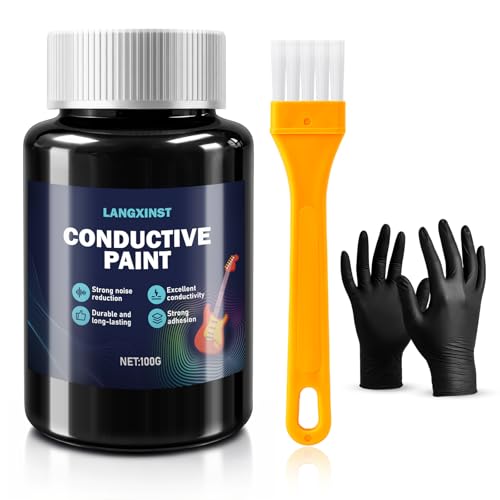
Best for: electromagnetic shielding with a focus on sound purity in guitar applications. The graphene formulation aims to reflect and absorb electromagnetic waves, reducing EMI while delivering corrosion-resistance and heat-dissipation benefits for coatings on guitars and related devices.
Why selected: It provides both shielding and protective properties, making it appealing for instrument owners wanting more than just a conductive layer. Its emphasis on heat dissipation is a practical bonus for electronic components inside guitars.
Limitation: Optimized for shielding and corrosion protection; when the goal is copper electroforming, a graphite-based product designed for plating will generally be a better fit.
JAOJAO Conductive Paint

Best for: applications requiring ultra-high conductivity, anti-static behavior, and strong adhesion on diverse substrates like glass, ceramics, metals, and cement. This paint suits screen printing, electronic prototypes, or oil pipe projects where robust performance matters.
Why selected: Strong adhesion and stable resistance make it a solid technical option for broader manufacturing or industrial contexts beyond hobby electroforming.
Limitation: Use may require substrate preparation for best adhesion; verify compatibility with your specific substrate before large-scale deployment.
MG Chemicals 841AR-340G Super Shield Nickel Conductive Paint

Best for: EMI/RFI shielding across a broad frequency range with a nickel-based conductive coating. This option is well-suited for projects needing a strong shield and a relatively quick dry process without heat curing.
Why selected: The low resistivity and quick dry time support professional or enthusiast labs where consistent shielding is critical. It’s a dependable benchmark for EMI protection in more demanding electronics environments.
Limitation: As an aerosol option, it may require careful surface preparation and ventilation; not ideal for very small, detailed electroforming work where a brush-on graphite paint offers finer control.
Buying Guide
What is conductive paint used for in electroforming?
Conductive paint creates a conductive surface on non-metal parts so current can flow during electroforming. It helps initiate and sustain copper or other metal deposition on plastics, resins, or ceramics. Graphite-based coatings are common for plating, while graphene or metal-filled paints offer shielding or specialized finishes.
How do you choose between graphite and graphene coatings?
- Graphite paints are typically chosen for plating readiness and uniform metal growth on non-conductive substrates.
- Graphene-based paints excel at shielding and durability, offering EMI protection and heat dissipation benefits in some coatings.
What surface types and projects matter most?
- 3D-printed parts and SLA prints: graphite-based, no-thin formulations help preserve details and provide plating readiness.
- Resin models: look for smooth, uniform coating with good adhesion and minimal detail loss.
- Guitars and electronics: shielding-focused formulations reduce hum and RF interference.
How important is ease of use and cleanup?
Coatings that dry quickly, require no thinning, and allow simple cleanup (soap and water) save prep time. If you plan to switch between projects, easier-to-clean options can significantly improve workflow efficiency.
Safety and preparation tips
- Follow manufacturer instructions for surface prep and drying times.
- Work in a well-ventilated area when using spray or aerosol formats.
- Test a small area to confirm adhesion and conductivity before large-scale application.
Summary of key considerations
- Best for copper electroforming on non-metals: graphite-based, brush-on or air-brush ready formulas.
- Best for EMI shielding and instrument tech work: graphene-based or specialized shielding paints.
- Best for multi-use DIY projects: multipurpose conductive paints with easy cleanup.
- Best for consistent, repeatable results: select paints with clear current pathways and deposition guidelines.
FAQ
- What is conductive paint used for in electroforming? It creates a conductive surface on non-conductive parts to allow metal deposition during electroforming.
- Can I use any conductive paint for copper electroforming? For reliable copper plating, graphite-based paints designed for electroforming are typically preferred over general-purpose coatings.
- Is graphene-based shield paint suitable for plating? Graphene-based shields are intended for EMI protection; they are not primarily designed for metal deposition.
- Do these paints require thinning? Some products are designed to be used straight from the bottle; others may specify thinning for spray applications.
- Are these paints safe for home workshops? Many are non-toxic and home-workshop friendly, but always follow the specific safety guidelines on the product label.
- Which paint should I choose for a detailed 3D-printed part? A graphite-based paint that supports uniform conductivity and preserves fine details is typically best.