Answering the needs of hobbyists who require compact, travel-friendly HF antenna solutions, the following selections cover portable end-fed, fiberglass verticals, all-band hf sticks, and shortwave reel antennas. These options suit travelers, campers, apartment dwellers with restricted space, and field operators who value portability without sacrificing performance. Each pick is evaluated for portability, ease of setup, band coverage, and practical field use. A quick summary table follows to help you compare at a glance.
| Product | Best For | Key Trade-off |
|---|---|---|
| ASHATA Portable Short Antenna | Travelers needing 1–30 MHz coverage in a compact end-fed design | Limited mechanical robustness expected from PVC and compact housing |
| Taurus JN-316 HF/6M Base Antenna | Fixed-base station with easy tuner integration | Requires setup on a sturdy mast or mast-like support |
| JPC-12 HF Antennas (8-band) | Field Day and POTA with multi-band capability | Some tuning needed for optimal SWR on each band |
| GABIL GRA-1899T Portable HF Antenna | Apartment, travel, and portable ops | Limited to QRP-level performance in ultra-compact form |
| XHDATA AN-80 Shortwave Reel Antenna | Improved FM/Shortwave reception in limited spaces | Best as an added reception booster, not a primary transmit antenna |
ASHATA Portable Short Antenna
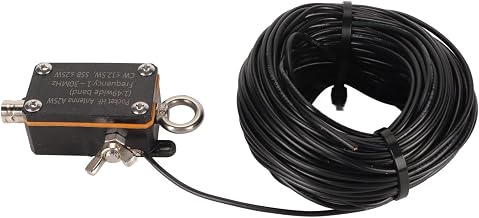
Best for travelers and hikers who need 1–30 MHz coverage in a compact end-fed design. This antenna uses a 1:49 balun and standard interfaces for quick setup. The compact size and easy portability make it a strong option for field operations or temporary setups in limited spaces. Its PVC construction favors durability in outdoor environments, though users should handle it with care to avoid damage during transit. This model is selected for its lightweight footprint and straightforward installation, which helps beginners and seasoned operators alike assemble an efficient HF link quickly.
- Best for: On-the-go operators who want a simple, low-profile end-fed solution.
- Why chosen: Combines a wide 1–30 MHz range with a 1:49 balun for reliable performance in a compact form.
- Caution: PVC materials can be susceptible to impact; store securely to extend service life.
Taurus JN-316 HF/6M Base Antenna

Best for fixed-location stations that can mount a fiberglass vertical and use an external tuner. This antenna covers 80 meters through 6 meters, with TX in the 3.5–57 MHz range and RX from 2.0–90 MHz, making it a versatile base option for home or portable shacks. The fiberglass vertical with an Unun-based base offers robust physical performance for field deployments and stable matching with a tuner. A limitation is the need for a solid mounting solution to maximize stability and performance in windy conditions.
- Best for: Stations requiring multi-band capability with a simple base setup.
- Why chosen: Broad TX/RX coverage and a rugged fiberglass build suit fixed or semi-fixed operations.
- Caution: Requires proper mounting and grounding to achieve best results.
JPC-12 HF Antennas All-Band (7–50 MHz)

Best for field operations such as POTA, SOTA, and Field Day where eight bands are beneficial. This 4.1 meter all-band vertical covers 40/30/20/17/15/12/10/6 meters with a 50-ohm impedance and up to 100W SSB, maintaining a low SWR across bands. A low-noise coil design and a sliding regulator streamline tuning in outdoor environments. It’s ideal for users who want predictable performance with minimal assembly, though occasional tuning to local conditions is advised.
- Best for: Operators needing reliable multi-band coverage with quick setup.
- Why chosen: High band count, stable SWR, and design features that ease field tuning.
- Caution: SWR might vary with mounting and nearby structures; verify with an analyzer.
GABIL GRA-1899T Portable HF Antenna

Best for QRP operations, travel, and compact setups where space is at a premium. The GRA-1899T is designed for 80m to 6m and emphasizes compactness with quick deployment. It’s well-suited for apartment dwellers, hikers, and field operators who need a portable multi-band HF solution. A potential limitation is that ultra-compact designs may underperform compared with larger, full-size antennas on certain bands, especially under load or in challenging terrain.
- Best for: Portable use in apartments, hotels, campsites, or travel scenarios.
- Why chosen: Supports multiple HF bands in a small, easy-to-transport package.
- Caution: Performance may vary by environment; plan for band-specific compromises.
XHDATA AN-80 Shortwave Reel Antenna

Best for boosting FM and shortwave reception in limited spaces. The AN-80 extends to 720 cm (23 feet) and attaches easily to a post or elevated location. It’s a practical add-on for improving reception when a primary transmit antenna is impractical in small living spaces. This reel antenna is not designed as a primary transmitting element; use it to enhance receive performance or as a supplemental feed for portable setups.
- Best for: Enhancing FM/shortwave reception in restricted spaces.
- Why chosen: Long reach in a compact reel design and easy mounting for portable use.
- Caution: Primarily a receive-oriented solution; rely on a dedicated transmit antenna for transmitting.
Buying Guide: Compact HF Antenna Considerations
- Portability vs. performance: Lightweight, compact antennas are easy to transport but may sacrifice some efficiency on certain bands. Consider your typical operating bands and how often you’ll travel.
- Band coverage: Multi-band options reduce gear needs but may require more tuning and setup time. Decide whether you need broad coverage or a focused, high-performance option on a few bands.
- Mounting and location: Fixed-base antennas benefit from solid mounting and grounding, while portable options rely on quick setups and compact form factors. Ensure you have permissions where you operate (apartment buildings, parks, or campgrounds).
- Tuning and SWR: Antennas with adjustable components or built-in tuning aids help maintain low SWR in varying environments. Use an antenna analyzer when possible for accurate tuning.
- Durability and materials: PVC, fiberglass, and metal components influence weather resilience and transport durability. Look for protective coatings and robust connections for outdoor use.
- Relevance to use-case: For POTA/SOTA or field days, prioritize quick assembly, stable SWR, and lightweight transport. For apartment or hotel stays, prioritize compact size and dual-use receive capability where applicable.
Frequently Asked Questions
- What makes a compact HF antenna suitable for travel? – It folds or telescopes, uses a lightweight build, and maintains workable performance across common HF bands while fitting into a backpack or carry-on.
- Is multi-band coverage worth it for portable use? – Yes, for versatility in diverse conditions, but be prepared to spend time tuning at each location.
- Do I need a tuner with these antennas? – Many portable designs work with a portable tuner; others include a balun or matching element. A tuner can simplify matching on multiple bands.
- Can I use these antennas indoors? – Some smaller models work in apartments with balcony or window access, but performance is limited by proximity to metal and nearby structures.
- What should I consider when choosing between a base antenna and a portable one? – Base antennas offer strong, stable performance with a fixed installation; portable options excel for travel and quick deployment in varied locations.
- How do I verify SWR in the field? – Use a portable antenna analyzer or a radio’s built-in SWR meter, and cross-check across the bands you intend to use.