Maintaining optimal carbon dioxide levels is essential for productive indoor growing. The right CO2 monitor helps you track CO2 concentrations, temperature, and humidity, enabling precise environmental control. This guide reviews five reliable CO2 monitoring options suited for grow tents, hydroponic rooms, and home gardens. Each entry highlights key features, sensor technology, alerting capabilities, and how it fits a grow room setup.
Summary of chosen products:
- Temtop CO2 Monitor Indoor Air Quality Monitor Portable CO2 Meter
- AC Infinity CO2 Controller, Smart Outlet for Grow Rooms
- INKBIRDPLUS Portable CO2 Detector, Mini Indoor CO2 Monitor
- Newentor CO2 Monitor, Indoor Air Quality Meters
- U UNNI CO2 Monitor Carbon Dioxide Detector for Home
Temtop CO2 Monitor Indoor Air Quality Monitor Portable CO2 Meter

Temtop’s multifunctional CO2 monitor delivers real-time measurements for carbon dioxide, plus temperature and humidity. It covers 400–5000 PPM for CO2 and -10°C to 60°C with a 0–99% RH range. A standout feature is the 70‑day standby capability enabled by a photoacoustic CO2 sensor and a smart algorithm. The device uses color indicators and optional audio alerts to signal when CO2 levels exceed safe thresholds, making it useful for growers who need quick, visual cues in addition to numeric readings. The compact form factor supports flexible mounting options, ideal for grow tent corners or bedside setups in grow rooms. With robust battery life and clear, color-coded feedback, it’s suited for operators who want a portable, always-on CO2 awareness tool without heavy installation.
AC Infinity CO2 Controller, Smart Outlet

The AC Infinity CO2 Controller provides an integrated approach to CO2 management in grow tents and rooms. It combines a smart outlet controller with independent programming for CO2 regulators and exhaust fans. The system dynamically adjusts operation based on measured CO2 levels to maintain an optimal environment. This setup is particularly useful for growers who already use CO2 regulators or inline exhaust fans and want automated coordination to prevent over- or under-saturation. The controller supports custom CO2 and fan schedules, enabling a coordinated response to changing room conditions. It’s a practical choice for larger grow spaces or those seeking a plug-and-play automation solution that minimizes manual monitoring while maintaining consistent CO2 levels.
INKBIRDPLUS Portable CO2 Detector

The INKBIRDPLUS detector uses an advanced NDIR sensor for precise CO2 readings with strong anti-interference and stability. It displays readings with three indicator lights (green for 400–699 ppm, yellow for 700–1499 ppm, red for 1499–5000 ppm) and offers audible alerts when CO2 exceeds configurable thresholds. The device’s portable design makes it suitable for quick spot checks in grow tents or shaded corners of a larger room. A customizable alarm value adds flexibility for different crop needs or room configurations, helping growers maintain safety and efficiency without constant manual monitoring. This model is ideal for growers seeking a straightforward, reliable CO2 readout with clear visual alarms.
Newentor CO2 Monitor, Indoor Air Quality Meters

Newentor offers a CO2 monitor with a focus on patient-friendly alerts and a large display for easy visibility in grow rooms. It relies on Sensirion PASens technology with photoacoustic detection to deliver accurate CO2 readings across typical indoor ranges. The unit emphasizes customizable CO2 concentration alerts, allowing growers to tailor notification thresholds to crop type and growth stage. Temperature and humidity are monitored simultaneously, aiding in creating a stable microclimate. Additional features include a clear alert system and accessible controls, making it suitable for home setups or smaller grow tents where straightforward, reliable readings are essential.
U UNNI CO2 Monitor Carbon Dioxide Detector for Home
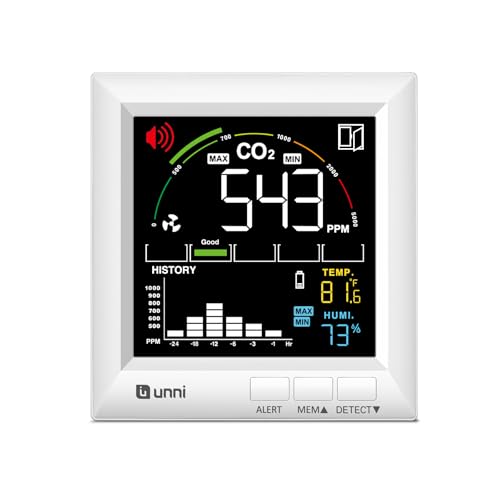
U UNNI presents a home-oriented CO2 monitor with a Swiss Sensirion photoacoustic sensor for precise CO2 readings and real-time data, including temperature and humidity. It features adjustable alarm volumes and backlights, plus a CO2 range of 400–5000 ppm. The device includes a CO2 history chart and a low battery indicator, making it a practical fit for small grow tents or hobbyist grow spaces. Its design emphasizes easy readability, quick alarms, and a reliable sensor core, suitable for growers who want a simple, dependable instrument to monitor preventing ventilation issues and ensuring stable crop conditions.
Buying Guide: Key Considerations For CO2 Monitoring In Grow Rooms
- Sensor technology: Look for non-dispersive infrared (NDIR) sensors for accuracy and low drift. Photoacoustic sampling can offer reliable long-term stability, especially in varying room conditions.
- Range and resolution: Ensure the CO2 range covers typical indoor levels (approximately 400–2000 ppm for many grows, up to 5000 ppm for aggressive strategies). Resolution should be fine enough to detect small changes (±50 ppm is common in quality units).
- Multi-parameter support: CO2, temperature, and humidity data help maintain a stable microclimate. Some models also offer dew point or air quality indices.
- Alerts and alarms: Customizable visual (LEDs) and audible alerts enable quick response, especially when you’re away from the tent.
- Portability vs. built-in mounting: Portable meters are great for spot checks; wall- or pole-mountable devices suit fixed grow spaces and provide consistent readings.
- Automation compatibility: If you use CO2 regulators or inline fans, a smart outlet or controller that integrates CO2 scheduling can automate adjustments and reduce manual intervention.
- Power life and battery: For portable models, long battery life minimizes downtime. Check whether auto-sleep modes are available to save energy.
- Display and accessibility: Large, high-contrast displays help quick readings at a glance, while mobile-friendly interfaces can support remote monitoring.
- Maintenance and calibration: Some units require periodic calibration. Consider how easy it is to calibrate and access support information.
- Size and form factor: For small grow tents, compact devices with flexible mounting options are often preferred.
When selecting a CO2 monitor for a grow room, balance accuracy with convenience. If you manage a single tent, a portable unit with clear alerts can suffice. For multi-room environments or larger grow operations, consider an integrated controller that coordinates CO2, ventilation, and timing. Finally, prioritize devices with reliable sensors, robust construction, and clear data presentation so you can keep crop cycles on track and avoid fluctuations that could stunt growth.