Choosing the right cine light meter helps ensure consistent exposure for both ambient and artificial light. This article reviews top-rated meters that balance accuracy, speed, and ease of use for film and video work. Below is a quick table of five versatile models to compare at a glance.
| Product | Brand | Key Benefit |
|---|---|---|
| Sekonic L-308X-U Flashmate | Sekonic | Accurate ambient and flash readings to 0.1 stop |
| Light Meter Digital Illuminance Meter | URCERI | High lux range to 200,000 Lux with color LCD |
| Sekonic LiteMaster Pro L-478D-U | Sekonic | Simultaneous ambient and flash, cine-ready modes |
| Sekonic Speedmaster L-858D-U | Sekonic | Advanced flash duration and wireless triggering |
| Dr.meter LX1330B | Dr.meter | Fast response, FC/LUX conversion, peak data |
These meters cover a range of workflows—from still photographers and cine shooters to plant lighting scenarios. The following sections detail five top picks, highlighting how each can support professional cinematography and accurate exposure control on set.
Sekonic L-308X-U Flashmate Light Meter

The Sekonic L-308X-U Flashmate is a compact, reliable choice for precise ambient and flash exposure. It delivers tenth-stop precision for ambient and flash readings in full-stop mode, making it practical on sets where quick, repeatable measurements matter. With ISO 100, the ambient EV range spans 0 to 19.9, and flash readings cover f/1.0 to f/90.9, supported by a shutter-speed span from 60 seconds to 1/8000th of a second (1 sec to 1/500th for flash). The Photo Mode supports shutter or aperture priority, presenting a full spectrum of ambient and flash options, including corded and cordless flash measurements. This meter is favored for its straightforward operation in fast-paced environments and compatibility with both stills and motion workflows.
Light Meter Digital Illuminance Meter (URCERI)
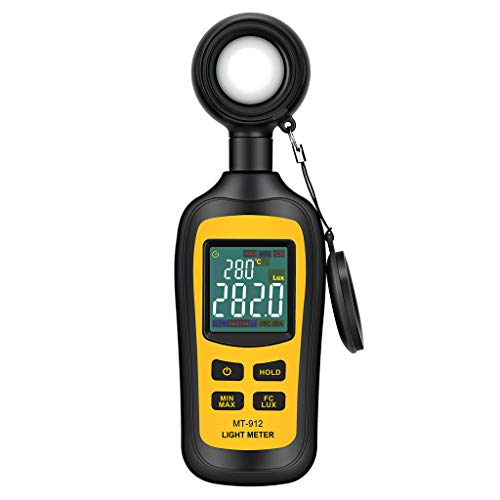
The URCERI Luxmeter provides a high-range lux measurement up to 200,000 Lux and also records ambient temperature. It features a 4-digit color LCD screen, MIN/Max readings, data hold, auto power off, and low-battery indication. Its dual capability suits studio and location shoots where precise lux measurements guide lighting placement and brightness balance. The device’s accuracy is specified as ±3% rdg ±8 digits up to 10,000 Lux and ±4% rdg ±10 digits beyond that, making it a solid option for projects that require dependable lux readings in both indoor and outdoor environments.
Sekonic LiteMaster Pro L-478D-U

The L-478D-U is designed for on-set speed and clarity. Its large color LCD presents ambient, flash, cine, and other data in a clear, accessible layout. The meter excels when flash contributes to scene lighting, automatically indicating the percentage of flash in total exposure. With two motion-capture modes, it adapts to different camera setups—touch to set shutter speeds for HD SLRs or quickly choose frame rates and shutter angles for cine. This model is appreciated by operators who need quick, intuitive control without sacrificing complex measurement capabilities.
Sekonic Speedmaster L-858D-U

The L-858 Speedmaster Pro specializes in advanced flash duration measurements and wireless triggering. It supports radio control modules for Elinchrom Skyport and Phottix Strato II/Ares II, extending compatibility for modern lighting ecosystems. The meter adds increased light sensitivity—three extra stops for incident readings, two stops for reflected light (spot), and the ability to capture readings down to 0.1 lx. This model is tailored for professional productions where precise flash control and remote operation are essential, particularly when balancing high-speed lighting cues with ambient exposure.
Dr.meter LX1330B Digital Illuminance Light Meter

The Dr.meter LX1330B emphasizes fast response and practical versatility. It records up to 200,000 Lux and offers FC/LUX conversion, giving users options to match project requirements. The device supports peak data recording, which is helpful for measuring brief bursts of light from lasers or strobe bursts. Its quick readings and robust feature set make it suitable for horticultural setups, stage lighting, and on-location shoots where rapid exposure assessment is critical.
Lightray Mobile Light Meter with Photone App

The Lightray system turns a smartphone into a professional light meter via the Photone app. It supports iPhone 5S and newer, iPad 2013+ and most popular Android devices, providing a portable, app-driven workflow. The app-based approach simplifies acquiring and logging readings, while the device remains compatible with multiple light scenarios. Note that setup requires selecting the Diffuser Type in the app for accurate readings, as misconfigurations can skew results. This option is ideal for field work and quick checks on location shoots where carrying traditional meters is impractical.
TopTes TS-710 Light Meter

The TopTes TS-710 offers a 180° rotating sensor for flexible measurement angles, with a fast sampling rate of 0.5 seconds. It supports lux and foot-candle readings across a range of 0.1 to 200,000 Lux and 0.1 to 20,000 FC, with an accuracy of 3% rdg + 5 digits. Its large backlit display is designed for easy reading in dim environments, making it a practical choice for plant lighting, film shoots, and office lighting assessments. The rotating probe helps align measurements from multiple angles, aiding setups that require precise light direction assessment.
UNI-T UT383 Light Meter Lux Meter

The UNI-T UT383 provides a compact, reliable illuminance measurement solution with Lux and FC readouts. It covers 0 to 199,900 Lux (0 to 18,500 FC) and features a large 4-digit LCD with backlight, 0.5-second sampling, overload indication, Max/Min, data hold, and auto-shutdown. This meter is well-suited for portable field use, quick checks on set, and educational environments where a straightforward, dependable lux meter is preferred. It offers a balanced mix of affordability and essential functionality for entry-level Cine and photography applications.
Buying Guide
- Exposure needs: Decide between ambient-only, flash-dominated, or cine-style simultaneous readings. Models like the L-478D-U and L-858D-U excel when balancing ambient with flash in motion projects.
- Measurement range and accuracy: Look for meters offering broad Lux/EV ranges and stated accuracy (e.g., ±3% to ±4%). For lighting-heavy sets, higher sensitivity and wide dynamic ranges matter.
- Device ecosystem: Some meters pair with apps or use digital interfaces. The Lightray/Photone option provides smartphone-based measurements, while others rely on LED/LCD readouts.
- On-set workflow: Consider motion-capture modes, quick shutter-speed adjustments, and the ability to read both ambient and flash quickly. Cine workflows benefit from meters that show flash contribution as a percentage of total exposure.
- Portability and build: Compact meters are handy for location shoots; larger meters with full-color displays may be easier to read in bright sun or low light, depending on the environment.
- Power and durability: Check battery type, battery life, and auto-off features. Devices with auto power-off help conserve energy on long shoots.
- Compatibility with lighting gear: If you use wireless triggers or specific studio lights, ensure your meter supports those protocols or modules.
In summary, cine light meters vary from compact, budget-friendly models to feature-rich devices tailored for professional film work. For on-set efficiency and precise control of both ambient and flash, the Sekonic L-478D-U and Sekonic L-858D-U are strong choices. If you prioritize app-based workflows or portable field use, the Lightray with Photone and the URCERI lux meter offer compelling options. The Dr.meter LX1330B provides robust peak measurement and quick FC/LUX conversion, while the TopTes TS-710 and UNI-T UT383 cover essential, dependable readings in a more compact form factor. Select the model that aligns with your camera system, lighting setup, and shooting environment.