Looking for affordable XLR cables that deliver solid performance for stage, studio, or home setup? This guide highlights cost-effective options that balance price and reliability. Each pick suits different buyers—from beginners building a small home studio to pros needing spare cords for live gigs. Below, you’ll find concise comparisons, ideal use cases, and practical buying tips to help you choose the right XLR cable without overspending.
Summary table of selected products:
| Product | Best For | Length |
|---|---|---|
| Amazon Basics XLR Male to Female Microphone Cable — 6 ft | Budget studio or PA setups; beginners | 6 ft |
| Cable Matters 2-Pack Premium XLR to XLR Cables — 6 ft | Spare or dual-device setups; small studios | 6 ft |
| Amazon Basics XLR Microphone Cable — 10 ft | Middle-length studio/PA runs | 10 ft |
| EBXYA 3 ft XLR Cables 4-Pack | Color-coded backups; portable setups | 3 ft |
| EBXYA XLR Cable 50 ft 2 Packs | Long runs; venues and stages | 50 ft |
Amazon Basics XLR Male to Female Cable — 6 ft

This budget-friendly XLR cable is designed for general PA systems, recording setups, and stage use. It features all-copper conductors with inner spiral shielding to reduce noise and a durable 6.0 mm PVC jacket with nickeled 3-pin connectors. Best for entry-level home studios or small gigs where cost is a priority, and reliability is still important. A potential limitation is that some users may prefer longer lengths for larger rooms or venues.
Who it’s best for: small home studios, classroom presentations, or budget gigs where straightforward, dependable XLR connections are needed without extra frills. Why selected: solid basic construction, shielding to minimize noise, and a lower price point compared with higher-end cables.
Key considerations:
– Length: 6 ft is ideal for close-mic setups or direct connect from mixer to near-field monitors.
– Conductors and shielding: All-copper conductors with shielding help reduce hum and interference.
– Durability: Zinc alloy connectors with nickel plating offer corrosion resistance and reliability in everyday use.
Caution: If your setup requires longer runs or critical high-fidelity performance, consider the 10 ft option or a premium cable with even stronger shielding.
Cable Matters 2-Pack Premium XLR to XLR Cables — 6 ft

This 2-pack from Cable Matters offers two 6-foot XLR cables with oxygen-free copper conductors for enhanced audio clarity. The design emphasizes professional-grade signaling suitable for studio microphones and live performances. The soft PVC jacket helps manage cabling in compact setups. A clear advantage is the bundled option, giving you spare cables for different devices, locations, or concurrent projects.
Who it’s best for: home studios, small venues, or runners needing a reliable spare pair. Why selected: value-packed two-pack provides cost-effective redundancy without sacrificing signal integrity.
Key considerations:
– Conductors: OFC (oxygen-free copper) for low signal loss.
– Shielding: Balanced design reduces external interference.
– Durability: Shielded, nickel-plated connectors help resist corrosion in frequent use.
Caution: Not the longest option for large rooms; consider longer cables if a stage or large venue is involved.
Amazon Basics XLR Microphone Cable — 10 ft
This 10-foot option provides a middle-ground length for balanced stage and studio needs. It mirrors the 6-foot version with all-copper conductors and inner shielding to reduce noise. The zinc alloy 3-pin connectors and protective metal housing deliver reliable performance in moderately spaced rooms or small venues. Best for users who require a longer reach than a compact cable without stepping up to premium-heavy gear.
Who it’s best for: semi-professional setups, small venues, or streaming studios needing a longer line from mixer to microphone or interface. Why selected: favorable length for versatile layouts while maintaining affordability.
Key considerations:
– Length choice: 10 ft supports mid-room mic placement and stage connections.
– Shielding and construction: maintains signal integrity across longer runs.
– Practicality: a good balance of price, length, and durability for everyday use.
Caution: If you demand ultra-low noise in critical recording environments, a higher-end option with advanced shielding might be preferred.
EBXYA 3 ft XLR Cables 4-Pack

This compact 3-foot pack includes four color-coded XLR cables, designed to simplify quick swaps and identification during live performances or busy studio sessions. The cables use 24 AWG oxygen-free copper conductors with dual shielding (foil and copper braid) for robust anti-interference properties. The self-locking connector design and nickel-plated pins improve connection reliability, particularly in fast-paced environments.
Who it’s best for: performers and technicians who need multiple short cables on hand, or studios with tight mic-to-desk layouts. Why selected: color-coding aids organization, and the 4-pack provides cost-effective replacements or backups.
Key considerations:
– Shielding: Dual shield reduces RF/EMI interference.
– Durability: Self-locking connectors help prevent accidental unplugging.
– Use-case: Short runs—great for close-mic setups, drum booths, or instrument mics.
Caution: Short cables can create crowding on stage; ensure adequate slack to avoid unnecessary strain on connectors.
EBXYA XLR Cable 50 ft — 2 Packs
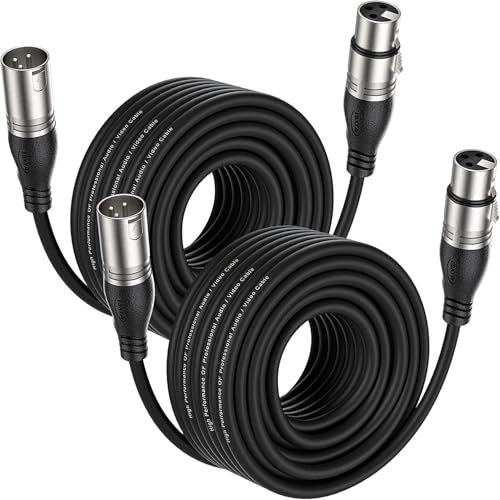
This set offers two 50-foot XLR cables, ideal for larger rooms, stages, or event setups where long runs are necessary. It emphasizes anti-noise performance with high-density braided shielding and oxygen-free copper conductors. The cable’s flexible PVC jacket extends durability in transport and deployment scenarios. The metal connectors include a locking design to secure connections and minimize accidental disconnections during performances.
Who it’s best for: live venues, churches, or larger studios where long, reliable connections are required. Why selected: long length and dual-pack provide coverage for spacious layouts and backup options.
Key considerations:
– Length: 50 ft enables extensive stage layouts and room measurements.
– Shielding: High-density braided shield supports strong anti-interference performance.
– Durability: Heavy-duty shell design and nickel-plated connectors increase longevity.
Caution: Heavy and longer cables can be harder to manage; pairing with cable wraps or reels is recommended to prevent tangling.
Buying Guide: How To Choose The Right Cheap XLR Cable
What length do you actually need?
Short cables (3–6 ft) are ideal for close-mup mic setups and compact desks. Medium lengths (10–15 ft) work well for most home studios and small stages. Longer runs (25–50 ft) are better for larger rooms or stages but come with increased risk of signal loss and tripping hazards. Choose the length that minimizes distance while avoiding excess slack.
What about cable construction and shielding?
Look for cables with copper conductors and inner shielding to reduce noise. Oxygen-free copper (OFC) or all-copper conductors generally provide better signal integrity. Dual shielding (foil plus braided shield) adds protection against EMI and RF interference, especially in venues with many electronic devices.
Are connectors important?
3-pin XLR connectors with nickel plating resist corrosion and ensure reliable mating. A robust metal housing and a locking or snug-fitting design help prevent accidental unplugging during use. For touring or frequent unplugging, prioritize stronger connectors and durable jackets.
Two-pack or multi-pack—does it matter?
Value packs save money and provide backups for busy setups, multiple devices, or color-coded organization. If you only need one cable, a single 6–10 ft model may be sufficient; if you routinely set up and break down gear, a 2-pack or 4-pack can reduce downtime.
What is the best option for beginners?
Budget-friendly cables with solid shielding and durable connectors are ideal. Start with a 6–10 ft length from a reputable brand to ensure straightforward compatibility with most consumer-grade audio gear.
What are common limitations of affordable XLR cables?
Lower-cost cables may show more cable wear over time or have slightly higher resistance in longer runs. They can also be less flexible or heavier than premium options. If you require top-tier noise rejection for critical recording, consider upgrading to higher-end cables with enhanced shielding and conductor quality.
Practical quick-start tips
- Label cables by length or color to avoid mixing them up on busy stages.
- Avoid tight bends and kinks to protect internal conductors.
- Store cables coiled loosely and use ties or reels to manage longer runs.
Short FAQ
- What is an XLR cable used for? – It carries balanced audio signals between microphones, mixers, and other professional audio gear.
- Do longer XLR cables affect sound quality? – Longer runs can introduce more resistance and potential interference if shielding is inadequate, but quality cables minimize this impact.
- Are expensive XLR cables always better? – Not always; for many home and small studio needs, affordable options with good shielding perform sufficiently well.
- What should I look for in a durable XLR cable? – Copper conductors, effective shielding, sturdy connectors, and a rugged jacket material.
- Can I use these cables for instruments? – XLR cables are typically designed for microphones; instrument cables use different connectors and wiring.
- Do I need two cables of the same length? – Having a primary and backup cable of the same length can simplify setups and reduce mismatch in stage layouts.
All selections above are designed to balance affordability with practical performance for American buyers seeking reliable, budget-friendly XLR cables. Each option focuses on clear signal transmission, acceptable durability, and compatibility with common audio gear in home studios, classrooms, and small venues.