Finding affordable speaker cables that deliver clear, undistorted sound can be straightforward with the right options. This guide focuses on budget-friendly, 16-gauge and 14-16 gauge cables suitable for home theater, car audio, and DIY projects. Each pick shown here emphasizes reliable conductivity, easy installation, and durable construction without breaking the bank. Below is a quick summary of five strong, low-cost choices to consider for your next audio setup.
| Product | Brand | Length | Gauge | Key Benefit |
|---|---|---|---|---|
| Amazon Basics Speaker Cable, 100 ft | Amazon Basics | 100 ft | 16 | Clear audio, easy assembly |
| Amazon Basics 16-Gauge, 50 ft | Amazon Basics | 50 ft | 16 | Transparent jacket, undistorted signals |
| Kinter Cable 100 ft 16-Gauge | Kinter | 100 ft | 16 | Flexible, red polarity strip |
| Install Link 30 ft 16-Gauge | Install Link | 30 ft | 16 | Copper-clad aluminum, good flexibility |
| Install Gear 100 ft 16-Gauge | InstallGear | 100 ft | 16 | Soft touch, marine-grade durability |
Note: All selections emphasize value without compromising essential audio performance. The following sections detail five carefully chosen options with direct Amazon purchase links and imagery to help you compare at a glance.
Amazon Basics Speaker Cable, 100 Ft — 16-Gauge

Amazon Basics presents a straightforward 100-foot roll of 16-gauge speaker wire. The plastic jacket helps preserve high-quality, undistorted signals between audio components and speakers. This option is convenient for connecting speakers to A/V receivers or amplifiers, making it ideal for budget-friendly home theater setups. The length reduces the need for multiple splices or purchases for larger rooms. The design accommodates general-use environments, and the wire is easy to handle during installations.
Amazon Basics 16-Gauge Speaker Wire Cable, 50 Feet

This 50-foot, 16-gauge speaker wire from Amazon Basics offers a transparent jacket for clear signal transmission. It’s designed to connect speakers to receivers or amplifiers with minimal distortion. Suitable for smaller rooms or shorter runs, it provides dependable performance for everyday home audio without paying a premium for features you may not need. It’s a practical choice for dorm rooms, apartments, or budget-conscious setups where simplicity matters.
Kinter Cable 100ft 16-Gauge Speaker Wire
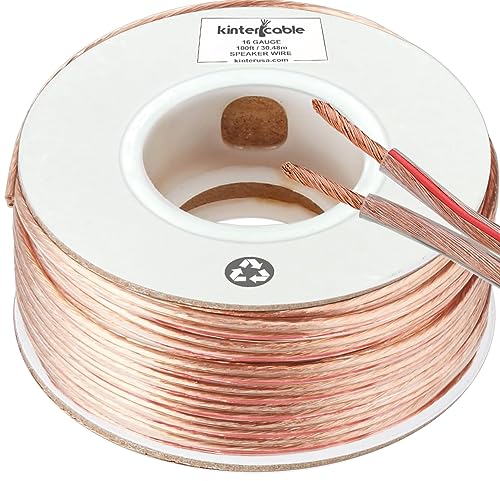
Kinter’s 100-foot 16-gauge speaker wire features a soft, flexible PVC jacket with a red polarity stripe for easy installation. It uses 74 high-strand-count copper-clad aluminum (CCA) conductors, which keeps costs down while delivering adequate conductance for home theater or HiFi use. The long length makes it a good value for larger rooms or settings where you need a single run from receiver to multiple speakers. The polarity marking helps prevent wiring errors during setup.
Install Link 30 Ft 16-Gauge Speaker Wire

Install Link offers a 30-foot, 16-gauge speaker wire with a frosted red/black double conductor. Built with copper-clad aluminum (CCA), this cable balances cost and performance for home theater, car audio, or professional studios. Its flexibility and easy stripping support quick installations, while the color-coded conductors aid correct polarity identification. It’s well-suited for shorter runs in multiple-room setups or vehicle audio projects where budget limits are a consideration.
Install Gear 100 Ft 16-Gauge Speaker Cable

InstallGear’s 100-foot 16-gauge speaker cable emphasizes true spec performance with a soft-touch wire and color-coded red/black insulation for easy polarity recognition. This option is designed for car stereos, home theaters, and surround sound systems, combining flexibility with durability to withstand regular installations. The true-spec construction aims to minimize resistance and maintain signal integrity across typical consumer audio setups, making it a practical pick for budget-conscious buyers who still demand reliable audio transmission.
Buying Guide: Key Considerations For Budget Speaker Cables
Purpose and environment matter: For general home use, 16-gauge cables are standard and typically adequate for most rooms under 100 feet. If you’re wiring a car or boat, select cables with higher flexibility and robust jackets to withstand vibration and moisture.
Conductor material and construction: Copper-clad aluminum (CCA) provides cost savings but may have higher resistance than pure copper. For longer runs or high-fidelity needs, copper conductors or thicker gauges can help preserve signal quality.
Jacket and durability: A durable plastic jacket protects against moisture, abrasion, and handling. Transparent jackets can help verify connections, while color coding (red/black) reduces polarity errors during installation.
Length versus signal loss: Longer runs increase resistance. If you need extended runs, consider a thicker gauge (14 or copper options) or plan for a single run with minimal splices to maintain audio clarity.
Installation ease: Flexible jackets and stranded designs simplify routing around corners, under carpets, or through walls. Look for easier stripping features and clearly marked polarity to minimize errors.
Application versatility: For home theaters, car audio, or multi-room setups, ensure the chosen cable supports the required impedance and is compatible with your speakers and receiver specifications.
Overall value: The best budget option balances length, gauge, conductors, jacket quality, and ease of installation. Prioritize cables that maximize reliability and quiet operation within your price range.