Answering the need for affordable, portable charging on outdoor adventures, these cheap solar chargers offer practical power for travelers, campers, and everyday tech users. This guide highlights five budget-friendly options, who they suit best, and why each is a solid pick. The top picks are ideal for hikers, families, and emergency preparedness kits. A quick summary table helps you compare key traits at a glance.
| Product | Brand | Capacity | Best For |
|---|---|---|---|
| Solar Charger, 38800mAh Power Bank | Kepswin | 38800mAh | Outdoor adventures with USB sharing |
| BLAVOR Solar Power Bank 10,000mAh | BLAVOR | 10000mAh | Compact, everyday use with fast USB-C |
| Solar Power Bank 20000mAh With Cables | Luvknit | 20000mAh | Group charging on trips |
| Durecopow Solar Charger 20,000mAh | Durecopow | 20000mAh | All-in-one with multiple cables |
| SOARAISE 48000mAh Solar Charger | SOARAISE | 48000mAh | Long expeditions with multiple ports |
Kepswin 38800mAh Solar Charger Power Bank

Features: Ultra-light 38800mAh battery supports iPhone, iPad, Android, and most USB devices. Includes a compass and two LED flashlights for emergencies. Dual USB outputs allow sharing with partners. Indicators show solar charging (green) and USB charging (blue). Best for solo hikers or small groups who need a reliable power bank with built-in lights. Caution: Solar charging is slower; USB charging is recommended for daily use. The device should be fully charged with an adapter before outdoor trips.
Best for: Outdoor enthusiasts who want a rugged, feature-rich charger with lighting and navigation aids. Choose this if you value an all-in-one outdoor toolkit in a single unit.
BLAVOR Solar Power Bank 10,000mAh

Features: Over 10 years of brand experience, high-grade materials, and safety focus. USB-C input/output with 20W fast charging supports multiple devices simultaneously. Compact, lightweight, and capable of charging iPhone, iPad, Samsung, and more with 2–3 device compatibility. Best for travelers who want a lightweight option with modern USB-C fast charging. Caution: Real-world solar charging may be slow; rely on USB-C charging for regular use.
Best for: Tech-savvy travelers who value fast USB-C charging in a compact form. Great for short trips or as a compact daily driver.
Luvknit Solar Power Bank 20000mAh

Features: 20000mAh capacity with six-device charging capability via multi-port design. Includes built-in cables and 15W fast charging for quick top-ups. Suitable for group trips where multiple devices need power simultaneously. Best for families or teams on extended trips. Limitation: Solar charging is supplemental; full charges should come from wall adapter to optimize performance.
Best for: Small groups or families needing a single bank that can power several devices at once. Choose this for convenience during camping or long hikes.
Durecopow Solar Charger Power Bank 20,000mAh

Features: 3 ports plus 4 built-in cables (Type-C, Lightning, Micro USB) enable charging up to six devices simultaneously. Drop-proof and water-resistant with silicone covers on ports. Includes dual flashlight LEDs with SOS modes. Best for campers who want built-in cables for quick setup. Limitation: Solar charging speed depends on sunlight; USB input/output performance will vary with conditions.
Best for: Outdoorists who value an all-in-one charger with a ready-to-use cable set and rugged housing. Avoid this if weight is a critical concern, as it can be heavier than basic models.
SOLPERK Solar Panel Kit 20W
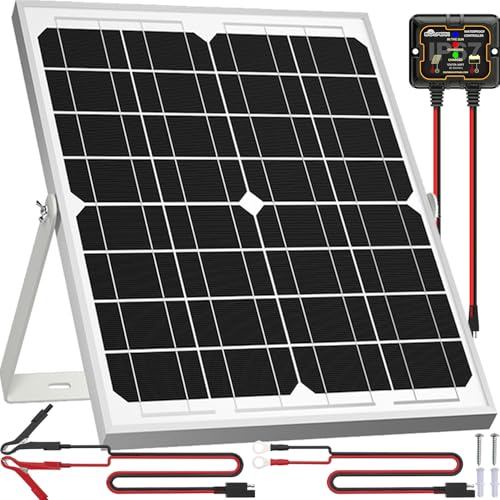
Features: 20W monocrystalline panel with 21%-30% efficiency, designed for charging 12V batteries in various setups. Built to last with low-iron tempered glass and corrosion-resistant framing. Includes a smart MPPT-style controller for efficient charging and clear status indicators. Best for boats, RVs, cars, and outdoor installations where a dedicated solar panel is needed. Caution: This is a panel, not a portable power bank; requires a battery system to store power.
Best for: Users seeking a reliable solar panel to maintain or charge a 12V battery system during travel or storage. Choose this if you want a durable outdoor panel rather than a handheld charger.
YESSZ USB Solar Panel Charger 5W

Features: 5W USB solar panel powered by monocrystalline cells, designed for cameras, phones, and small USB devices. Durable and weather-resistant for outdoor use. Best for quick, low-power top-ups during hikes or travel. Limitation: Low wattage means slow charging for larger devices; ideal for small accessories or emergency use only.
Best for: Light travel where only small devices need occasional top-ups. Avoid this if you require fast charging for multiple devices from solar alone.
SOARAISE Solar Charger Power Bank 48000mAh
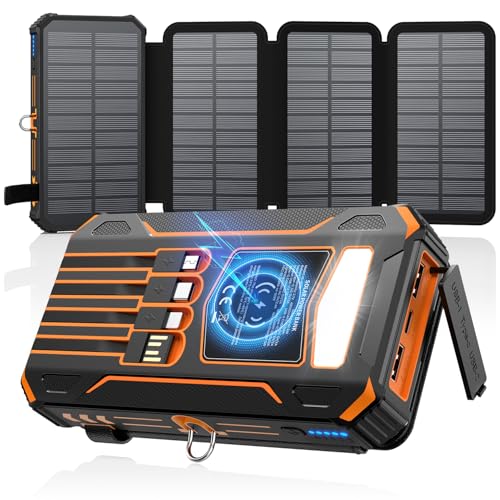
Features: Very high-capacity 48000mAh with built-in four cables, 4 solar panels, and wireless charging. Supports PD QC 3.0 fast charging via USB-C. Can power several devices at once and includes a flashlight. Best for long trips where power needs are high and solar charging support is beneficial. Limitation: Heavier and bulkier; best used as a stationary power source on long expeditions rather than pocketable everyday carry.
Best for: Extended outdoor adventures where multiple devices require sustained charging and you want flexibility with cables, wireless charging, and solar support. Avoid if you need a compact, lightweight option.
Buying Guide: Key Considerations For Selecting A Cheap Solar Charger
- Power needs: Match capacity (mAh) and outputs to your devices. Higher capacity suits multi-device use; lower capacity suits daily carry.
- Charging method: USB charging is fastest for daily use; solar charging is best for emergencies or off-grid scenarios.
- Port variety: Look for USB-A, USB-C, and built-in cables for convenience. Wireless charging adds flexibility.
- Durability: For outdoor use, check water resistance, drop protection, and panel durability.
- Weight and size: Heavier packs offer more capacity and features; lighter packs are easier to carry on trails.
- Solar efficiency: Panels with higher efficiency converge power faster in sunlight; consider your typical sunlight exposure.
- Safety and certifications: Verify protection against short circuits, overcharging, and environmental exposure.
Frequently Asked Questions
- Q: Can I rely on solar charging for daily device use? A: Solar charging is often slower than USB charging and is best used as a backup or emergency option.
- Q: What’s the best capacity for hiking trips? A: A higher capacity (20,000–48,000mAh) is ideal for multiple devices and longer trips.
- Q: Are built-in cables worth it? A: Built-in cables simplify packing and reduce the need for extra cords, but add weight.
- Q: Is waterproofing essential for solar chargers? A: For outdoor use in rain or near water, water resistance is valuable; otherwise, basic models may suffice.
- Q: Do solar panels require sunlight to work? A: Yes, solar panels convert sunlight to electricity; performance depends on sun exposure and panel efficiency.
- Q: Should I buy a panel kit or a power bank? A: If you need portable charging, a power bank is convenient; for stationary setups, a panel kit with a battery can be more flexible.