Answering your search for a cheap quadcopter flight controller, this guide highlights affordable yet capable options for FPV racing, freestyle, and fixed-wing setups. Each selected model is best for a specific use case—whether you’re building a compact whoop, a mid-size freestyle rig, or a fixed-wing platform. The product summaries below include clear buyer guidance and a concise buying table to compare core capabilities at a glance.
| Product | Brand | Best For |
|---|---|---|
| HGLRC F405 8S V1 FC | HGLRC | High-performance freestyle and racing quads needing strong data logging |
| SoloGood F722 Flight Controller | SoloGood | 8-motor setups and integrated power with dual BEC for versatile builds |
| BETAFPV Matrix 1S G4 4IN1 | BETAFPV | 1S micro quads with built-in OSD and external VTX options |
| BETAFPV F4 2-3S | BETAFPV | HD digital FPV and lightweight 2-3S quads |
| HGLRC SPECTER F722 Lite FC | HGLRC | ULtra-light, ELRS-enabled FPV drones for speed and agility |
HGLRC F405 8S V1 FC Flight Controller
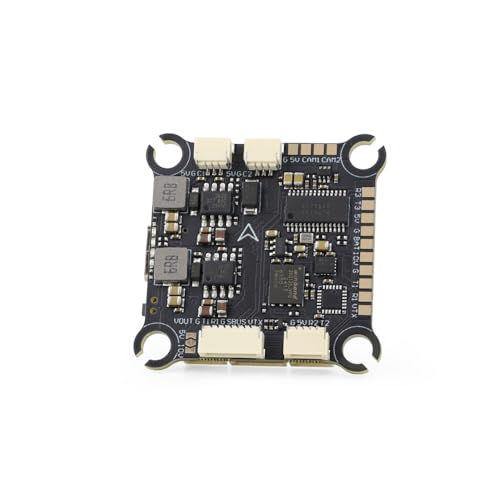
The F405 V1 uses a high-performance ICM42688P gyroscope, offering enhanced stability for demanding FPV flybys. It includes pads for an MPU6000 gyroscope, enabling flexible retrofits. The design is fully modular with a direct-connect layout for plug-and-play operation, reducing wiring complexity. A large 16MB black box provides flight data recording for post-flight analysis. This controller is best for builders seeking strong stabilization and easy integration into mid- to high-end freestyle setups. Caution: read wiring guides carefully when using the MPU6000 pads for compatibility.
Who it’s best for:
- Freestyle pilots needing robust gyro performance and reliable data logging
- Builders prioritizing modular, plug-and-play installation
Why selected:
- Excellent stability from ICM42688P
- Modular design minimizes soldering and simplifies upgrades
- Large black box for comprehensive flight data
SoloGood F722 Flight Controller

The SoloGood F722 FC supports up to eight motor outputs, making it suitable for larger X8 configurations or more complex builds. It integrates 5V and 10V BECs, with the 10V supply able to power a VTX, which helps maintain stable operation and reduces extra wiring. Four LED indicators show status across states, and the board includes an F722 main control chip, onboard OSD, barometer, and a black box option. This is a strong pick for pilots who want a feature-rich 4-in-1 stack without needing external power management. Caution: ensure your VTX and camera wiring align with the 10V BEC if used.
Who it’s best for:
- Mid- to large-size freestyle or racing drones needing integrated power management
- Users seeking accessible debugging with LED status indicators
Why selected:
- High motor output capacity simplifies building bigger quads
- Dual BECs allow independent VTX power
- Embedded components aid quick setup and troubleshooting
BETAFPV Matrix 1S G4 4IN1 Brushless Flight Controller

The Matrix 1S G4 is designed for 1S whoop-like performance with built-in OSD and solder pads for an external VTX. It features a STM32G473 MCU delivering faster processing and smooth flight dynamics, along with a 12A continuous / 18A peak ESC, which supports reliable thrust for small quads. Dual serial ports accommodate external devices such as GPS, HD VTX, or serial receivers. This makes it a flexible choice for pilots testing higher-definition image transmission on compact frames. Caution: 1S performance is frame-dependent; ensure your frame and motors match the power profile.
Who it’s best for:
- Whoops or micro quads needing built-in OSD and external VTX options
- Pilots seeking a compact, versatile 4IN1 with solid processing power
Why selected:
- Integrated OSD plus external VTX options for flexible video setups
- Faster MCU enables more responsive control
- Solid ESC capacity supports stable micro-quads
BETAFPV F4 2-3S Brushless Flight Controller

This F4 2-3S controller provides a dual 9V@2A BEC for DJI O3 and 5V@3A for external devices, with an easy installation via a new DJI O3 6-pin PMU. It improves control with a 20A ESC featuring a single NMOS for continuous current capability. It is ideal for smaller, lighter builds that rely on reliable power delivery to maintain stable flight on 2-3S packs. Caution: check compatibility with your specific VTX and camera wiring to prevent overloading the PMU.
Who it’s best for:
- Lightweight 2-3S quads needing compact, integrated power management
- Pilots integrating DJI O3 or similar external transceivers
Why selected:
- Compact yet powerful power distribution for small frames
- DJI O3 PMU simplifies installation and wiring
- Higher current ESC supports better agility on light quads
HGLRC SPECTER F722 Lite FC

The SPECTER F722 Lite integrates an ELRS 2.4G receiver and emphasizes ultra-light, compact design. It boasts fast millisecond-level responsiveness and supports high-frequency PID refresh for aggressive freestyle and speed. Its wide voltage range (8.4V-25.2V) supports a variety of frame sizes, from tiny whoops to longer-range builds. It eliminates external BEC modules by design, simplifying wiring for many setups. Caution: ensure your ELRS version and receiver compatibility align with this board’s configuration.
Who it’s best for:
- Pilots prioritizing low weight and quick response for freestyle
- Builds using high-rate flight control with ELRS integration
Why selected:
- Onboard ELRS for reliable long-range control
- Ultra-light design reduces overall weight
- Wide power range enhances compatibility across frame sizes
Buying Guide: Key Purchase Considerations
- Power needs: Match the FC’s current rating and BEC provisions to your motor setup and power distribution requirements.
- Frame compatibility: Check form factor (F4 vs F7, 20×20/30.5×30.5mm, wings) and voltage support (2S–6S; 8.4V–25.2V range).
- Onboard features: Consider built-in OSD, black box, barometer, ELRS/RX options, and GPS if your project demands post-flight data and remote control features.
- Ease of wiring: Modular and plug-and-play designs reduce assembly time; watch for integrated BECs to simplify the power tree.
- Software compatibility: Ensure the FC supports your preferred flight stack (Betaflight, INAV, ArduPilot) and the required firmware version.
- Support and updates: Availability of documentation, community support, and firmware updates influence long-term usability.
- Size and weight: Lighter boards improve performance on micro and 1S quads, while larger boards suit bigger builds with more sensors.
Frequently Asked Questions
- Q: Do these flight controllers support multiple firmware options? A: Yes, several boards list INAV, ArduPilot, and Betaflight compatibility depending on model and MCU family.
- Q: Are built-in BECs sufficient for VTX power? A: Many 4-in-1 boards include BECs; verify voltage and current to avoid overloading devices like the VTX or camera.
- Q: Is ELRS compatibility a major factor? A: For long-range or low-latency control, selecting a board with onboard ELRS support can simplify installation.
- Q: Can I upgrade to 6S on these boards? A: Power range varies; always confirm the board’s supported voltage to ensure safe operation.
- Q: Which board is best for a small micro quad? A: For light frames, Matrix 1S and SPECTER F722 Lite offer compact footprints with essential features.
- Q: Do these flight controllers include data logging? A: Some models feature onboard black box (flight data memory) for post-flight analysis; verify capacity per model.