Investing in a reliable MPPT (Maximum Power Point Tracking) charge controller is essential for getting the most energy from your solar panels. This guide highlights affordable MPPT options that balance performance and value, suitable for residential, RV, marine, and small commercial setups. Each product below uses modern MPPT technology to optimize charging, protect batteries, and extend system life.
Summary of selected products:
| Product | Brand | Voltage Range | Key Benefit |
|---|---|---|---|
| 60A MPPT Solar Charge Controller | Depvko | 12V/24V | High tracking efficiency up to 99% with LCD display |
| Victron Energy SmartSolar MPPT 15A | Victron Energy | 12V/24V | Bluetooth monitoring, synchronized charging |
| Upgraded 100A MPPT Solar Charge Controller | ELUSH | 12V/24V/36V/48V | Ultra-high efficiency, time-control modes |
| [Upgraded] 30A MPPT Solar Charge Controller | Depvko | 12V/24V | Adaptive LCD, dual USB, auto parameter memory |
| Voltset MPPT Solar Charge Controller | Voltset | 12V | IP65 waterproof, 130W panel compatibility |
60A MPPT Solar Charge Controller (Depvko)

The Depvko 60A MPPT solar charge controller is designed for 12V and 24V systems with automatic recognition of battery type. It uses upgraded MPPT technology with high tracking efficiency up to 99%, enabling efficient battery charging even in less-than-ideal sunlight. The LCD display communicates status and data, and the device supports easy mode switching and parameter configuration. It includes protections to prevent over-discharge for lithium batteries and is suitable for homes, small businesses, and industrial installations.
Victron Energy SmartSolar MPPT 15A (Bluetooth)

Victron Energy’s SmartSolar 15A MPPT charge controller is crafted to maximize energy capture while preserving battery longevity. It features fast optimum power point tracking and smart charge algorithms for efficient performance in various light conditions. Bluetooth connectivity enables convenient monitoring and setup via mobile devices. Multiple controllers can synchronize to operate as a single system, enhancing long-term efficiency for larger arrays or scalable installations.
Upgraded 100A MPPT Solar Charge Controller (ELUSH)

This high-capacity ELUSH controller handles 12V/24V/36V/48V systems and up to 100A input with an LCD display and dual USB charging ports. It delivers MPPT tracking efficiency no less than 99.5%, enabling rapid charging across diverse environments. A seven-mode interface supports a range of operations including timer and remote control modes, while comprehensive protections guard against over-voltage, over-current, short circuits, and overheating, helping protect both solar panels and batteries over time.
[Upgraded] 30A MPPT Solar Charge Controller
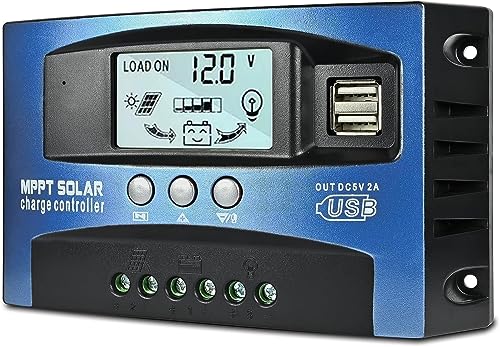
Depvko’s 30A MPPT controller offers solid compatibility with 12V and 24V systems, along with a built-in LCD and dual USB outputs (5V/2.5A max). It promises up to 10–30% efficiency gains over PWM systems and memorizes parameters to avoid resets after battery depletion. Overcurrent, short-circuit, reverse polarity, low voltage, and overcharge protections contribute to safe, reliable operation in home and small workshop applications.
Voltset IP65 MPPT Solar Charge Controller

Voltset presents a rugged IP65 waterproof MPPT controller designed for 12V systems and compatible with gel, AGM, LiFePO4, and other battery types. It supports up to 130W solar panels and is well-suited for outdoor installations on RVs, boats, campers, trailers, and remote sheds. The waterproof construction makes it a reliable choice for harsh environments where weather exposure is unavoidable.
Buying Guide: Key Factors for Choosing an Affordable MPPT Controller
- System voltage and battery chemistry: Ensure the controller supports your battery type (lead-acid, AGM, GEL, or LiFePO4) and your system voltage (12V, 24V, or higher).
- Current rating and scalability: Match the controller’s maximum current to your solar array’s output. If you expect future expansion, consider models with higher ratings or modular designs.
- MPPT efficiency: Look for a tracking efficiency of 99% or higher for maximum energy capture, especially under partial shading or varying temperatures.
- Display and controls: An LCD display helps monitor voltage, current, and charge state. Some models include clock-based timing or remote control features for automation.
- Protection features: Ensure protections for overcharge, over-discharge, short circuits, reverse polarity, overheating, and reverse current. These extend battery life and system reliability.
- Monitoring options: Bluetooth or app-based monitoring can simplify setup and ongoing monitoring, particularly for larger or remote installations.
- Durability and environment: For outdoor use, IP ratings (such as IP65) and robust enclosures are important to withstand rain, dust, and temperature fluctuations.
- USB charging ports: Some models incorporate USB outputs to directly power small devices, which can be a practical feature in off-grid setups.
- Brand support and warranty: Reputable brands with good customer support and clear warranty terms reduce risk in long-term use.
Comparison Considerations
- Price vs. performance: Higher current controllers offer more power handling but at a higher upfront cost. Balance budget with expected solar output and future needs.
- System integration: For larger solar arrays, consider controllers that can synchronize with other units to operate as one system for improved efficiency and battery longevity.
- Ease of use: Some units emphasize plug-and-play setup and automatic recognition of 12V/24V systems, which can reduce installation time and errors.
- Physical durability: Outdoor and marine environments benefit from waterproof or sealed enclosures and rugged build quality.
In summary, affordable MPPT charge controllers from brands like Depvko, Victron Energy, ELUSH, and Voltset provide a range of features to optimize solar performance without breaking the bank. When selecting a model, align the product specs with your battery chemistry, system voltage, and future expansion plans to maximize long-term value.