Looking for budget-friendly MFT lenses that deliver good image quality without breaking the bank? This guide highlights five affordable options suitable for everyday photography, travel, and beginner setups. Each pick avoids overpriced glass while offering solid performance for a Micro Four Thirds mirrorless system. The selections favor compact designs, bright apertures, or versatile focal lengths that pair well with Panasonic, Olympus, and other MFT bodies. Read on to find which lens fits your style and camera, plus practical buying tips.
| Product | Brand | Mount | Best For |
|---|---|---|---|
| Panasonic LUMIX G 25mm F1.7 | Panasonic | Micro Four Thirds | Street and portrait photography with smooth bokeh |
| TTArtisan 25mm F2 | TTARTISAN | MFT M4/3 | Low-light learning and creative close-ups |
| Meike 25mm F1.8 | Meike | Panasonic/Olympus M43 | Budget portrait and general use |
| YONGNUO YN17mm F1.7 | YONGNUO | M43 | Compact prime with bright aperture |
| TTArtisan 25mm F2 (APS-C) | TTARTISAN | APS-C (MFT via adapter) | Natural perspective for landscapes and travel |
Panasonic LUMIX G 25mm F1.7 ASPH

The Panasonic LUMIX G 25mm F1.7 is a compact, lightweight prime with a natural 50mm equivalent field of view. It provides excellent low-light performance thanks to a bright F1.7 aperture and a modest 125g body, making it ideal for street photography, travel, and everyday shooting. The 8-element in 7-group design, including aspheric and UHR elements, helps produce sharp images with pleasing background separation. Best for budget-conscious shooters who want a versatile standard prime.
Who it’s best for: beginners and enthusiasts seeking a small, fast prime for general use and portrait work without a large investment. Caution: some users may want faster autofocus in action scenes, as AF speed varies with camera body.
TTArtisan 25mm F2 Wide-Angle APS-C

The TTArtisan 25mm F2 is a bright APS-C prime that reaches a natural perspective on MFT cameras when used with adapters, offering a flexible focal length for landscapes, portraits, and travel. The large F2 maximum aperture supports low-light shooting and creamy bokeh, with a close focusing distance around 0.25 meters for detailed close-ups. Best for creative enthusiasts who want a budget option with strong close-up capability.
Best for: users who want a compact, affordable lens with a strong small-objects close-up potential. Caution: APS-C design requires an adapter or specific camera compatibility for best results on MFT bodies.
Meike 25mm F1.8
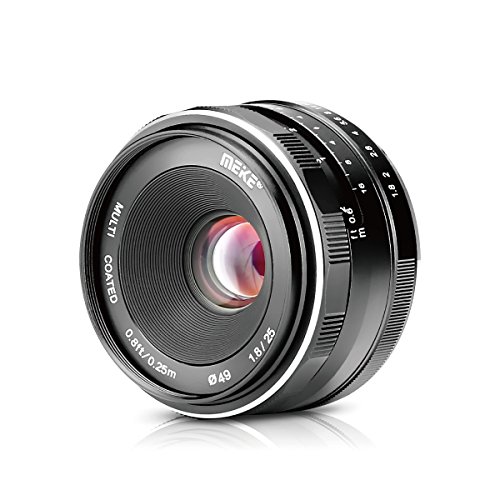
The Meike 25mm F1.8 is a manual focus prime designed for Panasonic and Olympus M43 bodies. With a wide maximum aperture of F1.8, it delivers smooth bokeh suitable for portraits and creative low-light shooting. The lens uses a 7-element in 5-group design with multi-layer coatings to help with contrast and flare control. Best for photographers who don’t mind manual focusing for a smaller price tag.
Best for: budget-conscious shooters who value a bright, compact prime and are comfortable with manual focus. Caution: manual focus can be tricky in fast-action scenarios or when AF is preferred.
YONGNUO YN17mm F1.7

The YONGNUO YN17mm F1.7 offers a compact, lightweight option with a bright F1.7 aperture for MFT cameras. It combines autofocusing and manual focus modes and uses a multi-element, nano-coated optical design to help reduce reflections. This lens is a strong choice for street, travel, and general photography on a tight budget.
Best for: shooters who want a small, bright prime that’s easy to carry and use across various MFT bodies. Caution: build quality and autofocus performance can vary between copies; test if possible before heavy use.
TTArtisan 25mm F2 APS-C Manual Focus

The TTArtisan 25mm F2 for APS-C offers a natural field of view similar to 37.5mm full-frame, providing a versatile option for portraits, landscapes, travel, and food photography. The f/2 aperture enables better depth control in low light and produces smooth bokeh with a 7-blade diaphragm. It is a manual focus option for those who want precise control and cost efficiency on APS-C systems.
Best for: photographers who want an affordable APS-C prime with reliable manual focus for creative control. Caution: requires APS-C sensor alignment with a compatible camera, and may not be ideal for fast-action shooting.
Buying Guide
Key considerations when choosing a cheap MFT lens include compatibility, brightness, focal length, and handling.
- Compatibility: Confirm your camera’s mount compatibility (Micro Four Thirds, and whether an adapter is needed for APS-C TTArtisan lenses).
- Brightness: Aperture values between F1.7 and F2 offer better low-light performance and blur control; larger apertures come at a lower depth of field and weight trade-off.
- Focal length: Standard primes around 25mm on MFT provide a 50mm equivalent look, which is versatile for everyday photography and portraits; consider other focal lengths for landscapes or tight indoor spaces.
- Autofocus vs. manual focus: Budget primes often favor manual focus or slower AF; decide based on shooting style and subject movement.
- Build and weight: Lighter lenses improve balance with compact bodies; check diameter, length, and coatings to minimize flare and reflections.
- Close-focusing distance: Short distances enable attractive close-ups, especially for product, food, or macro-ish work; verify minimum focus distance if this is important.
- Image quality trade-offs: Budget lenses may show softer corners, chromatic aberration, or vignetting; weigh these against price and purpose.
Frequently Asked Questions
- What does the F-number tell me about a lens?
Answer: The F-number (aperture) indicates light entering the lens and depth of field. Lower numbers (like F1.7) are brighter and create blurrier backgrounds. - Are manual focus lenses compatible with all MFT cameras?
Answer: Most are compatible with MFT bodies, but some require camera settings adjustments or adapters for full functionality. - Is a 25mm lens too long for street photography on MFT?
Answer: A 25mm lens on MFT gives about a 50mm equivalent field of view, which is a versatile focal length for street and candid photography. - Should I buy an APS-C lens for MFT cameras?
Answer: APS-C lenses can be used with certain adapters on MFT cameras, but results vary. Stability, vignetting, and field of view should be considered. - What is the benefit of a compact lens?
Answer: Compact designs improve portability, balance on smaller bodies, and overall handling for travel and daily use. - Do budget lenses affect image quality significantly?
Answer: They can show more artifacts or softer edges compared with high-end glass, but careful shooting and post-processing can keep results satisfactory for many applications.