Looking for affordable ways to get that classic Leslie-inspired rotary sound without breaking the bank? This guide highlights five cost-effective pedal options that deliver authentic dub, swirl, and vibe tones. Each pick is explained with who it’s best for, potential limitations, and why it stands out for budget-conscious players. Whether you want a full Uni-Vibe vibe, a vintage-style rotary emulation, or a versatile chorus/vibrato/phaser, these pedals offer solid value for beginners and seasoned players alike.
| Product | Brand | Best For | Why It Stands Out |
|---|---|---|---|
| Leslie Digital Pedal | HAMMOND | Players chasing authentic Leslie models on a budget | Multiple vintage simulations with virtual mic placement and true bypass |
| JHS Unicorn V2 | JHS Pedals | Analog Uni-Vibe with modern control | Tap tempo and dry/wet options for flexible modulation |
| Ripply Fall RetroVibe | Jam | Chorus, Vibrato, and Phaser combo | Two-stage phaser with lush, classic modulation |
| Tranquilizer | J. Rockett | Classic phase 45 and Univibe flavors | External biasing to morph tones across styles |
| RetroVibe MK4 | Jam | Authentic Uni-Vibe voice with versatile modes | All-analog design with dedicated tempo control |
Leslie Digital Pedal by Hammond

The Leslie Digital Pedal emulates multiple classic slow-rotor and fast-rotor sounds via presets modeled after 122A, 147A, 18/V, and PR40. It includes rotary controls to adjust virtual mic placement, letting players tailor the perception of space and depth. Three foot switches provide true bypass, speed, and brake control for real-time performance tweaks. Best for: players who want realistic Leslie-style motion without a dedicated Leslie cabinet or organ setup. Limitation: digital simulations may feel less dynamic than true mechanical rotaries with multiple moving parts.
JHS Unicorn V2 Analog Univibe
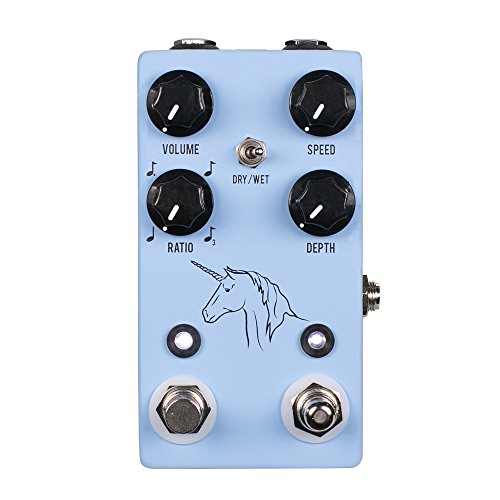
The JHS Unicorn V2 uses an all-analog Uni-Vibe circuit with a Tap Tempo feature for synchronized modulation. It offers a dry/wet toggle to blend the effect with your dry signal or switch to Vibrato for a broader modulation palette. Best for: players who want a classic Uni-Vibe texture with modern tempo synchronization. Limitation: analog circuits can be sensitive to equipment noise and temperature changes, which may affect stability in certain setups.
Ripply Fall RetroVibe by Jam

Ripply Fall combines Chorus, Vibrato, and Phaser in one compact unit with a smooth, lush chorus and a sweet two-stage phaser. Best for: players seeking a versatile modulation toolbox with a warm, vintage character. Limitation: some users may require EQ tweaks to sit well in a mix depending on guitar or amp tone.
J. Rockett Tranquilizer

The Tranquilizer recreates classic phase 45 and Univibe tones with an external biasing Focus control to morph tones in new directions. Best for: players who want classic phase and Univibe colors with sound-mculpting flexibility. Limitation: it may require careful setup to dial in optimal bias settings for different guitars and amps.
RetroVibe MK4 Uni-Vibe by Jam

The RetroVibe MK4 delivers the legendary Uni-Vibe voice using all-analog circuitry, offering Chorus and Vibrato modes plus a dedicated Tap Tempo. This pedal emphasizes authentic vintage vibes while maintaining modern control for live performance. Best for: players who want a faithful Uni-Vibe vibe with reliable tempo-synced modulation. Limitation: all-analog designs can be more sensitive to power and temperature changes in variable environments.
Buying Guide
What should you consider when buying a budget Leslie-inspired pedal? Start with your primary use case and tone goal. If you want the quintessential rotary motion and mic-position feel, the Leslie Digital Pedal or RetroVibe MK4 may better mimic speaker cabinet movement. For classic Uni-Vibe textures, consider the JHS Unicorn V2 or the RetroVibe MK4, which provide pronounced swirl and vocal-like modulation. If you want a broader modulation palette, Jam’s Ripply Fall and Tranquilizer deliver multiple modes in one unit.
Key questions to guide your choice:
- Do you need analog warmth or is digital authenticity acceptable for your rig?
- Is Tap Tempo important for syncing modulation to your song tempo?
- How important is dry/wet blending for your live or studio setup?
- What is your power situation and pedalboard footprint?
- Do you require external controls like bias or focus to morph tones?
Practical considerations for budget-friendly purchases:
- Power compatibility and stability matter more in affordable pedals; check power supply requirements and noise floor.
- Analog versions might give richer textures but can be less consistent across environments.
- Digital simulations can offer a wide range of models at a lower cost but may lack some depth in dynamic response.
Frequently Asked Questions
- What is a Uni-Vibe and how does it relate to a Leslie sound?
Uni-Vibe is a modulation effect that simulates slow rotating speaker movement; it shares a lush, swirling character with Leslie tones but uses a different circuit approach.
- Are these pedals suitable for bass or only guitar?
Most are designed for guitar, but some players adapt them to bass with appropriate input levels and EQ adjustments.
- Can I use these pedals with a digital amp or modeling processor?
Yes, these pedals can sit in front of an amp, in an effects loop, or with a DI setup depending on the pedal’s output options.
- Do these pedals require a high-widelity power supply?
Power quality matters; use a stable supply recommended by the manufacturer to avoid hum and noise.
- Which pedal offers the most authentic rotary sound on a budget?
For classic rotary motion, the Leslie Digital Pedal and RetroVibe MK4 are strong contenders within budget-friendly options.