Yes—high-quality active monitors can be affordable. This guide highlights five budget-friendly options that deliver honest, distortion-free sound for home studios, gaming desks, and multimedia setups. The top picks cater to different needs: compact desktop listening, near-field music production, portable travel use, and compact bookshelf setups. Below, you’ll find a quick product comparison and detailed sections to help you choose the right model for your space and workflow.
| Product | Best For | Key Benefit |
|---|---|---|
| PreSonus Eris 3.5 | Small desks, near-field listening | Compact 3.5” woofer with 50W amplification |
| Ortizan C7 | Multi-device setups, Bluetooth | Multiple inputs and wireless option for flexibility |
| DAMRAPT Portable Monitor | On-the-go productivity | 10-point touch with height-adjustable stand |
| Sanyun SW208 | Budget hi-fi vibes | Carbon fiber woofer with 24-bit DAC |
| Edifier MR3 | Compact desktop with Bluetooth | Hi-Res certified, balanced connections |
PreSonus Eris 3.5 Powered Studio Monitors, Pair

The PreSonus Eris 3.5 pair delivers true studio sound in a compact form. Best for small desks, bedroom studios, and casual music creation where space is at a premium. The 50-watt built-in amplification provides clean, distortion-free output with enough headroom for daily mixing tasks. The combination of a 3.5” woven-composite woofer and a 1” silk-dome tweeter yields tighter bass and balanced highs from 80 Hz to 20 kHz. This model is a solid choice for beginners and budget-conscious creators who still want accurate monitoring.
Who it’s best for: Home studio newcomers, gamers on a compact desk, and students needing reliable reference sound without breaking the bank.
Why selected: It offers trusted studio quality in a small package with sufficient power for close-range listening and everyday media tasks.
Caution: As a small-format monitor, it may not fill a large room with bass; consider placement for optimal acoustics or pair with a subwoofer if deeper lows are needed.
Ortizan C7 Dual-Mode 2.0 Studio Monitors

The Ortizan C7 is designed for flexible, multi-input setups with Bluetooth 5.3 and wired connections. It’s well-suited for near-field listening and multimedia work on a desktop or small studio. The 3.5” carbon fiber woofer and 0.75” silk-dome tweeter combination aims for clear mids and smooth highs, with a built-in DAC that enables direct USB audio. The dual-input design allows easy switching between devices, which is helpful in a multi-device workspace.
Who it’s best for: Creators who need wireless streaming and multiple wired sources without clutter.
Why selected: It provides flexible connectivity and a balanced sound in a compact package at a reasonable price.
Caution: Some users may prefer higher-end accuracy for critical mixing; consider using for reference listening rather than final mixes.
DAMRAPT Portable Monitor 15.6″ With Touch

This portable monitor focuses on productivity and versatility with a 15.6″ Full HD touchscreen. It’s ideal for on-the-go editing, note-taking, and touch-friendly workflows. While not a traditional audio monitor, it serves as a practical display companion for audio production on laptops and portable rigs when paired with proper desktop speakers or headphones. The touchscreen, full lamination, and durable build support mobile creators who need a portable, interactive screen.
Who it’s best for: Mobile professionals, students, and creators who travel light but need an interactive display.
Why selected: It adds a portable, responsive display option that complements a budget studio setup without acquiring a full desktop monitor array.
Caution: It’s not a high-end audio monitoring tool; use it alongside dedicated monitors or headphones for sound work.
Sanyun SW208 3″ Active Speakers
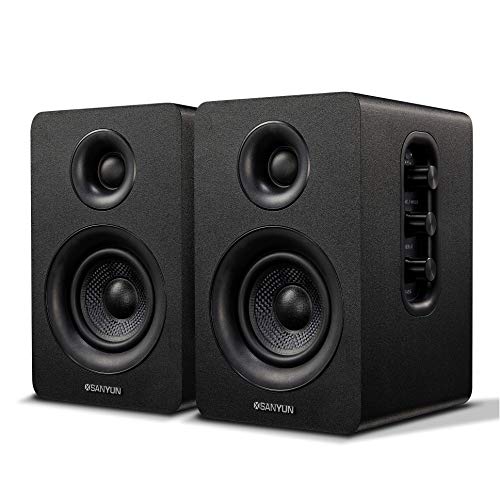
The Sanyun SW208 compact 2.0 system uses a 30W per channel configuration with carbon fiber drivers for a punchy, detailed sound. It includes a built-in 24-bit DAC via USB and Bluetooth 5.0 for wireless listening. This model is well-suited for budget-conscious desktop setups where space is limited but you still want a convincing stereo field and clear highs and lows. It also benefits users who want a simple plug-and-play solution for gaming or general media.
Who it’s best for: Budget-minded gamers, students, and small-space workstations that need a compact, surprisingly capable stereo pair.
Why selected: It offers a strong balance of affordability, DAC-enabled playback, and flexible connectivity.
Caution: The 3″ drivers limit deep bass performance; for critical mixing, consider a monitor with larger woofers or add a subwoofer in the future.
Edifier MR3 Powered Studio Monitors

The Edifier MR3 monitors are compact, Hi-Res Audio certified, and Bluetooth-enabled. They provide 18W per speaker output with a balanced set of inputs including TRS, RCA, and AUX, plus a headphone output. This arrangement makes MR3 a versatile choice for desk setups, multimedia listening, and lighter production work where space is limited. The Hi-Res certification suggests a flat response suitable for casual monitoring and listening across common audio tasks.
Who it’s best for: Desk setups requiring Bluetooth streaming and multiple wired inputs, plus easy headphone connectivity for late-night work.
Why selected: It combines compact size with a broad connectivity suite and Hi-Res audio support at a budget-friendly price.
Caution: Power output is modest; for larger rooms or demanding mixing, consider larger monitors or additional loudspeakers.
Buying Guide: Choosing The Right Cheap Active Monitors
What should you consider when buying budget active monitors? Here are practical questions and answers to guide your choice.
- What is the best size for small desks? Smaller monitors (like 3.5″ to 4″) save space and reduce room-reflection issues in near-field setups. Pair with proper acoustic treatment for the best results.
- Do I need Bluetooth? If you want wireless playback from phones or tablets, Bluetooth-enabled monitors add convenience. If you’re focusing on critical mixing, prioritize wired connections for consistency.
- Is DAC built-in necessary? Built-in DACs in monitors like the Sanyun model reduce signal loss from digital sources. USB DACs are convenient for laptops and desktops without external audio interfaces.
- Should I add a subwoofer? For music production or gaming with deep bass, a subwoofer helps. For near-field editing, high-quality 3.5” or 4” drivers can suffice with careful placement.
- How important is driver size? Larger drivers (4”–5”) generally offer deeper bass and more detailed mids, but they take more space. Smaller drivers shine in tight rooms and budget setups.
- What about room acoustics? Budget monitors still benefit from placement strategies: keep them at ear level, form an equilateral triangle with your listening position, and minimize hard surfaces with soft furnishings or panels.
Quick Buying Tips
- Choose a model with a balanced frequency response in the 80 Hz–20 kHz range for versatile use.
- Prioritize low distortion at your typical listening levels to avoid fatigue during long sessions.
- Test proximity to walls and corners; shallow desk setups may require wall-mount options or isolation pads.
FAQ
- What qualifies as “cheap” for active monitors? Budget monitors typically balance price with acceptable audio accuracy and build quality, suitable for reference listening and everyday tasks.
- Can I use these as studio monitors for professional work? Some models are suitable for home-studio reference listening; for high-stakes mixing, consider larger monitor options or a dedicated audio interface with calibrated monitors.
- Do budget monitors need room treatment? Yes, even modest acoustic treatment improves accuracy by reducing reflections and standing waves in the listening area.
- Is Bluetooth audio quality good enough for monitoring? Bluetooth can be convenient but may introduce compression. For critical tasks, wired connections are preferred.
- How do I decide between portable vs stationary monitors? If you require mobility and a simple setup, portable or compact models fit. For a dedicated workspace, stationary monitors with proper isolation deliver steadier performance.
- Should I pair monitors with a subwoofer? A subwoofer benefits bass-heavy music and game audio, especially with small monitors that struggle with deep lows. For voice-focused tasks, careful tuning may suffice without one.