Choosing the right calculator can streamline statistics coursework, exams, and data analysis. This guide highlights five popular models ideal for college statistics students, balancing function, readability, and ease of use. Each option supports essential statistical operations, such as regression, standard deviation, and matrix calculations, while remaining user-friendly for beginners and advanced learners alike. Below, you’ll find concise product sections, an introductory buying guide, and a quick product summary table to help you compare at a glance.
Product Snapshot
| Product | Brand | Key Benefit |
|---|---|---|
| Casio fx-115ES Plus 2nd Edition | Casio | Natural Textbook Display; 280+ functions |
| TI-84 Plus CE Color Graphing Calculator | Texas Instruments | High-res color display; graphing; rechargeable |
| CATIGA CS-229 Scientific Calculator | CATIGA | Graphic functions; multiple modes; 360+ functions |
| CATIGA CS-121 Scientific Calculator | CATIGA | Graphing capabilities; compact design; 360+ functions |
| iPepul 991ES Plus Pink | iPepul | 417 functions; four-line display; solar power |
Casio fx-115ES Plus 2nd Edition — Advanced Scientific Calculator

Casio’s fx-115ES Plus 2nd Edition is widely used in statistics courses for its balance of power and simplicity. Its 16-digit, four-line LCD and NATURAL TEXTBOOK DISPLAY℠ let you view fractions, equations, and results as they appear in textbooks. With more than 280 functions, it handles complex number calculations, linear regression, summations, integrals, permutations, and matrix/vector operations. This model is particularly strong for students who want a capable scientific calculator without a graphing interface.
Texas Instruments TI-84 Plus CE Color Graphing Calculator
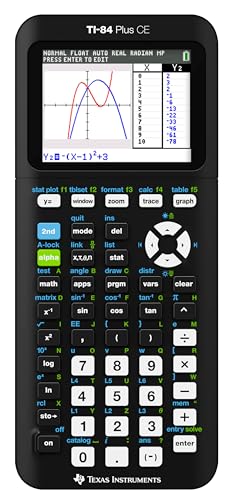
The TI-84 Plus CE combines color graphing with a high-resolution display, making it a standout choice for statistics and data visualization. Its rechargeable battery reduces ongoing costs, and preloaded apps and images extend its utility beyond basic statistics. Horizontal and vertical split-screen options support multitasking during study sessions, while interactive zoom features help you analyze data sets more intuitively. This model is best for students who regularly graph distributions and regression models.
CATIGA CS-229 Scientific Calculator with Graphic Functions

CATIGA CS-229 offers a robust all-in-one scientific and graphing experience. It supports plotting functions, analyzing graphs, and solving complex equations with a clear visual display of graphs and formulas. With over 360 functions, including fractions, complex numbers, statistics, and linear regression, this calculator accommodates algebra, calculus, and exam prep. Its ergonomic design and comfortable key layout help maintain efficiency during long study sessions and exams.
CATIGA CS-121 Scientific Calculators with Graphic Functions

The CATIGA CS-121 continues the brand’s focus on graphing capability coupled with scientific functions. Designed for high school and college courses, it supports multiple modes and more than 360 functions, including statistics, linear regression, and standard deviation. Its graphing interface helps visualize complex mathematical topics and supports steady navigation during tests and assignments.
iPepul Pink Math Calculator with 417 Functions

The iPepul 991ES Plus Pink model emphasizes a large four-line display and a broad function set, including 417 calculation options. It supports solar power and a rechargeable battery, making it reliable for long study sessions in classrooms or libraries. Its natural display capability helps users interpret expressions as written, which can aid in statistics workflows involving long equations, fractions, and symbolic results. This model is appealing for students who want a budget-friendly, all-purpose calculator with extensive capabilities.
Buying Guide
Key purchase considerations for a statistics-focused calculator include display readability, function breadth, and data handling capabilities. If you frequently perform regression, standard deviation calculations, and matrix operations, a model with built-in statistical functions and matrix support can save time. Graphing features are beneficial when visualizing distributions, probability plots, or regression lines, but not strictly required for all statistics courses. Battery type or charging capabilities matter for long study sessions or field work; rechargeable models reduce ongoing costs. Finally, consider the overall ergonomics, key layout, and size to ensure comfortable daily use during lengthy exams.
Comparison considerations by category:
- Entry-level scientific calculators: Focus on natural textbook display and essential statistics functions. These are typically light on memory but user-friendly for beginners.
- Graphing calculators: Best for courses with data visualization and large data sets. They provide regression analysis, plotting, and multiple modes to compare results interactively.
- Ergonomics and durability: A compact form factor and responsive keys improve speed and accuracy, especially on timed assessments.
- Power options: Solar-powered devices offer reliability and lower long-term costs, while rechargeable batteries minimize maintenance.
All highlighted models are suitable for college statistics, with variations in display, graphing capability, and function depth. Prospective buyers should align the choice with their course requirements, preferred workflow, and the level of data analysis expected throughout their program.