Modern homes rely on clean, reliable signal distribution across multiple TVs, set-top boxes, and streaming devices. A high-quality cable splitter amplifier can boost signal strength, reduce pixelation, and improve overall picture quality without introducing noise. Below are five carefully selected products that cover a range of needs—from passive return options to multi-port active splitters—helping you choose the right tool for your cable or OTA antenna setup.
| Product | Ports | Return Path | Best For |
|---|---|---|---|
| Reliable Cable Products 9 Port Bi-Directional Cable TV Splitter | 9 (8 amplified + 1 modem) | Active Return | Multi-TV homes with VoIP needs |
| GE Digital 2-Way Coaxial Splitter | 2 | Passive Return | Simple, reliable distribution |
| Reliable 8-Port TV Antenna Signal Splitter | 8 | Passive Return | Antenna/Cable with multiple TVs |
| Reliable Cable 4-Port Booster / Splitter | 4 | Passive Return | Smaller setups requiring modest boost |
| Reliable Cable Products 9 Port Bi-Directional Kit | 9 | Active Return | All-in-one kit with power cable |
Note: All products are suitable for standard and digital cable TV services. Some models are not MoCA capable or not recommended for OTA antennas with certain configurations. Verify compatibility with your provider if MoCA or specific networking features are required.
Reliable Cable 9-Port Bi-Directional with Active Return
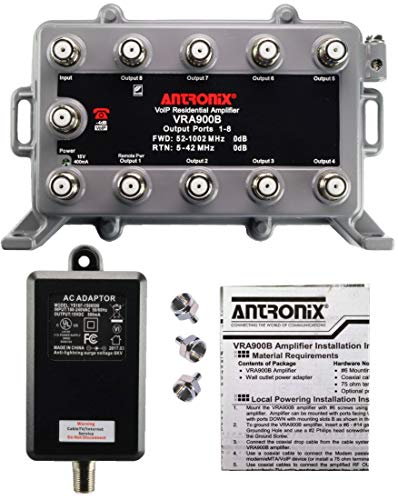
This true lossless 8-port splitter-style device provides 8 amplified outputs plus an integrated modem port for VoIP equipment, protecting services during power outages. It uses Active Return, which supports forward and reverse paths with lossless performance. Not recommended for OTA antennas or satellite systems. CamPort auto seizing F-ports and downward-facing ports help with clean wiring. Housing is powder-coated aluminum for corrosion resistance. Suitable for standard and digital cable TV, including triple play phone services.
GE Digital 2-Way Coaxial Splitter

This multi-purpose splitter distributes a digital signal across two outputs with a frequency range of 5–2500 MHz. Gold-plated RG6 connectors provide corrosion resistance and reliable connectivity, making it suitable for use with amplifiers, HDTVs, and high-speed internet setups. It’s a simple, durable choice for straightforward distribution without complex power considerations.
Reliable 8-Port Antenna Signal Splitter with Booster

Designed to connect up to 8 devices from a single antenna or cable line, this distribution amplifier provides a +4 dB boost per port. It enhances OTA reception and helps reduce signal snow and pixelation for digital channels. While suitable for OTA and cable TV, it is not recommended for installations with pre-amplifiers or existing amplifiers. This model emphasizes reliability for multi-room antenna setups and supports standard and digital TV services.
Reliable Cable 4-Port Passive Return Booster

This four-port amplifier delivers +7.5 dB per port, providing signal strength for multiple televisions or cable boxes. It supports OTA antenna reception and standard digital cable TV services. The unit features a nickel-plated housing with strong corrosion resistance and43 6 kV surge protection to help shield against lightning-induced surges. It’s not compatible with systems that already have an amplifier or pre-amplifier in place.
Reliable Cable 9-Port Bi-Directional Kit

This kit includes a complete 9-port configuration with Active Return and a dedicated power cable. It mirrors the features of the single 9-port model but comes as a bundled option that includes F59 terminators for clean termination. It remains not MoCA capable and not suitable for satellite systems. It emphasizes lossless, bidirectional signal handling across eight amplified ports and a dedicated modem connection to preserve service continuity during outages.
Buying Guide
Key considerations when selecting a cable splitter amplifier:
- Return path design: Active vs passive return affects how signals travel back toward the source. Active return can improve performance in multi-device setups but may introduce compatibility concerns with some services (verify with your provider).
- Port count and output levels: More ports allow distributing a signal to multiple TVs, but each added port may require higher amplification. Check the per-port gain (dB) to prevent over-amplification, which can degrade signal quality.
- MoCA compatibility: If your home uses MoCA networking for in-home TV and data distribution, ensure the splitter supports MoCA or choose models explicitly advertised as MoCA-capable.
- Return type and compatibility: Some units are designed specifically for OTA antennas, while others target cable TV or mixed environments. Ensure the device matches your primary use (OTA, cable, or mixed).
- Physical durability: Corrosion-resistant housings and surge protection help in harsh environments or outdoor installations. Consider aluminum or nickel-plated bodies for longevity.
- Power considerations: Amplified splitters may require a power source. For passive designs, no external power is needed but signal loss may occur with multiple drops.
- Cable type compatibility: Most devices use RG6 or RG59 cables. Verify connector quality and impedance matching to maintain signal integrity across runs.
- Installation constraints: Some models are not compatible with existing amplifiers or pre-amplifiers. Confirm compatibility with any current equipment to avoid double amplification or signal conflicts.
When evaluating options, balance the number of outputs, required amplification, and the specific services (OTA, cable, or satellite) you rely on. For multi-room TV setups with VoIP services, active-return, multi-port devices can provide robust distribution. For simpler installations, a two-port or four-port unit with passive return may be sufficient and easier to integrate.