Finding the right audio MIDI interface for Mac can boost both recording quality and workflow. This guide highlights five solid options that balance preamp quality, latency, and compatibility, helping you capture vocals, instruments, and podcasts with clarity. Each product section includes core features and practical considerations to help you compare at a glance.
| Product | What It Delivers | Best For |
|---|---|---|
| Focusrite Scarlett Solo 3rd Gen | Bright pre-amps, Air mode, 24-bit/192kHz | Vocal/ Guitar focused setups |
| M-Audio M-Track Solo | USB bus-powered, 48kHz, compact | Podcasters and beginners |
| PreSonus Studio 24c | XMAX-L preamps, 2×2 I/O, 192 kHz | Home studios with DAW |
| Mackie Onyx Producer 2X2 | Onyx preamps, MIDI I/O, 24-Bit/192kHz | Musicians needing MIDI |
| Focusrite Scarlett 2i2 4th Gen | Auto Gain, Clip Safe, 120dB dynamic range | Multitude of sources |
Focusrite Scarlett Solo 3rd Gen USB Interface

The Focusrite Scarlett Solo 3rd Gen is designed for solo vocal or guitar work with a bright, transparent mic preamp and an instrument input that accommodates electric guitars and basses. Air mode adds presence for acoustic recordings, while Gain Halos help monitor input levels to prevent clipping. It records or plays back at up to 24-bit/192kHz, preserving the nuance of your performances. This model prioritizes simplicity and high-quality capture in a compact USB interface, suitable for podcasters and solo musicians working on a Mac.
M-AUDIO M-Track Solo USB Audio Interface
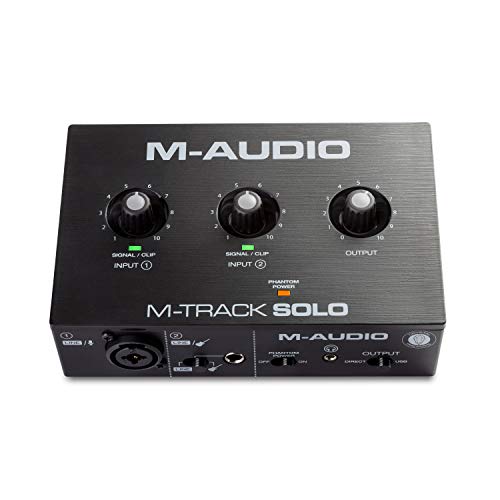
The M-AUDIO M-Track Solo focuses on solo performers and podcasters needing simple, reliable USB audio. It provides a single combo XLR/Line input with phantom power and a separate instrument input, delivering 48kHz recordings on a Mac or PC. Monitoring is flexible via 1/8″ headphone output and stereo outputs. The USB/Direct switch enables zero-latency monitoring for real-time performance, making it a practical entry point for Mac users starting out or streaming content.
PreSonus Studio 24c 2×2 USB Audio Interface

The PreSonus Studio 24c offers a compact 2-in/2-out setup with XMAX-L mic preamps and 192 kHz conversion. Its two balanced ¼-inch TRS main outputs connect directly to studio monitors, making it suitable for small home studios that require clean conversion and dependable monitoring. This interface pairs well with Studio One software and Mac workflows, delivering reliable performance for recording, podcasting, and live streaming.
Mackie Audio Interface Onyx Producer 2X2

The Mackie Onyx Producer 2X2 delivers two boutique-quality Onyx mic preamps with strong clarity and dynamic range, plus MIDI I/O to integrate external synths or controllers. It sports XLR/TRS combo inputs for mic, line, and instrument sources, and supports up to 24-bit/192kHz recording. This interface is well-suited for Mac users building a small studio with a focus on both audio capture and MIDI capabilities for music production or performance setups.
Focusrite Scarlett Solo 4th Gen USB Interface

The Focusrite Scarlett Solo 4th Gen expands on the Solo line with enhanced Air mode for vocal and guitar presence, a broad 120dB dynamic range, and Auto Gain to help avoid levels that are too hot or too quiet. It ships with software to support Mac users in building a quick-start environment for recording, mixing, and streaming. This model is well-suited for musicians and podcasters who want dependable performance with minimal setup friction.
Buying Guide: Key Purchase Considerations
- Compatibility and drivers: Most interfaces here are class-compliant for Mac, but verify macOS compatibility and any required drivers or software suites.
- Input/Output needs: Assess the number of mic/line inputs, instrument inputs, and the presence of MIDI I/O if you work with external keyboards or control surfaces.
- Preamp quality and latency: Preamps influence warmth and clarity. Look for devices offering low-latency monitoring and sufficient headroom for your input levels.
- Conversion quality: 24-bit/192kHz is common; higher resolution helps preserve detail in both recordings and playback.
- Monitoring options: Latency-free monitoring and headphone outputs should align with your workflow, whether solo recording or multi-track sessions.
- Software ecosystem: Some interfaces bundle DAW licenses or companion software which can add value for Mac users starting out or expanding setups.
- Portability and power: USB-powered interfaces are convenient for mobile setups; consider bus-powered models if you primarily record on laptops.
Across these options, users can prioritize preamp quality, MIDI capabilities, and ease of use to suit their Mac-centric recording and streaming workflow. The options above present a balance of compact designs and robust features suitable for home studios, podcasters, and performers seeking reliable USB connectivity and studio-grade sound.