Finding the right USB audio interface for recording, live streaming, or podcasting can improve clarity, reduce latency, and simplify monitoring. This guide highlights five reliable options, covering multi-input versatility, high-quality mic preamps, and user-friendly controls. Each pick supports common needs from home studios to beginner setups, with features designed for Mac or PC workflows and software bundles.
| Product | Brand | Main Benefit |
|---|---|---|
| M-AUDIO M-Track Solo | M-AUDIO | Compact, versatile input options with zero-latency monitoring |
| Focusrite Scarlett Solo 3rd Gen | Focusrite | High-quality preamps with Air mode for vocal clarity |
| XTUGA USB Audio Interface | XTUGA | Ultra-low latency, multiple input/output controls |
| MAONO PS22 Lite | MAONO | 24-bit/192kHz recording with strong dynamic range |
| M-AUDIO M-Track Duo | M-AUDIO | Dual inputs for more simultaneous signals and monitoring |
M-AUDIO M-Track Solo USB Audio Interface
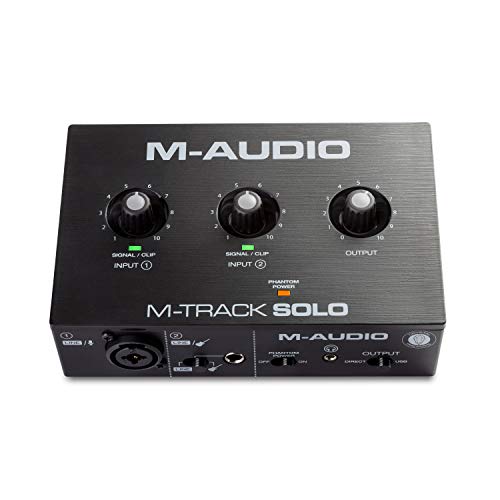
This compact USB sound card supports Mac or PC, delivering 48kHz audio for clear recordings. It combines a combo XLR/Line input with phantom power and a Line/Instrument input, enabling vocal, guitar, or line-level recordings. Monitoring is flexible with a 1/8″ headphone output and stereo RCA outputs, plus a USB/Direct switch for zero-latency monitoring. It’s suitable for podcasts, streaming, and versatile solo recording setups.
Focusrite Scarlett Solo 3rd Gen USB Audio Interface

Scarlett Solo 3rd Gen provides professional-grade preamps and a switchable Air mode to add brightness to vocals and acoustic instruments. It features two high-headroom instrument inputs and Gain Halos to prevent clipping, supporting up to 24-bit/192kHz for studio-quality recordings. This model aims at guitarists, vocalists, podcasters, and producers seeking pristine clarity and straightforward operation.
XTUGA USB Audio Interface

XTUGA offers a PC-friendly interface with 48V phantom power, a front-panel XLR input, and 3.55mm mic jack options. It supports low-latency monitoring and provides a 3.5mm auxiliary input for added flexibility. The device emphasizes independent channel controls and a straightforward setup for recording musicians, podcasters, and streamers who value real-time tweaks and reliable performance.
MAONO USB Audio Interface PS22 Lite

The PS22 Lite delivers 24-bit/192kHz recording with a dynamic range of 106dB, making it suitable for podcasts and music. It supports condenser and dynamic mics with up to 56 dB preamp gain and 48V phantom power, and includes an instrument input for guitars. Its design focuses on warm, clear sound for voice work, streaming, and music creation, with straightforward routing and monitoring.
M-AUDIO M-Track Duo USB Audio Interface
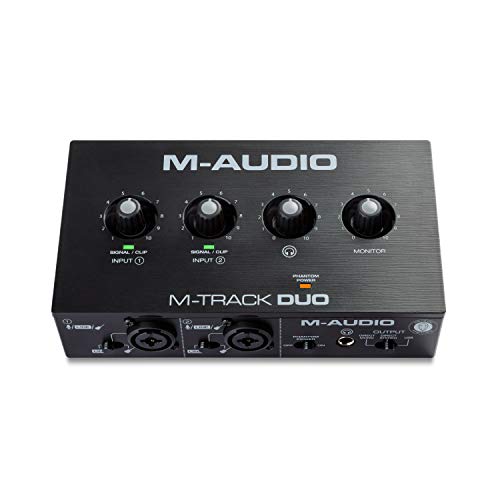
The M-Track Duo expands to two combo XLR/Line/Instrument inputs with phantom power for dual-voice or instrument setups. It provides 48kHz recording resolution and a robust monitoring path with a 1/4″ headphone output and stereo 1/4″ outputs, plus a USB/Direct switch for zero-latency monitoring. This model suits collaborations, dual-microphone podcasts, or small-band demos.
Focusrite Scarlett Solo 4th Gen USB Audio Interface

Focusrite Scarlett Solo 4th Gen emphasizes high-fidelity recording with 120dB dynamic range and a redesigned Air mode for enhanced vocal and instrument presence. It includes auto gain and clip safety features to support confident takes, making it a strong option for singers, songwriters, and podcasters seeking reliable studio-quality results in a compact unit.
Buying Guide: Key Purchase Considerations
- Input capacity: Choose a model with the right number and type of inputs for your setup (XLR, instrument, line). Dual-input interfaces are ideal for two-person podcasts, while single-input units work for solo creators.
- Mic preamp quality: Preamps affect vocal warmth and detail. Look for interfaces with higher headroom and features like Air mode or gain halos to prevent clipping.
- Monitoring and latency: Zero-latency monitoring and separate direct monitoring controls help you hear takes in real time without feedback delays.
- Headphone and main outputs: Ensure the interface has comfortable headphones output levels and appropriate line outputs for speakers or monitors.
- Sample rate and bit depth: 24-bit/192kHz offers professional clarity, though 24-bit/96kHz is sufficient for many home studios. Consider your software and project needs.
- Software bundle: Some interfaces ship with bundled DAW software or plugins; factor this into the value and workflow you want to build.
- Compatibility and drivers: Confirm compatibility with your operating system and DAW, plus easy driver installation and updates.
- Size and portability: If you travel or have limited desk space, a compact interface with straightforward setup is advantageous.
- Phantom power: Needed for condenser mics; ensure the interface provides 48V if you use such mics.
- Price-to-performance: Balance features, build quality, and included software to meet your budget while retaining future-proofing.