Looking for an audio interface that pairs smoothly with MIDI workflows? This guide highlights five reliable options that deliver clean mic preamps, solid conversion, and easy MIDI I/O. Each pick suits different creators—solo songwriters, small home studios, and mobile setups—while supporting high-quality audio plus seamless MIDI integration.
Summary table of selected products
| Product | Brand | Why it’s a good pick for MIDI users |
|---|---|---|
| Scarlett Solo 3rd Gen USB-C | Focusrite Store | Great preamps, USB-C, Air mode for brighter tracks; ideal for solo performers and vocalists |
| Onyx Producer 2×2 USB | Mackie Store | Two mic pres, built-in MIDI I/O, solid multi-instrument workflow |
| Scarlett Solo 4th Gen USB-C | Focusrite Store | Enhanced dynamic range, Air modes, modern USB-C |
| Zen Quadro | Antelope Audio Store | Real-time FX, multiple preamps, near-zero latency for complex MIDI/virtual instrument sessions |
| AudioBox 96 25th Anniversary | PreSonus Store | Two preamps, MIDI I/O, portable and value-packed for small setups |
Focusrite Scarlett Solo 3rd Gen USB-C Audio Interface

The Scarlett Solo 3rd Gen centers on a single XLR mic preamp and one high-headroom instrument input, offering 24-bit/192kHz conversion and an Air mode option for added clarity on acoustic sources. This makes it a strong choice for solo vocalists or guitarists who want studio-quality results without a larger setup. The Gain Halos provide visual feedback to avoid clipping during recording. For MIDI-focused use, pair this interface with a dedicated MIDI controller or a separate MIDI interface if needed, as Solo 3rd Gen does not include built-in MIDI I/O.
Best for: solo singers and guitarists who need compact, high-fidelity recordings with a transparent sound and easy setup. Also suitable for podcasters who primarily use a single mic and voice-driven content.
Limitation: No built-in MIDI I/O, so MIDI devices must connect via a separate MIDI interface when needed.
Mackie Onyx Producer 2×2 USB Audio Interface with MIDI

The Onyx Producer 2×2 combines two boutique-quality Onyx mic preamps with 24-bit/192kHz recording and built-in MIDI I/O. This makes it a compelling all-around option for small studios that require both vocal/ instrument inputs and MIDI connectivity. The combo XLR/TRS inputs handle mics, lines, and Hi-Z sources with ease, and the unit’s robust build supports mobile and desktop workflows.
Best for: musicians who need a balanced, mid-priced solution with both high-quality mic pres and direct MIDI I/O for keyboards or controllers. This is a solid choice for producers juggling live mic takes and virtual instruments.
Caution: The interface’s footprint is larger than ultra-compact models, which may influence desk space in tight setups.
Focusrite Scarlett Solo 4th Gen USB-C Audio Interface

The Scarlett Solo 4th Gen upgrades dynamics range to 120dB and keeps a simple, high-quality pathway for one mic and one instrument input. Air mode lifts the vocal and guitar presence in the mix, delivering a brighter, more engaging final product for vocal takes or guitar-forward productions. It shares the Focusrite lineage of straightforward setup and reliable drivers, with broad compatibility across PC, Mac, and iPad.
Best for: songwriters and solo artists who need a compact, high-fidelity interface with enhanced sonic character and flexible device compatibility. Ideal for mobile or home studios requiring a reliable one-mic, one-instrument solution.
Caution: Despite USB-C, it remains a single-channel interface, so MIDI needs remain external if required for complex sessions.
Antelope Audio Zen Quadro with Synergy Core
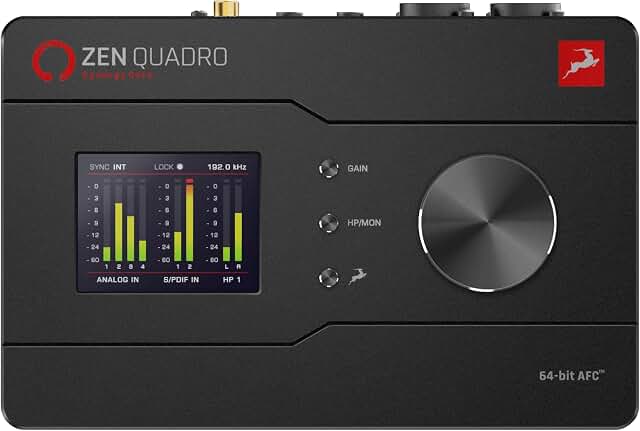
The Zen Quadro offers four discrete mic preamps and extensive real-time effects via Synergy Core DSP. It delivers near-zero latency for tracking and mixing with virtual instruments, alongside high-quality conversion rated at wide dynamic range. Its dual USB-C connectivity and bus-powered design suit compact studios that require flexibility and extensive effects processing without stressing the computer CPU. This makes it a strong choice for producers who rely on real-time FX during MIDI-rich sessions.
Best for: studios and performers needing multiple clean preamps and built-in DSP FX for real-time processing of MIDI-driven tracks and vocal/instrument recordings. Choose this if you value low latency and onboard processing over a smaller footprint.
Caution: Higher feature set means a more complex setup; new users may require a short learning curve to maximize Synergy Core FX.
PreSonus AudioBox 96 25th Anniversary

The AudioBox 96 provides two Class-A mic preamps, two instrument inputs, and MIDI I/O in a value-packed USB 2.0 package. This setup is well-suited for small home studios and portable recording rigs where both voice and instrument recording, plus MIDI control, are needed. The two preamps are designed to deliver clean gain with good headroom, helping maintain vocal clarity in mixed productions.
Best for: beginners or budget-conscious producers seeking a straightforward two-channel interface with MIDI I/O and reliable performance for basic home studio workflows.
Caution: USB 2.0 connectivity may limit max transfer rates compared to USB-C interfaces in some systems, especially with large multi-track sessions.
Buying Guide: Key Considerations For MIDI-Ready Audio Interfaces
What counts as “MIDI-ready”?
Interfaces with built-in MIDI I/O simplify connecting keyboards, controllers, and sound modules. If a model lacks MIDI I/O, plan to pair it with a separate USB MIDI interface to preserve workflow efficiency.
How important is preamp quality?
High-quality mic preamps ensure clean, adjustable gain for vocals and instruments. Look for interfaces with clear gain halos or visual indicators to avoid clipping during performance takes.
What about conversions and latency?
24-bit/192kHz conversion is standard for modern interfaces and supports detailed mixes. For MIDI-heavy work, near-zero latency on monitoring helps you track virtual instruments with minimal timing gaps.
USB-C compatibility and portability
USB-C interfaces tend to offer broader compatibility with contemporary laptops and mobile setups. If you work on the go, prioritize compact designs with bus power or easy portability.
Best practice for choosing
If you need a compact setup for solo work, focus on one-mic and one-instrument models with optional Air modes. If you require MIDI I/O and multiple inputs, consider two-channel or four-channel interfaces with robust MIDI support and onboard processing when available.
How to compare head-to-head
Compare preamp quality, conversion specs, dynamic range, and latency. A table or side-by-side feature list helps you see where a model outperforms another for your specific use case.
Frequently Asked Questions
- Do I need MIDI I/O on an audio interface for a MIDI keyboard?
If your MIDI keyboard is class-compliant, you can connect it via USB without I/O on the audio interface. However, built-in MIDI I/O can simplify routing and reduce computer bandwidth usage in complex sessions. - Is USB-C essential for modern interfaces?
USB-C offers broad compatibility and future-proofing, but many USB-A interfaces still work well with adapters. Consider your computer’s ports and power needs when choosing. - What’s the advantage of Air mode in Scarlett interfaces?
Air mode adds brightness and harmonic content to vocals and acoustic guitar, helping tracks cut through a mix without excessive boosting in post-processing. - Should I choose a 2-in, 2-out interface or a 4-in, 4-out for MIDI work?
Two inputs are enough for solo performance with a single instrument. If you plan multiple mics or more instruments plus MIDI, a larger interface provides more routing flexibility without switching devices mid-session. - Are DSP effects worth it for MIDI-heavy work?
DSP FX can reduce CPU load when tracking. If your workflow relies on heavy virtual instruments, onboard effects can help keep your computer responsive. - What is the best interface for small studios with MIDI needs?
A model combining dependable mic preamps, reliable MIDI I/O, and good conversion—like the Mackie Onyx Producer or Antelope Zen Quadro—offers a balance of features for small studios.