Choosing the right audio interface can transform a computer-based recording setup. This guide reviews five solid options geared toward guitarists, vocalists, podcasters, and producers who want professional sound without a heavy rig. Each pick combines reliable preamps, good dynamic range, and easy setup for Windows and Mac. Read on for performance highlights, key features, and practical buying considerations to help you select the best match for your workflow.
Summary of the chosen products:
| Product | Brand | Key Benefit | Inputs |
|---|---|---|---|
| Focusrite Scarlett Solo 3rd Gen USB Audio Interface | Focusrite | Bright, clean mic preamps with Air mode | 1 XLR, 1 instrument |
| Focusrite Scarlett Solo 4th Gen USB Audio Interface | Focusrite | Higher dynamic range, improved Air mode | 1 XLR, 1 instrument |
| Focusrite Scarlett 2i2 4th Gen USB Audio Interface | Focusrite | Auto Gain and Clip Safe for easy use | 2 XLR/Line combo |
| M-Audio M-Track Solo USB Audio Interface | M-AUDIO | Versatile with one XLR/Line and instrument input | 1 XLR/Line, 1 Instrument |
| Behringer UMC202HD Audiophile | Behringer | Midas-designed mic preamp, zero-latency monitoring | 2 XLR/Line combo |
The following sections highlight five prominent models, drawn from the current lineup, to help you compare features, performance, and value. Each entry includes a concise overview, notable specs, and practical notes for typical computer-based recording tasks.
Focusrite Scarlett Solo 3rd Gen USB Audio Interface

The Focusrite Scarlett Solo 3rd Gen offers studio-grade mic preamps with Air mode to brighten acoustic recordings. It features one high-headroom instrument input and a reliable 24-bit/192kHz conversion suite for clear guitar and vocal tracks. Ideal for solo performers and podcasters seeking high-quality, simple USB recording without a complex setup. Its gain halos help prevent distortion by signaling when you’re at safe levels during takes. This model emphasizes ease of use with strong clarity for home studios and small project setups.
Focusrite Scarlett Solo 4th Gen USB Audio Interface

The Scarlett Solo 4th Gen advances on-demand studio-quality sound with a broad 120dB dynamic range and new Air mode to lift vocals and guitar presence. It retains the familiar Solo form factor with a single mic input and one instrument input, making it a strong choice for singers, guitarists, or podcasters who want professional results in a compact package. The updated converters are designed to deliver clean, detailed recordings suitable for mixing in most DAWs.
Focusrite Scarlett 2i2 4th Gen USB Audio Interface

The Scarlett 2i2 4th Gen expands to two combo inputs, enabling simultaneous use of two microphones or instruments. Its 120dB dynamic range and Auto Gain with Clip Safe features help prevent unwanted peaks, simplifying recording for beginners and experienced users alike. This model is well-suited for small bands, podcasts with multiple hosts, or learners who need a flexible setup at a reasonable price point.
M-Audio M-Track Solo USB Audio Interface
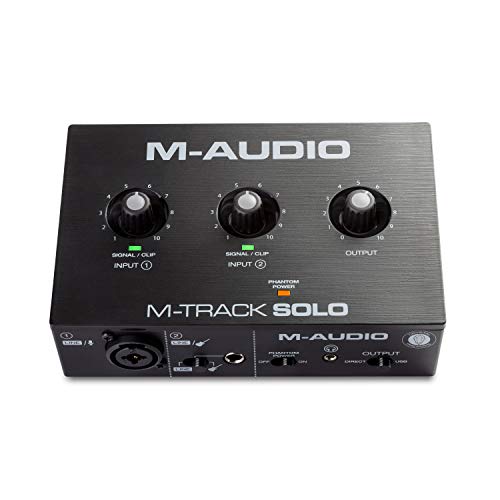
The M-Audio M-Track Solo provides a balance of simplicity and capability, featuring one XLR/Line input with phantom power for mics and a dedicated instrument input. It supports 48 kHz recording and offers flexible monitoring through a headphone output and main outputs. This entry is particularly appealing for solo performers, vloggers, and streamers who require a straightforward USB interface with dependable performance for spoken word and instrument recordings.
Behringer UMC202HD Audiophile 2×2

The Behringer UMC202HD pairs two combination XLR/TRS inputs with MIDAS-designed mic preamps for high-quality capture of voices and instruments. It supports zero-latency monitoring, easing real-time recording and streaming workflows. The unit’s compact design and solid driver support make it a practical choice for home studios, podcasters, and musicians who want reliable performance at a competitive price point. It emphasizes dependable core features rather than flashy extras.
Buying Guide
- Number and type of inputs: Choose based on your setup. Solo performers benefit from 1 XLR and 1 instrument input, while small duos or podcasts with two hosts may need 2 XLR/Line inputs.
- Preamps and signal quality: Look for reputable mic preamps and high dynamic range (e.g., 120dB or similar) to minimize noise and maximize headroom.
- Conversion quality: 24-bit/192kHz is common for modern interfaces and supports clean recordings and precise mixing.
- Air or presence features: Some Focusrite interfaces offer Air mode to brighten certain sources; this can help vocal and acoustic recordings.
- Monitoring options: Zero-latency monitoring and direct monitoring controls are important for real-time tracks without feedback loops.
- Software bundle: Some interfaces ship with useful DAW licenses and bundle software—evaluate whether it fits your needs or if you prefer standalone hardware.
- Compatibility and drivers: Ensure drivers are stable for your operating system and DAW, and confirm compatibility with macOS, Windows, or both.
- Portability and build: If you travel or perform live, consider a compact, sturdy unit with reliable USB connections.
- Future-proofing: If you anticipate needing more inputs or two-channel expansion, choose an interface with room to grow (e.g., 2-in models).
- Budget vs. features: Higher-priced models often offer better preamps and converters, but entry-level units can deliver excellent results for hobbyist and beginner projects.