Whether you’re tracking drums, podcasts, or multi-instrument sessions, an 8-input audio interface offers the connectivity and preamps you need. This guide highlights five solid options that balance input versatility, sound quality, and workflow efficiency for American home studios and small production rigs. Each pick below is evaluated for how it handles multi-mic setups, instrument direct feeds, and reliable software compatibility.
| Product | Brand | Inputs | Outputs | Notes |
|---|---|---|---|---|
| Tascam US-16×08 Rackmount | Tascam | 16 mic/line inputs (8 preamps) | 8 outputs + 8 line inputs | Rackmount, strong gain, direct instrument switching |
| Behringer UMC1820 | Behringer | 18 inputs (mics and lines) | 20 outputs | ADAT I/O, versatile for expanding channels |
| M-Audio AIR 192×14 | M-AUDIO | 8 inputs (preamps/line) | 14 outputs | USB-C, high-resolution capture |
| Focusrite Scarlett Solo 3rd Gen | Focusrite | 2 inputs (combo) | 2 outputs | Compact, premium preamps, Air mode |
| Behringer ADA8200 | Behringer | 8 mic preamps (ADAT) | 8 outputs (ADAT) | ADAT expansion |
Introduction to these products: For creators who juggle multiple vocal takes, guitar and bass tracks, and drum mics, an 8-input interface can simplify your signal routing and monitoring. The options below vary from compact desktop units to rack-mountable interfaces with expansion capabilities. Each entry includes preamp quality, latency behavior, driver compatibility, and practical workflow notes to help you choose the best fit for your studio setup.
Tascam US-16×08 Rackmount USB Audio/MIDI Interface

Designed for larger tracking sessions, the Tascam US-16×08 provides 16 mic and line inputs with eight dedicated preamps and up to 56dB of gain, making it suitable for drum kits, choirs, and dense multi-mic setups. The unit also offers eight line inputs, with two switchable to instrument level for direct guitar or bass recording, delivering flexible routing for complex projects. Its rackmount form factor helps organize a grounded studio workflow and reduce desk clutter. The interface ships with control software to manage routing and monitoring, facilitating real-time adjustments during sessions. This model is ideal for users needing substantial input capacity without sacrificing sound clarity in a professional environment. Its preamps are positioned as a strength, delivering quiet operation across demanding mixes while maintaining low noise floors.
Behringer UMC1820 Audiophile 18×20 USB Interface

The Behringer UMC1820 offers a broad input/output matrix with 18 inputs and 20 outputs, coupled with ADAT I/O to expand capacity as your studio grows. The device is engineered for high-resolution 24-bit/96 kHz audio, ensuring professional sound capture across multiple channels. Its compatibility with popular DAWs—such as Pro Tools, Ableton Live, and Cubase—helps integrate into most studio setups. This interface is well-suited for producers who need more than the basic 8-input setup and plan to expand through ADAT to accommodate future projects. The combination of Midas-quality mic preamps in a budget-friendly package makes it a compelling option for serious home studios.
M-Audio AIR 192×14 USB-C Audio Interface
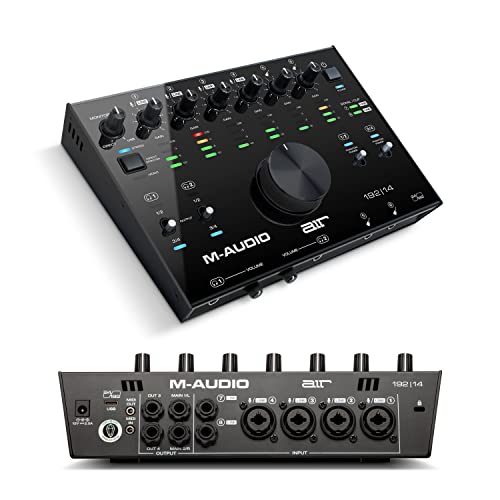
The M-Audio AIR 192×14 centers on 24-bit/192 kHz recording for high-fidelity capture, with eight inputs and four outputs, plus MIDI connectivity. Its USB-C capability ensures fast, low-latency performance suitable for studio recording, streaming, and podcasting. The interface includes class-leading latency figures and pristine preamps, making it a practical choice for projects requiring clean multi-channel capture alongside glassy clarity on vocal or instrument tracks. The bundled software suite from MPC Beats and Ableton Live Lite adds value for producers seeking immediate productivity in a compact footprint.
Focusrite Scarlett Solo 3rd Gen USB Audio Interface

The Scarlett Solo 3rd Gen is a compact solution designed for guitarists, vocalists, podcasters, and producers who prioritize high-quality preamps and ease of use. With two inputs and robust preamps, it delivers clear, bright recordings through Scarlett’s acclaimed preamp circuitry. The Air mode adds extra clarity to acoustic recordings, while Gain Halos visually guide you to optimal gain levels to prevent distortion. The unit supports up to 24-bit/192 kHz conversions, ensuring studio-grade fidelity for both voice and instrument applications. Its simplicity makes it a strong candidate for creators who need reliable performance without a large footprint.
Behringer ADA8200 8-Channel ADAT Audio Interface

The Behringer ADA8200 provides an 8-in/8-out ADAT expansion option, featuring 24-bit AD/DA conversion and ADAT Optical Out. It’s designed to extend an existing interface with additional mic preamps, making it a practical upgrade path for expanding multi-mic recording sessions. While it does not operate as a stand-alone high-channel-count interface, its ability to add eight additional channels through ADAT makes it ideal for studios that already own a compatible audio interface and need more input infrastructure for drums or large ensembles. Its compact build and straightforward setup appeal to mid-sized home studios seeking scalable growth.
Pyle Professional 8-Channel USB Bluetooth Mixer

The Pyle PMXU83BT represents a hybrid mixer/interface option with eight channels, USB connectivity, Bluetooth streaming, and MP3 input support. It includes phantom power for condensers and a built-in DSP processor for effects, offering flexibility for live streaming, podcasting, and basic recording workflows. Its integrated mixer approach is useful when you need quick on-device routing with some multi-track recording capability, though it’s more of a bundled solution than a pure professional interface. For small setups that require an all-in-one mixer/recording solution, this device provides a convenient, easy-to-use pathway.
Buying Guide: Key Considerations For 8-Input Interfaces
- Channel count and preamp quality: Higher input counts with clean, low-noise preamps are essential for multi-mic setups. Look for adequate gain ranges and low noise figures to preserve dynamic range.
- Latency and drivers: Low-latency monitoring is crucial for real-time performance. Check compatibility with your OS (Windows, macOS) and DAW, plus bundled software and drivers.
- Expansion options: If you foresee growth, prioritize devices with ADAT or other expansion paths. This lets you add more channels without replacing the core interface.
- Connectivity and compatibility: USB, USB-C, or Thunderbolt can affect throughput. Ensure your computer has the appropriate ports and that drivers support your DAW workflow.
- Monitoring and routing features: Look for direct monitoring, headphone mixes, and flexible routing matrices to manage complex sessions efficiently.
- Portability vs. rack-mount form: Desktop interfaces work well for small studios and travel, while rackmount units help with bigger setups and studio organization.
- Included software and compatibility: Bundled software can add value, especially if you’re starting from scratch or upgrading current rigs.
- Budget vs. future-proofing: Balance current needs with potential expansion. An interface that supports ADAT or is easily upgradable can save more long-term.
Each option above presents a distinct balance of inputs, quality, and flexibility. For drum-heavy sessions or large ensembles, consider rack-mounted or ADAT-expansion models. If you value compact footprint and premium mic pres for vocals or podcasts, a 2-in or 8-in unit with strong preamps may better suit your workflow. Evaluate your planned monitoring chain, required outboard equipment, and software ecosystem to select the best 8-input interface for your project needs.