If you want to preserve vinyl, tapes, or CDs by converting them into digital MP3s or WAV files, these audio CD recorders and related devices are designed to simplify the process. This guide highlights five options that cover standalone recorders, multi-format players, and versatile recorders for lectures or meetings. Best for casual home use, students, and hobbyists who want straightforward digitization without a computer.
Buyer needs vary: some shoppers want compact USB-to-MP3 capture, others seek classroom-friendly recorders with long battery life, and some need a rackmount player that can archive entire cassette or CD collections. The table below compares five relevant products to help you choose quickly.
| Product | Best For | Key Benefit | Limitations |
|---|---|---|---|
| HopCentury Music Digitizer CD Recorder | Casual digitizers, anyone with 3.5mm/RCA output | USB-only save without a computer | Requires USB/SD storage and FAT32 format |
| Tascam CD-A580 Rackmount | Collectors and archivists | Cassette, CD, USB MP3 workflow | Rackmount setup may be large for small spaces |
| Sphktey Portable CD Player with Ripper | Home theater and small rooms | All-in-one CD playback and ripping with outputs | Limited to built-in features; no full professional suite |
| Tonfarb 136GB Digital Voice Recorder | Lecture capture and interviews | High capacity memory and noise reduction | Voice-focused, not audio CD recorder per se |
| HoTiyan 8GB Digital Voice Recorder | On-the-go recording | Rechargeable, long battery life | Smaller capacity, not a CD ripper |
HopCentury Music Digitizer CD Recorder

This device captures audio from 3.5mm or RCA outputs and saves directly to MP3 on a USB flash drive or SD card. It requires no computer, making it ideal for quick digitization of cassettes, CD players, or other analog sources. The built-in playback lets you verify recordings via earphones. It records at 128 Kbps 44.1 kHz in dual-mono MP3, which makes editing and sharing easy. Best for users who want a simple, standalone recorder without PC dependence.
- Best for converting old analog music to MP3 without a computer
- Better for users with devices providing 3.5mm or RCA outputs
- Choose this if you want portable, USB/SD storage options
Caution: Do not insert a SD card and a USB flash drive at the same time; format drives to FAT32 and keep file sizes manageable.
Tonfarb 136GB Digital Voice Recorder

This device focuses on PCM HD audio with up to 1536 kbps and built-in memory plus a generous 128GB microSD card. It excels for lectures, meetings, and interviews thanks to automatic noise reduction and voice-activated recording. A USB-C connection makes transferring files straightforward. It is best for students, journalists, and professionals who need long recordings and easy file management, even when away from a computer.
- Best for long-form recording with clear playback
- Better for environments with potential background noise due to noise reduction
- Choose this if you need one-click recording and secure USB-C transfer
Limitation: It is primarily a voice recorder; for CD ripping or direct analog-to-MP3 capture from external audio gear, you may need a different setup.
Digital Voice Recorders 8GB by HoTiyan
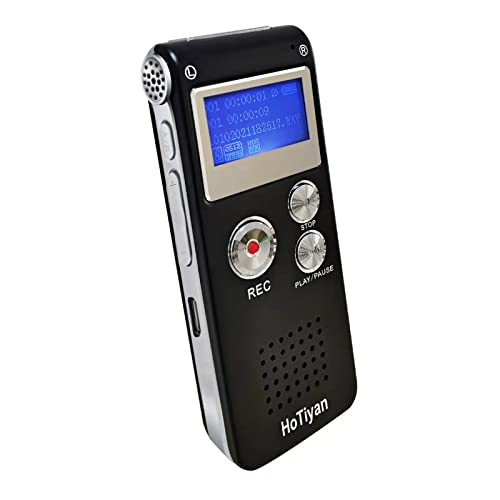
HoTiyan’s recorder provides a compact 8GB storage with a rechargeable battery and up to 20 hours of continuous recording. It uses a high-sensitivity microphone with noise reduction for clear audio in meetings, interviews, and lectures. This option is best for on-the-go recording and later transfer to a computer or player. It’s a solid pick for those who need portable notes and audio capture rather than CD manufacturing.
- Best for short to medium length on-the-go recordings
- Better for users needing rechargeable operation and simple USB transfer
- Choose this if you want a lightweight, pocket-size recorder
Limitation: It does not include a CD ripping or direct MP3-from-CD feature; it’s focused on voice capture and playback on the device or to a computer.
Tascam CD-A580 Rackmount MP3 Recorder

A rackmount player and recorder, this model supports cassette-to-USB and CD-to-Cassette workflows, enabling digital archiving of cassette collections. CDs can also be recorded to USB MP3 via the LINE inputs. It’s best for archivists or stations that require a robust, multi-format workflow in a professional or semi-professional setting. The rackmount design makes it ideal for studios, classrooms, or control rooms with built-in playback and recording capabilities.
- Best for multi-format archiving and professional setups
- Better for users needing cassette and CD to USB MP3 workflows
- Choose this if you have a rack-friendly installation and require flexible media handling
Limitation: The setup and space requirements may be larger, and it is more suited to fixed installations than portable use.
Sphktey Portable CD Player with Ripper

This all-in-one unit focuses on CD ripping and playback for home use. It supports optical and AUX outputs for connection to speakers or amplifiers. It aims to be ready out of the box with cables and a remote control, providing a straightforward setup for those who want to rip CDs and play them through their home theater system. Best for audiophiles who want one device for both CD playback and digital conversion.
- Best for immediate out-of-the-box CD ripping and playback
- Better for users who want optical or AUX wired connections
- Choose this if you prefer an all-in-one package with minimal extra components
Buying Guide: Key Considerations for Choosing an Audio CD Recorder
Purpose and workflow matter. If you want true PC-free digitization, prioritize devices with USB/SD storage support and straightforward recording. For multi-format archiving or professional classrooms, consider rack-mount options with cassette, CD, and USB MP3 capabilities. If your focus is lectures or interviews, look for noise reduction, long battery life, and sizable internal memory or an easy transfer path to a computer.
Storage formats and compatibility should guide your choice. FAT32 formatting, drive compatibility, and supported sample rates affect usability. Look for easy file management features, such as one-click recording, automatic save, and fast USB-C transfer when you need to move files to a computer. Consider whether you need line-level inputs, optical outputs, or Bluetooth for streaming from external sources.
Ease of use is essential for non-technical users. Clear labels, simple controls, and reliable playback checks help ensure your recordings meet your expectations. A device’s portability and power options also determine where you can set up and record, whether at home, in a classroom, or on the go.
FAQ
- What is the best device for quick standalone recording without a computer? A dedicated standalone recorder that saves to USB/SD directly, like the HopCentury model, is ideal for computer-free operation.
- Do I need a PC to edit or share my recordings? Not always. Some devices save to MP3 or WAV on USB drives, which you can edit with any standard audio editor on a computer later.
- Which feature helps in noisy environments? Automatic noise reduction and voice-activated recording help capture clearer audio when background noise is present.
- Is a rackmount player necessary for home use? Not typically. Rackmount units are best for studios, classrooms, or control rooms requiring robust multi-format workflows.
- What storage format should I use on flash drives? FAT32 is commonly supported; avoid mixing FAT32 with NTFS on the same device and format new drives before use.
- Can these devices digitize cassette tapes? Yes, many support cassette-to-USB or cassette-to-CD workflows, but verify inputs and compatible media types before purchase.