This article highlights five reliable at-home ECG monitors you can use to track heart activity from the comfort of your home. Each device supports smartphone or PC connectivity, helping you store, review, and share ECG data with healthcare professionals. The selection covers single-lead and multi-channel options to fit different needs and budgets.
| Product | Brand | Key Benefit |
|---|---|---|
| EMAY Portable ECG Monitor | EMAY | Lead I ECG recording, heart rate display, USB/Bluetooth connectivity |
| EMAY 6L Portable ECG Monitor | EMAY | 6-channel ECG recording, USB/Bluetooth, no subscription |
| OMRON Complete 2-in-1 | Omron | Blood pressure and ECG in one device, clinically validated |
| Monerr Portable ECG Monitor | Monerr | One-lead ECG, Bluetooth, no subscription, data sharing |
| EverOne PM10 | EverOne | Bluetooth ECG with free app and PC software |
EMAY Portable ECG Monitor
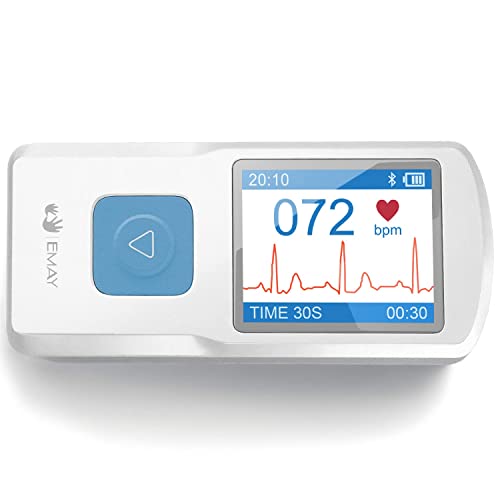
The EMAY Portable ECG Monitor records and stores Lead I ECG signals and displays heart rate for at-home health care. It connects to PCs via USB and to mobile devices via Bluetooth. The accompanying software for PC and mobile offers a sample mode, time settings, and features for uploading and reviewing cases. This single-lead device focuses on essential heart activity data, making it suitable for regular heart health checks and trend monitoring over time. Image-based data storage and cross-device compatibility add convenience for clinicians and caregivers alike.
EMAY 6L Portable ECG Monitor

The EMAY 6L model records and stores ECG signals while displaying heart rate for home health care. It supports USB PC connectivity and Bluetooth with mobile devices. The software suite includes sample mode, time setting, case upload and review, and various measurement features. This 6-channel option provides broader ECG capture versus single-lead devices, enabling more comprehensive monitoring for users needing more detailed heart activity insights while remaining user-friendly for home use.
OMRON Complete 2-in-1
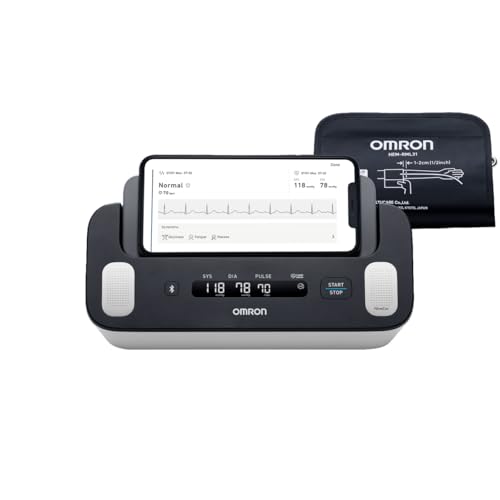
The Omron Complete 2-in-1 Blood Pressure Monitor combines upper-arm blood pressure measurement with ECG capability, offering a more complete heart health picture. Clinically validated, it can store up to 90 readings, helping users track progress over time. The device includes irregular heart activity alerts and app connectivity for broader data sharing with healthcare providers. This option is ideal for users who want integrated vital signs alongside ECG data for a holistic at-home monitoring routine.
Monerr Portable ECG Monitor

The Monerr Portable ECG Monitor records and stores Lead I ECG signals and provides heart health metrics for home care. It’s designed for adults over 20 and is not a hospital diagnostic substitute. The device includes a rechargeable battery and Bluetooth connectivity to iOS and Android devices, enabling unlimited data storage and sharing with healthcare providers. The monitor highlights heart metrics such as P waves, PR interval, QRS complex, and QTc within about 30 seconds of use, offering a quick snapshot of cardiac electrical activity.
EverOne PM10

EverOne PM10 provides Bluetooth-enabled ECG monitoring with a free app for iOS and Android and free PC software for data transfer and storage. The device features a 1.77″ color TFT-LCD screen for easy on-device reading and wireless data transfer to phones, PCs, or cloud storage. Data can be printed or shared with healthcare professionals. The PM10 emphasizes user-friendly wireless connectivity and cross-platform data management for ongoing heart health tracking.
Buying Guide
- Purpose and scope: Decide between single-lead versus multi-channel ECG. For routine heart rate tracking, a single-lead device may suffice; for more detailed analysis, a multi-channel option can provide additional insights.
- Connectivity: Consider how you want to store and share data. Bluetooth and USB options enable easy syncing with smartphones, tablets, and PCs, as well as remote sharing with clinicians.
- App and software support: Look for devices with active apps and PC software that offer case review, measurement history, and easy export formats (PDF/CSV).
- Data privacy and storage: Ensure that the device uses secure data transfer and local storage options if cloud storage is a concern.
- Clinical validation: Devices tied to clinically validated readings or recommended by health professionals may provide more reliable data for medical decisions.
- Battery life and durability: For ongoing home use, battery longevity and ease of charging are practical considerations.
- Ease of use: User-friendly interfaces, clear displays, and straightforward setup reduce barriers to regular monitoring.
- Cost and subscription: Note whether software features require ongoing subscriptions or are included with the device purchase.
When selecting an at-home ECG monitor, balance the need for data detail with ease of use and data management capabilities. The five products highlighted here offer varying levels of complexity and connectivity to fit different home health routines and clinician needs.