Answering the essential question for buyers: which antenna best fits an FM transmitter setup? This guide highlights five antennas optimized for 88-108 MHz transmitters, covering outdoor ground plane models, telescopic options, and indoor dipole designs. Ideal buyers include hobby broadcasters, small community stations, churches, schools, and home studios seeking reliable coverage, easy installation, and durable construction. The following table summarizes the highlighted products to help you compare at a glance.
| Product | Frequency Range | Key Benefit |
|---|---|---|
| FMUSER GP100 Outdoor Antenna | 88-108 MHz | Omnidirectional, weatherproof ground plane for small stations |
| MythGeek Rubber Antenna | FM band (0-1.5W typical) | Compact indoor option with TNC 50 Ohm |
| HzFitInc GP100 Outdoor Antenna | 87-108 MHz | Low VSWR, 3 dBi gain, true 360° coverage |
| FMUSER FT02A Telescopic Antenna | 88-108 MHz | Adjustable high gain, universal adapters for various transmitters |
| Bingfu Magnetic Base Indoor Antenna | Indoor FM setup | Magnetic base, easy placement with included 3m cable |
FMUSER GP100 Outdoor FM Transmitter Antenna

Best for: small FM stations needing reliable omnidirectional coverage. The GP100 uses a 1/4 wave ground plane design to provide broad radiation with a low-angle pattern, ideal when you want uniform signal in all directions around a compact mast. The ultra-low VSWR protects connected transmitters by maintaining stable impedance within 88-108 MHz. Weatherproof aluminum construction and waterproof connectors support outdoor use in varied climates. Limitations include the need for appropriate mounting hardware and coax connections (26 ft included) to maximize performance.
MythGeek Rubber Antenna for 05B FM Transmitter

Best for: compact indoor setups with modest power, up to about 1 W. The MythGeek unit uses a TNC 50 Ohm connector and copper interface material, making it straightforward to integrate with small FM transmitters. It’s a practical choice where space is limited, such as a small studio or classroom. Caution: performance may be limited at higher power levels or in outdoor environments without weatherproofing.
Bingfu Indoor Dipole FM Antenna

Best for: indoor stereo systems and home studios with 75 Ohm unbalanced coax. This adhesive-mount dipole antenna includes a 10 ft (3 m) coax extension and universal adapters for compatibility with common home receivers. It’s a suitable upgrade for rooms where magnetic or mast-mounted antennas aren’t feasible. Limitation: designed for indoor use and lower power environments; outdoor durability is not guaranteed.
HzFitInc GP100 87-108MHz Outdoor Antenna

Best for: professional outdoor FM broadcasting with a true 360° radiation pattern. The GP100 from HzFitInc emphasizes low VSWR and a gain of about 3 dBi, providing consistent coverage in all directions. The design supports durable outdoor operation and stable signal transmission for 0.5W–100W transmitters. Consider better mounting and mast support for optimal performance. Limitation: requires an appropriate outdoor mounting setup and weatherproofing for longevity.
FMUSER FT02A Telescopic FM Antenna
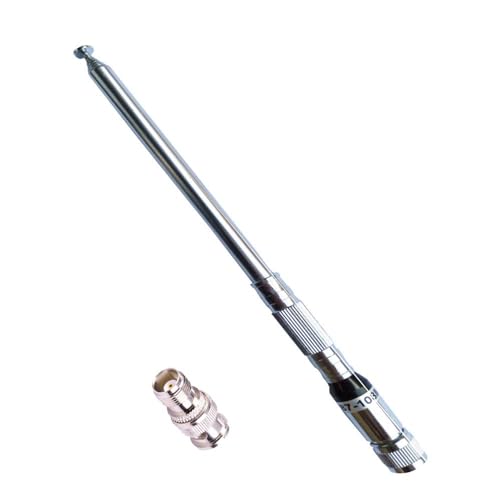
Best for: 0–7 W transmitters across home, church, and school environments. The FT02A offers universal compatibility with TNC male connectors and a TNC-to-BNC adapter, plus a 2 dBi gain boost over typical factory antennas. This makes it a straightforward upgrade for reliable signal reach. Limitation: higher gain is not guaranteed in extremely tall or obstructed locations; placement matters for achieving the best coverage.
Buying Guide
What matters most when choosing an antenna for an FM transmitter? Consider these practical factors:
- Power handling and deployment: Match antenna gain and impedance to your transmitter’s output power and the installation environment (outdoor mast vs. indoor shelf).
- Radiation pattern: Omnidirectional designs are ideal for round-the-clock, wide-area coverage; directional options are better when aiming at a specific area.
- Impedance and connectors: Ensure impedance compatibility (commonly 50 Ohm) and standard connectors (TNC, BNC, F-Type) to simplify integration.
- Durability and weather resistance: Outdoor antennas require weatherproofing and corrosion resistance; indoor antennas prioritize compact size and aesthetics.
- mounting and cabling: Plan for mast height, mount type, and coax length. Longer cables may introduce loss; choose low-loss coax where possible.
- Compatibility with existing equipment: Check transmitter power range, frequency stability, and any local regulations governing FM transmission.
Practical Questions To Guide Your Decision
- What environment will the antenna operate in—indoors, outdoors, or both?
- What is the transmitter’s power rating, and does the antenna support it without excessive SWR?
- Do you need omnidirectional coverage or targeted directional reach?
- Which connectors and adapters are already in use with your transmitter?
- Is weatherproofing a priority for your installation location?
FAQ
- Q: What is the typical advantage of a 1/4 wave ground plane antenna? A: It provides broad omnidirectional coverage with a low-angle radiation pattern suitable for compact outdoor installations.
- Q: Is indoor use acceptable for FM transmit antennas? A: Yes, but ensure the environment supports the power level and that the antenna matches the transmitter’s impedance.
- Q: Do I need adapters for different transmitter interfaces? A: If your transmitter uses a non-standard connector, adapters (TNC to BNC, etc.) can simplify setup.
- Q: How important is VSWR for FM antennas? A: Low VSWR minimizes reflected power, protecting equipment and ensuring stable transmission.
- Q: Can I mix and match antennas with any FM transmitter? A: Compatibility depends on frequency range, impedance, and connector type; verify these specs before pairing.
- Q: What maintenance is required for outdoor antennas? A: Regular inspection for corrosion, water ingress, and loose fittings helps maintain performance.