Answering the question: which all-metal hotend is best for high-temperature, high-speed 3D printing. This guide highlights premium all-metal hotends and notes who they’re best for. Ideal buyers include hobbyists upgrading traditional all-plastic setups, power users printing high-temp filaments, and professionals needing reliable heat management. The following top picks are organized to help you compare features, compatibility, and practical trade-offs.
| Product | Printer Compatibility | Best For | Notes |
|---|---|---|---|
| Microswiss All Metal Hotend Kit for CR-10 Series | CR-10, CR-10S, Ender 2, Ender 3 family | Users seeking zero-setup maintenance with a robust titanium heat break | Includes wear-resistant nozzle and silicone sock |
| Ender 3 Hotend All Metal Ceramic Heating Core | Ender 3, Ender 3 Pro, Ender 3 V2, Ender 3 Max | High-temperature, high-flow printing for consumer-grade Enders | Ceramic heating core for stability at temp |
| Ender 3 Hotend Upgrade For Voron 2.4 / Ender 3 Family | Voron 2.4, Ender 3, Ender 3 Pro, Ender 3 V2, Ender 5, CR-10 family | Modular hotend with removable heater block and separate heater/thermistor | Separate components ease replacement |
| Creality Ender 3 / Pro / V2 Extruder MK8 HotEnd Kit | Ender 3, Ender 3 Pro, Ender 3 V2 | Original Creality fit with Capricorn tubing and improved reliability | Low-friction tubing included |
| ChowThink Armour V3.5 All Metal Hot End | Ender 3 family, Ender 3 V2 Pro, etc. | High-speed, high-flow printing up to 600 mm/s | Integrated CNC frame with multiple fans for cooling |
Microswiss All Metal Hotend Kit for CR-10 Series

Reference features: Fits Creality CR-10 / CR-10S / CR-10-S5 / CR-10 MINI / CR-10-S4 / Ender 2 / Ender 3 / Ender 3 Pro / Ender 5 / TronXY X5S. Includes: Aluminum Cooling Block, Grade 5 Titanium Heat Break, Aluminum Heater Block, Brass Plated Wear Resistant MK8 .4mm Nozzle, Silicone Sock.
Best for: Builders upgrading multiple CR-10 and Ender machines with a durable titanium heat break and wear-resistant nozzle. Why selected: Provides robust heat isolation and reliable performance at higher temps. Caution: Verify fit on non-Creality boards; some extreme rework may require minor mounting adjustments.
Ender 3 Hotend All Metal Ceramic Heating Core
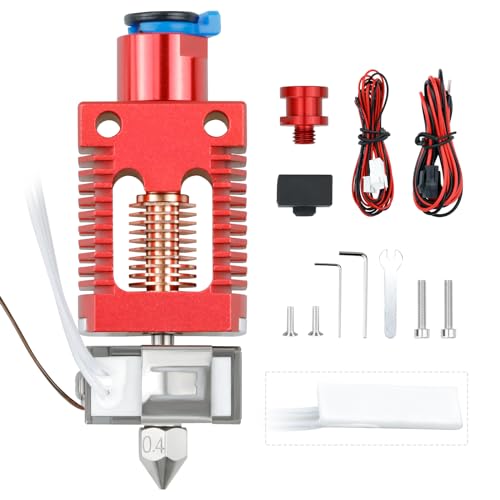
Reference features: Fits Creality Ender3/Ender3 Pro/Ender3 V2/Ender3 Max/Ender 3s/CR10 Voron Hot end Kit Replacement. Upgraded All Metal Ceramic Heating Core Hotend 3D Printer Parts, supports 300℃. Assembled hot end nozzles extruder kit; longer lifespan through rigid assembly.
Best for: Ender 3 users aiming for higher-temperature prints with a ceramic heating core. Why selected: Combines metal hotend with ceramic core for stability at high temps. Caution: Ensure voltage compatibility with your board when running at 300℃ or higher.
Ender 3 Hotend Upgrade For Voron 2.4 / Ender 3 Family

Reference features: Compatibility includes Voron series, Ender 3 family, Ender 5, CR10, and more. Package contains: hot ends as shown; separate ceramic heater tube and thermistor; easy replacement without changing the heater block kit.
Best for: Users who seek modular hotend components for easy maintenance. Why selected: Simplifies part replacement and reduces downtime. Caution: Verify adapters for exact printer model to avoid fit issues.
Creality Ender 3 / Pro / V2 Extruder MK8 HotEnd Kit

Reference features: 100% Creality Original with Creality-Capricorn tubing. Upgrade includes low friction Capricorn PTFE tubing (40cm). Hotend replacement parts suitable for Ender 3, Ender 3 X, Ender 3 Pro, Ender 3 V2.
Best for: Ender 3 owners seeking seamless compatibility with Creality’s own tubing and parts. Why selected: Ensures consistent performance with Creality’s ecosystem. Caution: May not be ideal for extreme high-temperature applications beyond standard Ender 3 use.
ChowThink Armour V3.5 All Metal Hot End

Reference features: High-flow version for speeds up to 200-600 mm/s; melting zone length increased by 50% to 28.5 mm; supports printing up to 300°C; copper-aluminum bimetal heatbreak for robust high-temp use.
Best for: Users aiming for very high-speed printing on Ender 3 family with demanding filaments. Why selected: Designed for high-speed, high-temperature performance with integrated cooling and advanced heat management. Caution: At very high speeds, some printers may require tuning to avoid artifacts or leakage in aggressive extruder setups.
Buying Guide
What to consider when choosing an all-metal hotend
- Temperature range: Look for components rated up to at least 300°C if you plan to print with higher-temp filaments like ABS, PETG, nylon, or polycarbonate blends.
- Material and construction: Titanium heat breaks offer stronger thermal isolation; copper-titanium combinations provide efficient heat transfer with stability.
- Compatibility: Verify printer family and model (Ender, CR-10, Voron, etc.). Some hotends require adapters or specific heater blocks.
- Cooling and heat dissipation: Integrated cooling blocks and multiple fans can improve melt-zone control at higher speeds.
- Maintenance and replacement: Systems with modular heater blocks and removable thermistors are easier to service without full block replacement.
- Tubing and fittings: Include low-friction PTFE tubing or Capricorn tubing when compatible, as it reduces extrusion resistance.
- Installation effort: Drop-in kits reduce the need for printer-specific modifications; others may need mechanical tweaks.
- Cost vs performance: Higher-end hotends often deliver better high-temp stability and print speeds but ensure your printer frame can handle the speeds without artifacts.
How to compare options at a glance
- Best for overall top-end performance: Armour V3.5 and similar high-speed, high-flow designs.
- Better for Ender 3 users upgrading from stock: Ender 3 MK8 hotend kits and ceramic-core variants.
- Choose this if you want easy maintenance: modular designs with removable heater blocks and separate thermistors.
- Avoid this if your printer lacks adequate cooling or you plan to print at extreme speeds without firmware adjustments.
Tips for installation and use
- Follow manufacturer installation instructions and use appropriate screws and heat-block spacers to avoid leaks.
- Calibrate temperature readings after installation to ensure accurate extrusion temperatures.
- Test print with standard materials before moving to aggressive high-temp filaments to confirm stability.
FAQ
- What is an all-metal hotend?
An all-metal hotend uses metal components for the heat zone, allowing higher temperature printing and better thermal stability than standard PTFE-based hotends. - Are all-metal hotends compatible with all printers?
Compatibility varies by model. Check the printer’s extruder type and any required adapters before purchasing. - Do all-metal hotends require special maintenance?
They may need periodic inspection of heat breaks and nozzle wear due to higher temperatures and faster printing. - Can I print nylon or polycarbonate with these hotends?
Yes, many all-metal hotends support high-temp filaments like nylon, PC, and PETG, depending on the specific model and calibration. - Is a higher price worth it?
For users requiring high-temp performance and faster printing, the improved thermal management can justify the cost.