Maintaining healthy indoor air quality is essential for mold prevention and overall well-being. This guide highlights top air quality monitors designed to detect pollutants like CO2, PM2.5, VOCs, formaldehyde, and humidity—crucial data when assessing mold risk. We review five reliable options and provide a practical buying guide to help you choose devices that fit homes, offices, and spaces prone to damp conditions. Each product below includes key features, what to look for, and how it supports mold prevention strategies.
| Product | Key Features | Why It Matters for Mold |
|---|---|---|
| YNAK 16-in-1 Air Quality Monitor | 9 parameters, 7 AQI alerts, real-time readings | Detects CO2, humidity, and pollutants that influence mold growth |
| Amazon Smart Air Quality Monitor | PM2.5, VOCs, CO, humidity, temperature | Easy integration with Alexa for alerts and trends |
| Kayenqo Mold Test Kit | 12 test plates, mold identification guide | Direct mold presence verification beyond ambient air |
| Nanezan 18-in-1 Air Quality Monitor | CO2, TVOC, PM1/2.5/10, humidity, temperature, time | Broad sensor set for environmental mold risk signals |
| PinoTec 5-in-1 Indoor Monitor | CO2, HCHO, TVOC, temperature, humidity | Simple alerts to curb damp conditions that feed mold |
YNAK 16-in-1 Air Quality Monitor

The YNAK 16-in-1 Air Quality Monitor provides real-time data on nine key environmental factors, including CO2, PM2.5, PM1.0, PM10, HCHO, TVOC, temperature, humidity, AQI, and time. It features seven AQI alert buzzers and a mute option for quiet environments. With external high-precision sensors and direct air sampling, it aims to deliver accurate measurements to help identify mold-prone conditions in living spaces. This device is suitable for homes and offices seeking proactive air quality management.
Amazon Smart Air Quality Monitor

The Amazon Smart Air Quality Monitor tracks PM2.5, VOCs, CO, humidity, and temperature, with color-coded LED indicators and an Alexa-enabled air quality score. This device is designed for households seeking a simple, voice-assisted way to monitor indoor air and identify conditions that could support mold growth, especially in damp seasons or poorly ventilated rooms. It provides actionable insights and integrates with smart home routines.
Kayenqo Mold Test Kit for Home

The Kayenqo Mold Test Kit offers 12 test plates and a detailed mold guide, enabling users to test various indoor surfaces and HVAC components for mold presence. While not a real-time monitor, it provides concrete evidence of mold contamination and helps verify remediation efforts. This is a practical add-on for homes undergoing mold investigations or post-remediation checks, complementing ambient air monitoring data.
Nanezan 18-in-1 Air Quality Monitor

The Nanezan monitor covers CO2, TVOC, PM1.0, PM2.5, PM10, humidity, temperature, and time, with a dual-chip architecture for real-time data processing. Its portable design and long battery life suit households that need to assess air quality across multiple rooms to reduce mold risk, particularly in spaces with fluctuating humidity or inconsistent ventilation.
PinoTec 5-in-1 Indoor Air Quality Monitor
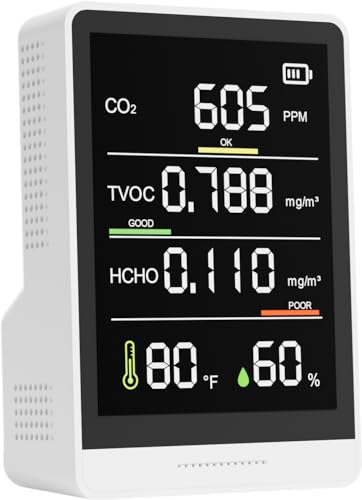
The PinoTec monitor measures CO2, HCHO, VOCs, temperature, and humidity with a color LED display to indicate overall air quality. It emphasizes ease of use and alert-based guidance to help occupants quickly respond to conditions that may foster mold growth, such as high humidity or elevated CO2 levels in poorly ventilated rooms.
Buying Guide: Key Considerations for Mold-Focused Air Quality Monitoring
- Scope of sensors: For mold prevention, prioritize devices that monitor CO2, humidity, particulate matter (PM2.5/PM10), and VOCs. Some models also track HCHO (formaldehyde) and temperature, which further informs condensation risk and mold conditions.
- Real-time alerts: Look for devices with real-time AQI alerts or alarms. Alerts can prompt immediate action to improve ventilation or reduce moisture levels, important in spaces prone to dampness.
- Sensor accuracy and drift: Devices with external, high-precision sensors tend to be more reliable. Consider models that specify measurement accuracy and recommended calibration or maintenance intervals.
- Data accessibility: Some monitors offer companion apps or smart home integrations (e.g., Alexa). Easy access to historical data helps identify mold-prone patterns over time and measure remediation success.
- Portability vs. fixed installation: Handheld or portable units are useful for scanning multiple rooms, while wall-mountable units provide continuous monitoring in high-risk areas like basements and bathrooms.
- Test kits as complements: Mold test kits provide direct evidence of mold spores on surfaces or in HVAC systems. Use them alongside ambient monitors for a comprehensive assessment.
- Ease of use and maintenance: Consider battery life, USB charging, display readability, and whether alarms are easily muteable. Simpler devices can be deployed quickly in rental homes or offices.
- Budget and value: Compare upfront costs with ongoing maintenance and sensor lifespan. A combination of a primary ambient monitor and occasional mold test kits often provides the best coverage.
- Space-specific needs: For kitchens, bathrooms, and basements—common mold hotspots—prioritize humidity-sensitive devices and those with robust VOC detection or HCHO monitoring.
In environments with moisture exposure, using a combination of ambient air monitors and targeted mold testing yields the most thorough assessment. Select devices that align with your space size, moisture risk, and desired level of data insight. Proper ventilation, moisture control, and proactive monitoring are essential for reducing mold risk and maintaining healthy indoor air.