Looking for an acoustic guitar simulator pedal that delivers convincing tones from an electric guitar or preserves your guitar’s natural voice? This guide highlights five top options suited for different players—live performers, home studios, and compact pedalboard setups. Each pick brings distinct advantages, whether you want rich piezo-like shimmer, warm jumbo voice, or flexible dual-mode preamps. Below you’ll find quick comparisons, clear buyer-focused notes, and practical limitations to help you choose confidently.
Summary of selected products:
- BOSS AC-3 Advanced Acoustic Simulator Guitar Pedal — Best for authentic Boss modeling and compact pedalboard use.
- IOppWin Acoustic Guitar Simulator Pedal — Best for electric-to-acoustic conversion with multiple cabinet modes.
- MOOER Acoustikar Acoustic Guitar Pedal — Best for smooth, natural acoustic textures in a small pedal.
- NUX Optima Air Dual-Switch Acoustic Guitar Simulator — Best for extensive profiles and IR loading with preamp options.
- SONICAKE Acoustic Guitar Effects Pedal — Best for integrated preamp and V-curve shaping with XLR output.
BOSS AC-3 Advanced Acoustic Simulator Pedal

Best for players who want a compact, proven acoustic-modeling platform with Boss-level reliability. This pedal is ideal for stage setups where a traditional acoustic tone is required from an electric-guitar signal.
Key features include acoustic guitar modeling tailored for electric guitars, Boss’s advanced modeling in a compact pedal, built-in reverb, and optimization specifically for acoustic-guitar simulation. The unit focuses on delivering a balanced, natural acoustic voice without needing external processors.
Why chosen This pedal represents a long-standing option in live rigs where a familiar Boss workflow and consistent tone are valued. It’s widely compatible with standard pedalboards and power supplies.
Caution Some users may prefer more modern voicings or extra cabinet simulations, which the AC-3 does not emphasize as heavily as newer models.
IOppWin Acoustic Guitar Simulator Pedal
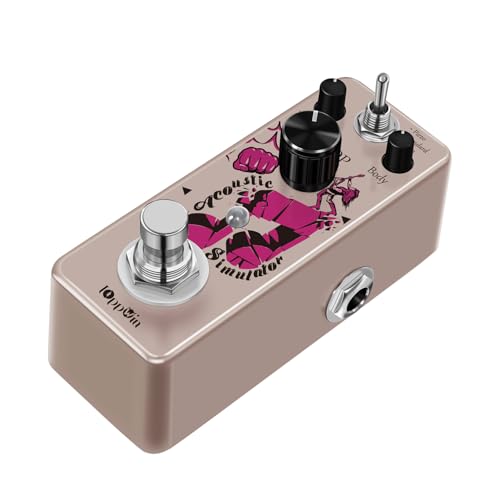
Best for players seeking electric-to-acoustic conversion with distinct cabinet modes. This pedal suits guitarists who want quick tonal shifts between bright, balanced, and warm acoustic colors.
Features include 3 cabinet modes (Piezo, Standard, Jumbo) and advanced analog technology to deliver organic acoustic textures without digital artifacts. It’s designed to be rugged for live use and simple to dial in quickly.
Why chosen The three-mode approach offers immediate tonal variety, useful for players who perform across genres or want to approximate different acoustic body sizes.
Caution The tonal realism can depend on pickup quality and guitar body; it may require additional EQ or amp shaping for perfect fit in some rigs.
MOOER Acoustikar Acoustic Guitar Pedal

Best for players who want a compact unit that yields a natural, warm acoustic texture from an electric guitar. Ideal for home studios and practice spaces with limited board real estate.
Reference features include 3 modes (Piezo/Standard/Jumbo) and a focus on restoring the acoustic voice with subtle warmth. It’s particularly suited for adding a smooth, organic feel to electric guitar tones.
Why chosen The Acoustikar emphasizes simplicity and smoothness, making it a strong choice when you need convincing acoustic texture without a complex setup.
Caution Some users may find the cabinet-mode realism less expansive than high-end multi-effect units; it’s best used as a tonal color in tandem with other effects or amps.
NUX Optima Air Dual-Switch Acoustic Guitar Simulator

Best for players who want extensive tonal control and the option to load impulse responses (IRs). This model is well-suited for studio work or advanced live rigs needing precise acoustic emulation.
Key features include dual-mode design (preamp and acoustic simulator), 15 built-in acoustic profiles plus IR loading, a user IR capture feature, and a 3-band EQ with gain and built-in reverb. It gives you broad tonal shaping and customization.
Why chosen The combination of built-in profiles and IR loading makes this a versatile option for players who value tonal experimentation and customization.
Caution The depth of options may require more setup time to dial in the exact voice you want, especially when integrating external IRs into a live chain.
SONICAKE Acoustic Guitar Effects Pedal

Best for players needing a compact pedal with an analog preamp and digital reverb plus practical output options. The XLR output supports straightforward DI use for stage or studio work.
Highlights include an analog preamp, digital reverb, a notch filter and mute with adjustable gain and frequency range, and a high-impedance input with a balanced XLR output. It’s a versatile choice for those who value direct PA compatibility.
Why chosen The integrated XLR output and notch filtering offer practical flexibility for live sound or recording environments where DI compatibility and tone shaping matter.
Caution The built-in reverb may not be as expansive as dedicated reverb pedals or multi-effects units; consider an additional reverb if you need a broader ambiance palette.
Buying Guide
- What tone do you want? If you need a classic acoustic voice from electric guitars, prioritize pedals with dedicated acoustic modeling and Piezo/Standard/Jumbo options (best for many performers).
- How important is versatility? Dual-mode units with IR loading or cabinet simulations offer broad tonal variety for studio and live use.
- What’s your pedalboard footprint? For tight boards, compact units with strong core acoustics (like the BOSS AC-3 and MOOER Acoustikar) are advantageous.
- Is direct DI output needed? Pedals with XLR or balanced outputs simplify front-of-house or recording chain integration.
- How much setup time is acceptable? Some models provide extensive customization; others prioritize quick dialing-in with fewer controls.
Key purchase considerations
- Modeling realism: Look for pedals that emphasize natural acoustic textures over purely synthesized tones.
- Cabinet and cabinet-like simulations: Cab simulations can influence feel and note separation; test if possible.
- Headroom and dynamics: Pay attention to how the pedal handles clean vs. driven signals—dynamic response matters on stage.
- Build quality and reliability: Rugged housings and true-bypass options reduce tone loss in complex pedalboards.
- Connectivity: Ensure input/output options align with your amp, DI, and recording setup (guitar to pedal to amp/DI).
Frequently asked questions
- Do acoustic simulator pedals work with any electric guitar? Yes, most models work with standard electric guitars, but the result varies by pickup type and guitar body.
- Which pedal sounds most like a real acoustic guitar? Pedals with dedicated acoustic profiles and cabinet modes tend to sound more natural across a range of pickups.
- Can I use these pedals for live performance? Yes, many are designed for stage use, with robust construction and simple real-time controls.
- Is IR loading necessary? IR loading adds tonal variety by using impulse responses; it’s particularly useful in studio setups.
- Should I choose analog or digital pedals? Analog preamps offer warmth; digital models can provide a broader suite of tones and effects.
- Are any of these pedals good for DI with the PA system? Pedals with XLR outputs are better suited for direct-in-to-PA or recording paths.