Finding the right 4 ohm amp means balancing power, compatibility, and installation flexibility. This article highlights top 4-ohm amplifiers suitable for four-channel setups, monoblock designs, and versatile bridge configurations. It targets buyers seeking clear guidance on when to choose each model, and who they’re best for. Below you’ll find a quick product snapshot and detailed sections to help you compare options side by side.
Summary Of Selected Products
| Product | Channels | Approx. Power (4 Ohm) | Best For |
|---|---|---|---|
| Taramps TS 400×4 | 4-channel | 100 W RMS per channel (400 W total) | Balanced four-channel setups with bridging options |
| Taramps TS 1200×4 | 4-channel | 300 W RMS per channel | High-power multi-speaker systems |
| SounDigital 800.4 EVO | 4-channel | 200 W RMS per channel | Compact installs with four-channel flexibility |
| Skar Audio RP-1200.1D | Monoblock | 1,200 W RMS @ 1 Ω | Powerful subwoofer duty, space-saving |
| AUDIOZERONE ZE1000.1 | Monoblock | 1,000 W RMS @ 1 Ω, 650 W @ 2 Ω, 400 W @ 4 Ω | Cost-effective mono power for subs |
Taramps TS 400×4 400W RMS 4 Channels Full Range Car Audio Amplifier
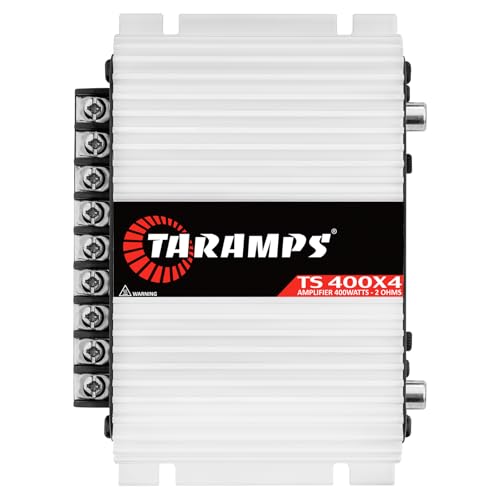
The TS 400×4 from Taramp’s is a four-channel full-range amplifier with 400 watts RMS total when driven at 2 Ohms. Each channel delivers up to 100 W RMS, giving a balanced amount of power for door speakers, mid/high drivers, or a lightweight bridge configuration. It supports bridging for flexible setups and includes LED indicators and short-circuit protection. Best for enthusiasts who want a compact, high-value four-channel amp with reliable protection features.
Best for: four-channel systems that require even distribution of power across multiple speakers in compact spaces.
Limitation: Not the highest wattage per channel available in the category; best when you don’t need maximal per-channel output.
Taramps TS 1200×4 Amplifier Car Audio 1200W RMS 2 Ohms 4 Channels

Taramp’s TS 1200×4 is a four-channel powerhouse with 1,200 W RMS total power and 300 W RMS per channel at 2 Ohms. It features multiple input options (RCA and high-level input in some models) and fixed crossovers (HPF/LPF/Full). The model is designed to drive a wide range of loudspeakers, from door kits to tweeters, while offering automatic activation in certain configurations. Best for loud, multi-speaker systems that require precise channel-to-speaker matching.
Best for: four-channel builds that demand substantial per-channel output and flexible input options.
Limitation: Requires careful tuning to avoid overpowering small speakers in a multi-speaker setup.
SounDigital 800.4 EVO 4.0 Car Amplifier

The SounDigital 800.4 EVO is a compact four-channel amplifier delivering a total of 800 watts, split across four channels. It is lauded for its suitability in compact installs, including motorcycles and tight automotive spaces, while maintaining clarity and low distortion. The design emphasizes moisture- and vibration-resistant construction, making it ideal for rugged or weather-exposed environments. Best for riders seeking robust performance in a small footprint.
Best for: compact installations and environments where space and durability matter.
Limitation: Power per channel is moderate compared with larger four-channel amps; plan for midrange-to-midbass speakers accordingly.
AUDIOZERONE ZE1000.1 2000W Monoblock Class D

The ZE1000.1 is a high-power monoblock designed for subwoofers, providing up to 1,000 W RMS at 1 Ω and 650 W RMS at 2 Ω. It also offers 4 Ω stability with solid efficiency thanks to Class D design. This model is better for those prioritizing deep bass and minimal space usage in a single-subwoofer setup. Best for power-focused sub applications where space is at a premium.
Best for: single-subwoofer configurations needing strong bass with a compact footprint.
Limitation: As a mono amp, it lacks four-channel versatility for full-range systems.
BOSS Audio Systems R1100M Monoblock

The BOSS R1100M is a 1,100-watt monoblock amplifier that stabilizes at 2 Ohms and 4 Ohms, with a MOSFET power supply and built-in protection features. It includes a low-pass crossover and bass boost, along with remote sub control. This unit is a straightforward choice for a single-subwoofer setup or a high-output bass channel in a compact chassis. Best for cost-conscious buyers who want solid bass performance in a simple, reliable package.
Best for: straightforward subwoofer power in a compact, affordable package.
Limitation: Not designed for full-range multi-speaker setups; use with a dedicated sub or a separate multi-channel amp for full-range systems.
Taramps HD 3000 4 Ohms Mono Amplifier

The Taramp’s HD 3000 is a 4-ohm mono amplifier rated at 3000 watts RMS. It is designed for high-power subwoofer applications and includes crossover and bass boost features. Best for enthusiasts who demand serious bass power and have a sub-driven setup that benefits from high wattage. Limitation: High power requires careful electrical and thermal management to prevent component stress.
Taramp’s HD 2000 4 Ohms Mono Amplifier

The Taramp’s HD 2000 is a 4-ohm mono amplifier offering up to 2,000 W RMS for one channel. It’s designed for deep bass duties with a robust signal path and built-in monitoring indicators. Best for large subwoofer setups where maximum single-channel power is required. Limitation: Large heat output may need adequate ventilation in enclosed places.
Buying Guide: How To Choose A 4 Ohm Amp
- Power needs by speaker type: For four-door speakers or coaxials, aim for 60–100 W RMS per channel. For subwoofers, monoblocks in the 1,000–3,000 W RMS range are common. If you bridge four channels to drive two pairs, ensure the amp supports proper bridging without overdriving the load.
- Impedance compatibility: 4-ohm stability is common. If your speaker configuration is 2-ohms or 1-ohm capable, ensure the amp supports those loads safely. High-current designs require a sturdy electrical system (battery, alternator, wiring).
- Inputs and integration: Consider RCA inputs and high-level inputs for aftermarket head units. Some models offer automatic turn-on or remote level control, which can simplify installation.
- Physical footprint and installation space: Compact amps fit tighter trunks, under seats, or motorcycle panniers. If space is tight, prioritize models described as compact or motorcycle-friendly without sacrificing essential features.
- Protection and durability: Short-circuit protection, thermal protection, and moisture/vibration resistance are valuable in real-world driving conditions.
- Sound goals: Four-channel amps typically deliver balanced midrange and treble across speakers; monoblocks excel at bass control. For a full-range system, combine a four-channel amp with a dedicated sub amp if needed.
Frequently Asked Questions
- What is the advantage of a 4-ohm amplifier? A 4-ohm amplifier generally provides stable performance with commonly matched speaker loads, balancing efficiency and heat generation for standard car audio setups.
- Should I choose a four-channel amp or a mono amp? Choose four-channel for full-range speaker sets; choose mono amps for subwoofers or when you need maximum single-channel power in a compact package.
- Can I bridge a four-channel amp? Some four-channel amps support bridging to increase power on two channels. Check the model’s bridging options and ensure it remains within safe impedance and thermal limits.
- What installation challenges should I expect? Power delivery, wiring gauge, and heat management are common concerns. Plan for a proper alternator/battery upgrade if installing multiple high-power amps.
- Is a compact amp always better for installation? Not always. Compact amps ease fitment but may trade off raw power or cooling capacity. Pick based on your space, target loudness, and efficiency needs.
- How do I protect my speakers? Use appropriate crossovers (HPF/LPF), set gain carefully with a source signal, and avoid overpowering speakers with high wattage without proper attenuation.