Answering the common buyer question: which 3S battery best fits a quadcopter’s power and endurance needs? This guide highlights five reliable 3S packs, explaining who each is best for and why. The selections cover different sizes, discharge rates, and connector setups to match varied quadcopter models and flying styles. ideal for hobbyists seeking longer flights, FPV racers needing quick bursts, or beginners wanting dependable backups. A concise summary table of the chosen products follows the introduction.
Product Snapshot
| Product | Voltage | Capacity | Discharge | Connector | Best For |
|---|---|---|---|---|---|
| Zeee 3S 120C 2200mAh | 11.1V | 2200mAh | 120C | XT60 | FPV racers needing high-drain performance |
| Zeee 3S Lipo Battery 2200mAh 50C Shorty | 11.1V | 2200mAh | 50C | XT60 | Compact builds and lightweight quads |
| OVONIC 3S 50C 3000mAh | 11.1V | 3000mAh | 50C | Dean-Style & JST-XHR | Longer runtime for medium-sized quads |
| EMEPOVGY 3S 2200mAh 35C | 11.1V | 2200mAh | 35C | XT60 | Balanced performance with safety |
| HOOVO 3S 11.1V 2200mAh 50C | 11.1V | 2200mAh | 50C | EC3 | Solid all-around power |
Zeee 3S 50C Shorty Pack 2200mAh with XT60

The Zeee 3S 2200mAh Shorty Pack delivers 50C discharge for steady power in compact form. With dimensions around 75x34x26.5mm and a weight near 137g, this pack suits small to mid-sized quads and tight builds where space matters. Best for lightweight FPV setups and pilots prioritizing flight time without bulk.
- Best for compact quadcopters and tight frames.
- Choose this if you need a shorter profile for special mounting or if weight savings are a priority.
- Limitation: 50C is solid but lower than high-rate FPV racing ranges; ensure your motor/ESC can utilize the discharge effectively.
Key details
- Voltage: 11.1V; Configuration: 3S1P; Capacity: 2200mAh; Discharge: 50C
- Connector: XT60; Dimensions: 75 x 34 x 26.5 mm; Weight: ~137 g
- Compatible with RC cars, planes, and boats in addition to drones—verify model compatibility before use
OVONIC 3S 35C 2200mAh with XT60

This OVONIC pack balances safety, weight, and runtime with 35C continuous discharge and a 2200mAh capacity. It’s packaged in a soft case and uses XT60 for easy connections. Best for pilots who want dependable, steady power with a straightforward setup for everyday flying. Great for beginner to intermediate quads that don’t demand ultra-high bursts.
- Best for steady, predictable power delivery and longer cycle life claims
- Choose this if you prioritize safety certifications and standard charging practices
- Caution: 35C is not ideal for aggressive 3D maneuvers or high-throttle FPV racing; consider higher C ratings for those uses
Quick specs
- Voltage: 11.1V; Capacity: 2200mAh; Discharge: 35C
- Dimensions: ~75 x 33 x 25 mm; Weight: ~139 g
- Discharge plug: XT60; Pack: Soft case
OVONIC 3S 35C 2200mAh 11.1V (1 Pack)

This unit mirrors OVONIC’s 3S 35C design in a single-pack configuration. It offers similar dimensions and weight to other OVONIC 3S packs, suitable for pilots who prefer a solitary spare or wish to extend their flight time on one aircraft without stacking multiple packs. It pairs well with mid-size quads and classic RC setups.
- Best for spares or single-battery configurations on standard quadcopters
- Choose this if you want a straightforward replacement with consistent performance
- Limitation: Lacks the extra runtime of higher-capacity packs; optimize flights accordingly
Specs at a glance
- Voltage: 11.1V; Capacity: 2200mAh; Discharge: 35C
- Dimension: about 164 x 64 x 54 mm; Weight: ~150 g
- Plug: XT60; Case: Soft
EMEPOVGY 3S 2200mAh 35C Pair

The EMEPOVGY 3S 2200mAh pack emphasizes safe operation with RoHS, CE, MSDS, and UN38.3 compliance. It uses JST-XHR for charging and XT60 for discharging. This is a practical choice for pilots who want robust safety documentation and a reliable power source for FPV drones and standard quads.
- Best for safety-conscious buyers and schools/club pilots
- Choose this if you value RoHS and MSDS compliance as part of your gear
- Note: The data emphasizes safety; if you need ultra-high bursts, consider higher-C options
Specifications
- Voltage: 11.1V; Capacity: 2200mAh; Discharge: 35C
- Dimensions: ~23.5 x 32.2 x 105 mm; Weight ~170 g
- Plug: JST-XHR (charge) / XT60 (discharge); 2 packs available
Zeee 3S 120C 2200mAh Graphene Lipo

This high-drain Zeee graphene pack provides 120C for demanding FPV racing and quick throttle responses. With 2200mAh capacity, it balances power and endurance for mid- to large-size drones. Ensure voltage limits and dimensions match your quadcopter’s battery bay and connector type.
- Best for high-demand racing quads and heavy lift FPV builds
- Choose this if you need instant bursts and minimal sag under load
- Limitation: Higher C rating can increase weight; verify frame clearance
Quick facts
- Voltage: 11.1V; Capacity: 2200mAh; Discharge: 120C
- Dimensions: 105 x 34.5 x 26 mm; Weight ~185 g
- Plug: XT60
Zeee 3S 5200mAh 50C With XT60

The Zeee 5200mAh pack focuses on extended flight times for larger quads or longer duration missions. At 50C, it still supports solid bursts, though the higher capacity increases overall weight. This is a strong choice for cruising quads, river or lake reconnaissance, or long-distance FPV flights where runtime is a priority.
- Best for bigger quads or tasks needing longer endurance
- Choose this if you want to reduce the number of battery swaps during a session
- Limitation: Heavier pack may affect maneuverability on small frames
Specs
- Voltage: 11.1V; Capacity: 5200mAh; Discharge: 50C
- Dimensions: 132 x 43 x 25 mm; Weight ~343 g
- Plug: XT60
OVONIC 3S 50C 3000mAh Pack
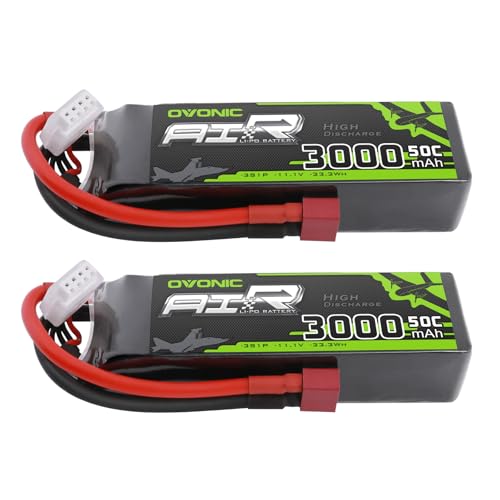
This OVONIC pack pairs 3000mAh capacity with a 50C discharge rating, offering longer flight times for medium to larger quads. The dimension and weight are balanced for stable handling, and the Dean-Style T connector is suitable for a wide range of vehicles. It’s a versatile option for pilots who want reliable endurance without overly aggressive power demands.
- Best for longer flights on mid-to-large drones
- Choose this if you need a robust runtime and compatible high-current connectors
- Caution: Larger size may not fit very compact frames; verify space before purchase
Key specs
- Voltage: 11.1V; Capacity: 3000mAh; Discharge: 50C
- Dimensions: 105 x 32 x 28 mm; Weight ~193 g
- Plug: JST-XHR (charge) / Dean-Style T (discharge)
Buying Guide: 3S Battery Essentials For Quadcopters
Should I prioritize capacity or discharge rate?
Capacity (mAh) determines how long you can fly between charges, while the discharge rating (C) indicates peak power delivery. For FPV racing or high-throttle maneuvers, a higher C-rated pack helps prevent voltage sag. For cruising or photography-focused flights, higher capacity can extend flight times without needing more frequent replacements.
What about battery size and frame compatibility?
Always confirm the physical dimensions and connector type before purchasing. Compact frames require shorter packs (shorty designs) to fit without pressing on props or ESCs. Larger frames can accommodate bigger capacity packs but may add weight and affect handling.
Which connector should I choose?
XT60 is common for many hobby quads and offers solid durability. Some models use XT30, XT60, or EC3 connectors. Ensure the connector matches your drone’s power system or plan to use an appropriate adapter. Also verify balance plug compatibility with your charger.
How important is safety certification?
RoHS, CE, and UN38.3 certifications indicate adherence to safety and shipping standards. If you fly in clubs or schools, these certifications can be a practical consideration alongside performance.
What maintenance practices improve battery life?
Avoid deep discharges and store batteries with a partial charge (around 3.8V per cell) for long-term storage. Use a proper LiPo balance charger and never leave charging packs unattended. Regularly inspect packs for swelling, heat, or damaged connectors.
Frequently asked questions
- Q: Can I mix different brands in the same quad? A: It’s best to use matched packs for consistent performance, especially on FPV quads with synchronized motors.
- Q: How do I know which C-rating I need? A: For racing or aggressive flying, aim for at least 35C-50C; for casual cruising, 20C-35C can suffice.
- Q: Do higher capacity packs weigh more? A: Yes, higher capacity packs typically weigh more, which can affect flight dynamics on small frames.
- Q: Are graphene batteries better? A: Graphene cells can offer higher discharge stability and durability in some designs, but always verify compatibility with your drone’s power system.
- Q: How should I store LiPo batteries long-term? A: Store at a partial charge in a cool, dry place; avoid extreme temperatures and punctures.
- Q: Can these batteries be used for other RC models? A: Many 3S packs use XT60 or similar connectors and are compatible with RC cars, boats, and planes if voltage, capacity, and dimensions match.