Choosing the right 3D scanner for small objects involves balancing accuracy, color fidelity, ease of use, and compatibility with your existing workflow. The following selections focus on handheld and desktop scanners optimized for tiny parts, miniatures, jewelry, electronics, and small mechanical components. Each option highlights sharp detail capture, reliable performance, and practical features for makers, designers, and professionals. Use this guide to compare capabilities and pick the best fit for your small-object scanning needs.
Summary of chosen products:
- Revopoint POP3 Plus — High-precision handheld with full-color capture and fast scanning.
- Revopoint MetroX — Industrial-grade blue laser with rapid 60 fps scanning for small-to-medium parts.
- Creality CR Scan Ferret Pro — Easy handheld scanning with RGB textures and anti-shake tracking.
- Revopoint MIRACO Plus — Photogrammetry-capable, robust color scanning with RAM and high-resolution capture.
- 3DMakerpro 3D Scanner — Lightweight handheld with AI tracking for mid-sized objects.
Revopoint POP3 Plus: Precise Full-Color Scans
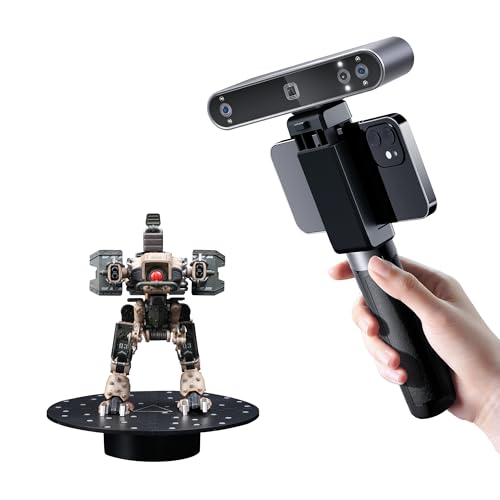
The POP3 Plus is designed for small-to-medium objects with a focus on precision and color accuracy. It offers an improved calibration board, enabling accuracy within 20 microns, and a 1.5x to 2x optical zoom to enhance fine details in the point cloud. The device supports fast scanning up to 18 frames per second and includes a 9-axis IMU to stabilize frames during movement. Its RGB camera and LED lighting system produce vibrant full-color scans, which is ideal for documenting small components, jewelry, or model parts with lifelike texture.
Key features include refined precision, faster capture rates, and eye-safe operation using class 1 infrared light. The combination of high-detail color data and stable scanning makes the POP3 Plus a compelling option for users who need detailed small-object models suitable for printing, reverse-engineering, or archival work.
Revopoint MetroX: 0.01mm Precision For Small Parts

The MetroX uses industrial-grade blue laser scanning to achieve metrology-grade precision for metal and dark objects. It delivers accuracy up to 0.02 mm, with a single-point precision near 0.01 mm and a dense 0.05 mm cloud distance. It supports rapid data capture with up to 60 frames per second and multiple scanning modes, including full-field and auto turntable, making it well-suited for small mechanical parts, molds, and components that demand crisp measurements. Users should note it requires caution around the laser and GPU-accelerated processing capabilities to achieve the best results.
Its design supports dark or shiny surfaces without relying on scanning sprays, thanks to multiple laser lines and robust processing. The MetroX is a strong pick for workshop environments where precise measurements and quick turnarounds for small assemblies are essential.
Creality CR Scan Ferret Pro: Colorful, Stable Handheld Scanning

The Ferret Pro offers beginner-friendly operation with professional-grade scanning accuracy up to 0.1 mm. Its handheld design is augmented by an anti-shake tracking system that helps maintain stable scans during movement, making it practical for on-the-go capture of small objects. A built-in 2 MP color camera records rich textures, preserving the original look of scanned items. This scanner is compatible with PC, iOS, and Android environments, enabling flexible workflows for prototyping, design, and 3D printing projects that involve small-to-medium items.
Users benefit from a straightforward setup and reliable color texture capture, which is helpful for producing publish-ready models or rapid-prototyping pipelines. The Ferret Pro strikes a balance between accessibility and quality, suitable for hobbyists and professionals who require dependable color scans of compact objects.
Revopoint MIRACO Plus: Photogrammetry And Color Depth

The MIRACO Plus integrates photogrammetry with a quad-depth camera system and a 48 MP RGB camera, enabling high-resolution color capture and deep texture detail. The device emphasizes photogrammetric metrology, delivering accurate measurements with a calibration framework and coded targets for complex measurements. An enhanced optics system with 1.5x and 2x magnification reduces noise and improves surface detail capture. RAM capacity and onboard processing support efficient scanning of both small and large objects, making MIRACO Plus a reliable choice for projects requiring photorealistic color models and precise measurements across object scales.
This scanner emphasizes versatility and accuracy, supporting various object sizes—from tiny components to larger assemblies—while ensuring color fidelity through robust lighting and color capture. It is particularly suitable for workflows that combine photogrammetry with 3D modeling and printing, where texture realism matters as much as geometric precision.
3DMakerpro 3D Scanner: AI Tracking For Small Objects

The 3DMakerpro model emphasizes AI visual tracking and consistent accuracy around 0.05 mm, with a resolution listed at 0.10 mm. It is built for handheld use and supports multiple platforms (Android, iOS, Windows, macOS), making it a flexible option for scanning various small-to-medium objects. The combination of AI tracking and a compact design is beneficial for users who need reliable scans of detailed components and parts without complicated setup.
While not the most feature-dense option in every category, the 3DMakerpro provides a practical balance of ease-of-use and adequate precision for educational, maker, and light professional projects that require consistent data capture for small objects.
Buying Guide: Key Purchase Considerations For Small-Object Scanning
- Accuracy and resolution: For tiny objects, look for scanners offering sub-0.05 mm precision when possible, and consider the trade-off between single-frame precision and overall mesh quality.
- Color fidelity: If textures and colors matter, prioritize devices with high-resolution RGB cameras, good lighting, and robust color mapping to minimize post-processing.
- Surface handling: Some surfaces—dark, shiny, or reflective—benefit from targeted scanning modes (e.g., blue laser, cross-line configurations) or from pre-scan surface treatment recommendations.
- Scanning speed and workflow: Faster frame rates reduce capture time and improve stability, especially for small parts that require multiple angles or auto turntable modes.
- Portability and setup: Handheld options offer portability, while desktop or turntable-supported models can improve consistency for featureless objects.
- Software compatibility: Ensure the scanner exports common file formats (OBJ, STL, PLY) and integrates with your preferred design tools and printing software.
- Safety and ergonomics: Consider infrared/laser exposure, especially around eyes, and ensure the device provides safe operation for your environment and users.
- Future-proofing: Some models include photogrammetry, multiple scanning modes, or RAM upgrades that enhance long-term usability as project needs evolve.
Additional Comparisons And Considerations
- Handheld versus stationary scanning: Handheld scanners are ideal for capturing details on irregular small parts, whereas desktop or auto-turntable setups deliver repeatable scans for identical items.
- Texture versus geometry emphasis: If texture is crucial (e.g., jewelry or collectibles), prioritize devices with strong RGB data and lighting. For precise fit checks, geometry-focused scanners with high-point density may be preferable.
- Maintenance and accessories: Look for calibration tools, protective cases, and recommended accessories (e.g., turntables or scanning sprays) that align with your typical workflow and object types.
- Operating system compatibility: Verify cross-platform support (Windows, macOS, Android, iOS) to ensure seamless integration with your devices and software suites.
- Cost-to-benefit balance: Higher-precision devices often come with steeper prices. Evaluate required accuracy against your projects to select the best value.