The construction and architecture sectors increasingly rely on fast, accurate 3D scanning to capture complex building geometry, facades, interiors, and site context. This guide highlights top 3D scanners suited for building-scale projects, with emphasis on precision, ease of use, outdoor performance, and data compatibility. Below are five models that balance accuracy and practicality for architectural, engineering, and construction workflows.
| Product | Brand | Key Strength | Best For |
|---|---|---|---|
| Revopoint MetroX 3D Scanner (Blue Laser) | Revopoint | 0.01 mm precision, high-speed capture | Industrial measurement, metal surfaces |
| Creality CR-Scan Ferret Pro | CREALITY FALCON | WiFi6, outdoor scanning, fast color capture | On-site building captures, exterior facades |
| Revopoint MIRACO Plus | Revopoint | Photogrammetry+, full-color, versatile modes | Small to large objects, color accuracy |
| Revopoint MIRACO Pro Wireless | Revopoint | Wireless, high color fidelity, onboard processing | Portable site scans, quick turnaround |
| Revopoint POP3 Plus | Revopoint | High-precision, full-color, fast capture | Mid-sized buildings, interior replication |
Revopoint MetroX 3D Scanner for 3D Printing

Industrial-Grade Blue Laser Scanning delivers precision to 0.01 mm with fused point cloud accuracy around 0.05 mm. MetroX is designed to handle dark or metallic surfaces with higher efficiency, aided by GPU-accelerated blue laser lines that support up to 60 fps. This enables metrology-grade scans for building components, fixtures, and metal details.
Five scanning modes support diverse objects and surfaces, including Cross Lines, Parallel Lines, Full-field rapid capture, and Auto Turntable for automated metrology workflows. While suitable for on-site measurements, users should avoid direct exposure to the Class 2M laser from close range for safety.
Creality CR-Scan Ferret Pro 3D Scanner

This handheld scanner supports outdoor and indoor use with 30FPS full-color scanning and up to 0.1 mm accuracy. The WiFi 6 bridge enables fast, stable data transmission, which is helpful for project teams capturing exterior walls, façades, and interior layouts with color texture. It also performs well under varied light conditions, broadening its suitability for urban site surveys.
Outdoor scanning capability and robust wireless connectivity help teams quickly acquire site data, reducing field time. The device is designed to adapt to dynamic building environments and provides reliable data for later BIM integration.
Revopoint MIRACO Plus 3D Scanner for 3D Printing

Combining photogrammetric metrology with a 48 MP RGB camera, MIRACO Plus emphasizes high-resolution texture capture and precision. The kit includes calibrated scale bars and coded targets for complex measurements, delivering 0.02 mm length accuracy and improved single-point cloud precision. It accommodates a wide range of object sizes, from small details to large mechanical surfaces, which aligns with architectural detailing and interior replication tasks.
It uses class 1 infrared laser technology for safe scanning and supports both near and far modes for flexible project coverage. The device is suited for color-dense models where texture realism matters for client presentations and as-built documentation.
Revopoint MIRACO Pro Wireless 3D Scanner

Wireless, onboard processing, and full-color capture provide a streamlined field workflow. MIRACO Pro maintains a high single-frame precision of up to 0.02 mm and supports scanning across a variety of project scales—from small interior components to larger equipment. The quad-depth camera system enables flexible near and far scanning modes, supporting efficient site documentation with minimal post-processing on some datasets.
Its portability is advantageous for building façades, interiors, and exterior details where power and cable management are constraints. The color fidelity and texture accuracy support accurate BIM texture mapping for presentation-quality models.
Revopoint POP3 Plus 3D Scanner for 3D Printing
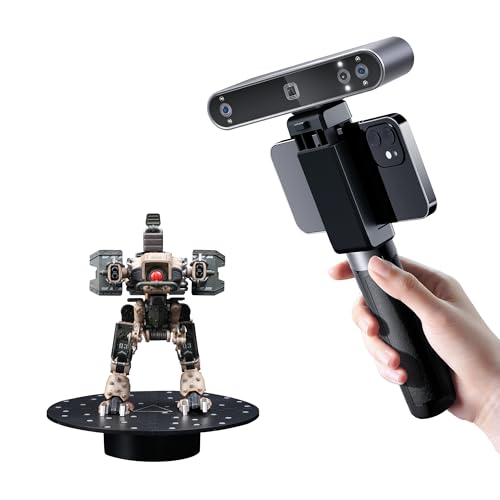
POP3 Plus emphasizes refined precision with calibration improvements yielding up to 0.04 mm point cloud accuracy and 20% more overall precision. A 1.5x to 2x optical zoom enhances detail capture for mid-sized architectural elements, while high-speed scanning at up to 18 fps accelerates fieldwork. Full-color texture capture supports realistic façades and interior finishes for client reviews and BIM as-built workflows.
Its compatibility across Android, iOS, Windows, and macOS, plus an eye- and skin-safe infrared system, makes it a practical option for varied on-site tasks without specialized equipment. The device targets a balance between speed, accuracy, and portability for building documentation tasks.
Buying Guide: Key Purchase Considerations For Building Scans
- Accuracy and resolution: For architectural modeling and as-built BIM, prioritize scanners offering sub-0.1 mm accuracy, reliable color texture, and consistent data capture across surfaces such as glass, metal, and concrete.
- Surface handling: Buildings include reflective and dark surfaces. Look for blue laser or multi-sensor systems that can handle these materials without excessive spraying or post-processing.
- Field usability: On-site constraints demand portability, battery life, wireless data transfer, and robust software compatibility with BIM workflows (OBJ, STL, PLY, LAS/LAZ, and native BIM formats).
- Outdoor performance: If exterior facades or site context are required, ensure the device has good performance under daylight, sun glare resistance, and is supported by GPS or alignment tools for aligning scans with site models.
- Data integration: Check whether the scanner supports automatic alignment, registries, and alignment with software like Revit, AutoCAD, or other BIM platforms. Look for packages that include registration and texture mapping features.
- Safety and compliance: For laser-based devices, follow safety guidelines and avoid direct exposure to the light source. Class labeling and user training are important for field teams.
- Future-proofing: Consider scanners with versatile capture modes (near, far, color texture, and photogrammetry options) to adapt to different project sizes and surface details over time.
- Support and updates: Opt for brands with active firmware updates, robust customer support, and readily available accessory ecosystems (targets, calibration boards, stands).
Comparative Considerations
- Precision vs. speed: Some devices offer higher precision but slower capture, while others prioritize rapid field scanning with adequate accuracy for many architectural tasks. Choose based on project needs and post-processing workflow.
- Color vs. geometry emphasis: If texture realism is critical for presentations, prioritize scanners with high-color fidelity. For pure geometry, prioritize point density and alignment robustness.
- Portability and power: For on-site building scans, a lighter, cable-free setup reduces fatigue and speeds up data collection across large facades or interiors.
- Software ecosystem: A strong pipeline into BIM and CAD software can significantly reduce post-processing time. Favor devices with proven interoperability and reliable sample datasets.