For hobbyists and small teams exploring rapid prototyping, choosing the right 3D printer can accelerate ideas from concept to reality. This guide highlights five high-performance machines that balance speed, multi-color capabilities, and reliable calibration. Each choice is evaluated for build volume, nozzle options, auto-leveling, and material compatibility to help you compare how they fit common use cases—from rapid concepting to durable functional parts.
Product Snapshot
| Product | Build Volume | Notable Strengths | Key Feature |
|---|---|---|---|
| FLASHFORGE Adventurer 5M Pro | 220x220x220 mm | High-speed coreXY, detachable nozzle, auto-levelling | Auto leveling, multi-nozzle options |
| FLASHFORGE AD5X Multi-Color | 220x220x220 mm | 4-color capable, auto leveling, high-speed | Multi-color IFS integration |
| FLASHFORGE AD5M Pro / AD5M | 220x220x220 mm | Fully auto calibration, quick heat-up | 1-click leveling, all-metal coreXY |
| Creality K2 SE | 220x215x245 mm | High-speed, solid metal build, auto leveling | Direct drive, quick-swap nozzle |
| ELEGOO Centauri Carbon | 256x256x256 mm | Out-of-the-box ready, auto calibration, high-speed | 320°C nozzle, built-in camera |
Below you will find in-depth sections for each selected model, followed by a buying guide with practical considerations for different use cases and budgets.
FLASHFORGE Adventurer 5M Pro 3D Printer

The Adventurer 5M Pro combines coreXY speed with a robust all-metal frame. It features a 600 mm/s travel speed, rapid nozzle options, and a 200°C operational limit with multiple nozzle sizes for balancing speed and detail. Its automatic bed leveling saves setup time, and a dual-sided PEI surface supports easy part removal. Designed for fast iterations, the 5M Pro aims to shorten development cycles for rapid prototyping and educational labs alike.
FLASHFORGE Adventurer 5M Series: Auto Leveling And Quick Nozzle Changes

One-click automatic printing and true bed leveling simplify setup, while a high-flow nozzle and fast warm-up to 200°C support longer print runs at high speeds. Its CoreXY all-metal structure contributes to stability during rapid moves, helping reduce artifacts on larger parts. This model prioritizes ease of use for teams that value consistent first layers and repeatable results without extensive calibration.
FLASHFORGE AD5X Multi-Color

This model supports vivid multi-color printing with up to four colors simultaneously and features a 1-click auto-leveling system. Its CoreXY design achieves speeds up to 600 mm/s with 20,000 mm/s² acceleration, enabling rapid prototyping while maintaining accuracy. It’s well-suited for teams that require multicolor parts or aesthetic-focused prints without swapping machines.
FLASHFORGE AD5X Multi-Material With IFS

The AD5X IFS model supports multi-material and multi-color workflows, enabling four-color outputs and seamless color transitions. It features full auto leveling to maintain consistent nozzle-to-bed distance. The Intelligent Filament System (IFS) broadens material options, including PETG and carbon-fiber composites, for projects requiring diverse properties and finishes.
Creality K2 SE 3D Printer
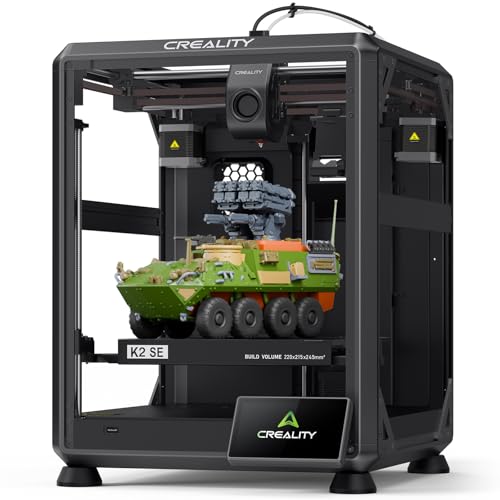
The K2 SE emphasizes high-speed capability with a CoreXY motion system and a solid metal frame for stability during fast printing. It provides auto leveling and a direct-drive extruder, plus a quick-swap nozzle feature for different filament types. The printer balances speed and rigidity to deliver reliable surfaces and precise tolerances on larger parts and functional prototypes.
ELEGOO Centauri Carbon
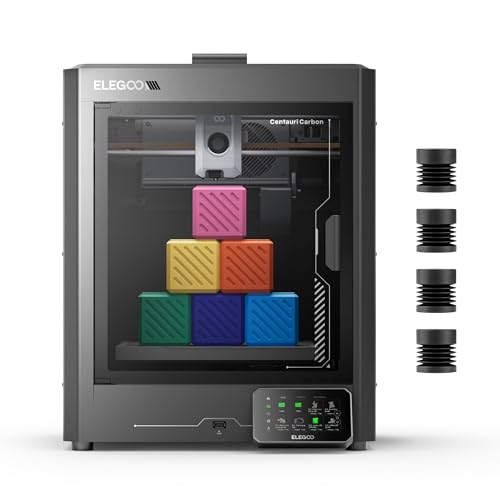
The Centauri Carbon combines a ready-to-printer experience with a high-speed CoreXY system that reaches up to 500 mm/s. It ships with auto-bed leveling, a built-in camera, and a 320°C hotend capable of advanced materials. The enclosed chamber and 256x256x256 mm build volume make it versatile for diverse projects, from drones to automotive components, while maintaining user-friendly operation.
Buying Guide: Key Purchase Considerations
- Speed vs. detail: Printers like the Adventurer 5M Pro and AD5X series prioritize speed through CoreXY architectures, but users should balance travel speed with nozzle size and layer resolution to avoid sacrificing surface quality on small features.
- Multi-color and multi-material needs: If your projects require color variation across parts, the AD5X with IFS or multi-color capabilities offers a streamlined workflow without manual filament changes. Consider filament compatibility when choosing a system.
- Auto leveling and calibration: Auto bed leveling saves setup time and reduces failed prints. Look for machines with multi-point or sensor-based leveling to improve first-layer consistency on varied bed surfaces.
- Build volume and enclosure: Larger builds enable more functional prototypes but may require stronger frames and better cooling. Enclosed or semi-enclosed designs help with temperature stability for challenging filaments.
- Material capabilities: Print temperature limits (e.g., 300°C or higher) expand material choices to carbon-fiber composites and high-temp filaments. Verify hotend compatibility and cooling for your target materials.
- Maintenance and upgrades: All-metal frames and modular hotends simplify maintenance and future upgrades. Consider printers with easily swappable nozzles and accessible extruders for long-term flexibility.
- Software and ecosystem: Strong slicer integration, compatibility with multi-color workflows, and open filament systems can significantly affect ease of use and production speed.
In selecting a 3D printing machine, buyers should map expected workloads to the printer’s strengths: speed for rapid iterations, color and material flexibility for multi-stage projects, and reliable auto-calibration for hands-off operation. The five machines highlighted here offer a spectrum of capabilities—from auto-leveling and high-speed printing to multi-color and multi-material support—enabling teams to choose a setup that best aligns with their design and production goals.