Manufacturing teams increasingly rely on high-speed, reliable 3D printers to prototype parts, create fixtures, and produce small-batch components. This guide covers five top models designed for efficient manufacturing workflows, including auto-leveling, fast print speeds, and robust build volumes. Each option is evaluated for speed, precision, material readiness, and ease of use to help facilities decide which printer best fits their production line and budget.
style=”display:none”>Summary Table of Chosen Products
| Product | Brand | Build Volume | Key Strength |
|---|---|---|---|
| Adventurer 5M | FLASHFORGE | 220x220x220 mm | Fully Auto Leveling; Ultra-fast coreXY |
| AD5X Multi-Color | FLASHFORGE | 220x220x220 mm | Multi-color printing; 600 mm/s |
| Centauri Carbon | ELEGOO | 256x256x256 mm | Auto calibration; high-speed CoreXY |
| Tina2 Basic V11 | Entina | 180x180x180 mm | Beginner-friendly; auto leveling |
| Geeetech Mini M1 | GIANTARM | 100x120x100 mm (example) | Auto leveling; direct drive |
FLASHFORGE Adventurer 5M 3D Printer

The Adventurer 5M offers one-click automatic bed leveling, reducing setup time and improving first-layer adhesion—a key factor in manufacturing environments where downtime costs productivity. Its CoreXY architecture supports high-velocity travel up to 600 mm/s with acceleration up to 20,000 mm/s², promoting rapid prototyping cycles and batch production. A direct extruder reaches up to 280°C with a detachable nozzle, enabling a range of materials while maintaining stable high-speed performance. The dual-sided PEI build plate simplifies part removal and supports repeated manufacturing runs with consistent quality.
FLASHFORGE AD5X Multi-Color 3D Printer

The AD5X adds vivid multi-color capability to a high-speed CoreXY platform, supporting up to four colors simultaneously. Its 1-click auto-leveling ensures a reliable bed plane for repeatable parts, a must for production lines performing daily batch cycles. With speeds up to 600 mm/s and an acceleration rating of 20,000 mm/s², the AD5X balances speed with precision, making it suitable for rapid prototyping and end-use component production where color differentiation matters for assembly or marketing models.
ELEGOO Centauri Carbon 3D Printer
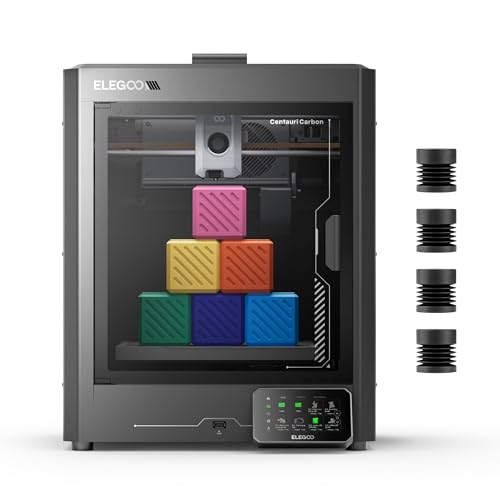
The Centauri Carbon features a CoreXY structure designed for high-speed printing up to 500 mm/s with strong acceleration for rapid production cycles. It arrives ready to print out of the box with auto calibration, simplifying setup in manufacturing environments. A 320°C nozzle supports advanced materials, while an enclosed chamber and efficient cooling improve print stability when working with demanding filaments. The build volume of 256x256x256 mm suits parts, jigs, and tooling components used in production workflows.
Geeetech Mini 3D Printer (Giantarm Tina2 Basic V11)

Designed for beginners and classrooms, Tina2 Basic V11 provides automatic leveling and a removable magnetic platform for easy part removal. While compact, it emphasizes reliability and straightforward operation, making it a practical entry point for manufacturing teams piloting additive processes or upskilling staff. The printer supports quick startup, a user-friendly LCD interface, and offline printing via MicroSD, with resume capability after outages to preserve production continuity.
Yibrvoik 50Pcs 3D Printer Tool Kit & Accessories

While not a printer itself, this 50-piece toolkit supports manufacturing workflows by enabling routine maintenance, nozzle cleaning, deburring, and model finishing. A complete starter kit like this reduces downtime, helping production teams maintain consistent part quality across daily manufacturing runs and post-processing tasks.
Buying Guide: Choosing 3D Printers For Manufacturing
Key factors to consider include print speed, reliability, and automation. For high-volume prototyping, prioritize fast CoreXY or similar architectures (600 mm/s or higher) and robust acceleration to reduce cycle times. Auto-leveling features save setup time and improve first-layer consistency across multiple prints in a workday. Material capabilities matter: look for nozzle temperatures around 300°C or higher if you plan to work with polycarbonate, carbon-fiber reinforced materials, or exotic filaments. Enclosed or semi-enclosed frames help manage heat and improve durability when used in shop floors. Build volume should align with typical part sizes and fixture dimensions, while platform reliability and ease of maintenance minimize downtime. Consider multi-color or multi-material options if your workflow involves adding colors for assemblies, signaling, or prototyping with different materials. For beginners or training environments, auto-leveling and straightforward software reduce training time and error rates.
Manufacturing environments should also weigh total cost of ownership, including spare parts availability, service support, and the ability to scale as demand grows. Integrated cameras for process monitoring, reliable firmware, and open-source compatibility can influence long-term flexibility. Finally, assess your post-processing needs—whether you require precise surface finishes, post-build machining, or cleaning workflows—to select printers that best integrate with existing manufacturing pipelines.