3D laser scanners enable fast, accurate digitization of objects for reverse engineering, 3D printing, and metrology. This guide highlights five top options that balance precision, speed, and usability. Each entry includes a concise feature snapshot and practical notes for professionals and hobbyists alike.
| Product | Brand | Key Feature |
|---|---|---|
| Revopoint MetroY Pro | Revopoint | 0.01 mm precision, multiple scanning modes |
| Revopoint MetroX | Revopoint | 0.01 mm precision, up to 60 fps scanning |
| Creality CR-Scan Ferret Pro | CREALITY FALCON | 0.1 mm accuracy, WiFi 6, outdoor capability |
| Creality Raptor | Creality | 0.02 mm precision, hybrid blue + IR scanning |
| EINSTAR Rockit | EinScan | Marker-free, wireless with built-in battery |
Note: The selections emphasize blue laser and hybrid scanning approaches, suitable for metal and dark surfaces, and they cover handheld convenience, wireless operation, and metrology-ready performance. Prices are not listed to keep focus on capability and fit for various workflows.
Revopoint MetroY Pro 3D Scanner

Industrial-grade accuracy distinguishes the MetroY Pro, featuring blue lasers that deliver precision up to 0.01 mm and volumetric accuracy up to 0.02 mm + 0.04 mm x L(m). It supports five scanning modes, including ultra-fast 62-line full-field and auto turntable modes, making it versatile for reverse engineering, metrology, and 3D printing projects. A notable benefit is its ability to scan shiny or dark surfaces without spray, enhancing workflow speed. Real-time preview and built-in Wi-Fi 6 streamline data transfer to a workstation or mobile device.
The MetroY Pro combines a robust feature set with practical usability. Its 34 cross-lines and 15 parallel lines enable quick surface capture and detailed scans, while the single-line deep-hole mode supports challenging features found in mechanical components. The scanner’s high data throughput supports large projects, and the device is designed for portability without sacrificing accuracy.
Revopoint MetroX 3D Scanner

The MetroX emphasizes metrology-grade precision with blue laser scanning, delivering accuracy up to 0.02 mm and a 0.01 mm precision target. Its 4 effective modes include cross-line and parallel-line configurations, plus full-field and auto turntable modes for automated, repeatable scans. The device excels at dark or shiny surfaces thanks to its GPU-accelerated line layout, achieving rapid capture rates up to 7 million points per second in full-field mode. It’s designed for industrial measurement, quality control, and intricate mechanical parts scanning.
Users should note the MetroX uses a Class 2M laser projector, so direct eye exposure at close range should be avoided. The combination of high point density and flexible modes supports a wide range of object geometries, from small components to larger assemblies, making it a strong choice for professional workflows requiring precise dimensional data.
Creality CR-Scan Ferret Pro

The Ferret Pro focuses on fast, color-rich handheld scanning with WiFi 6 transmission and external robustness. It delivers up to 0.1 mm accuracy and 0.16 mm resolution at a scanning frame rate around 30 FPS, providing smooth full-color scans for 3D printers. Outdoor scanning support improves versatility for field use. The WiFi 6 bridge enhances data throughput and lowers latency, helping maintain workflow momentum in dynamic environments, whether indoors or outside in bright light conditions.
Its practical design emphasizes mobility and ease of use, with a handheld form factor and reliable tracking for real-time capture. The Ferret Pro is well-suited for users seeking a balance between color texture fidelity and reasonable geometric accuracy, especially when rapid scanning and mobility are important factors in the project pipeline.
Creality Raptor 3D Scanner

The Raptor merges blue laser scanning with infrared structured light, delivering metrology-grade precision up to 0.02 mm and 0.16 mm resolution over a broad scan range. Its dual-mode approach supports both high-precision blue laser scanning and infrared marker-free scanning, enabling flexibility for varied object types and textures. The all-glass lens system enhances optical clarity and reduces distortion, supporting scans from small to large objects with a single device. Aimed at users needing versatility in texture capture and dimensional accuracy, the Raptor is a strong all-around option for Windows and macOS workflows.
The device is designed to be user-friendly and durable, with easy-to-operate controls and a compact build that reduces fatigue during long sessions. The combination of blue laser and infrared modes makes it suitable for a broad range of surfaces, including some dark or glossy items, minimizing dependence on spray powders in many cases.
EINSTAR Rockit Wireless 3D Scanner
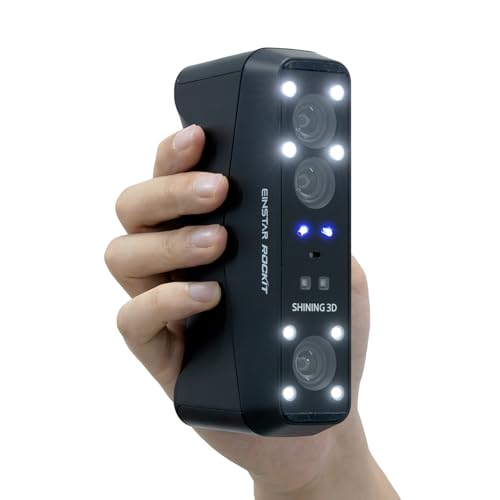
The Rockit Wireless 3D Scanner emphasizes marker-free scanning with blue laser lines (19 + 19 crossed lines) and 7 parallel lines for fine features. It supports VCSEL infrared light for versatile scanning conditions, and its true wireless design features a swappable battery for up to three hours of operation. The built-in Wi-Fi provides real-time PC sync without extra hubs, improving mobility and reducing cable clutter. It is well-suited for industrial parts, automotive components, and quick-on-site capture where portability matters.
Potential users should consider system memory and processing requirements when leveraging marker-free scanning and high-resolution data streams. The Rockit’s wireless design supports fast workflows, though cable connections remain available if needed to avoid interference in challenging environments.
Buying Guide
Key considerations when choosing a 3D laser scanner:
- Accuracy and resolution: Higher precision supports detailed reverse engineering and metrology. Look for scanners offering 0.01–0.02 mm precision for industrial work, with adequate point density for your object size.
- Laser type and safety: Blue laser scanners tend to perform well on dark or reflective surfaces. Note safety guidelines and class ratings to ensure appropriate use in workspaces.
- Scanning modes and speed: Multi-mode devices (cross-lines, parallel lines, full-field) provide versatility for different geometries. FPS or high point-per-second rates enable faster scans, especially for moving parts or larger objects.
- Surface compatibility: If you frequently scan shiny, black, or textured surfaces, consider scanners that claim spray-free operation or GPU-accelerated processing for noisy surfaces.
- Portability and power: Handheld devices with battery life or wireless connectivity offer more flexibility for on-site work. Weigh battery life against scan duration for your typical projects.
- Workflow integration: Check compatibility with Windows/macOS, file formats, and software ecosystems for alignment, meshing, and texture mapping. Real-time preview features help verify coverage during scanning.
- Connectivity: Wi-Fi 6 or robust Bluetooth can streamline data transfer, but consider whether a wired option is important to avoid interference in busy environments.
- Physical build and durability: A solid grip, lightweight design, and durable casing reduce operator fatigue and protect sensitive optics during outdoor or field work.
For buyers, it’s useful to map requirements to the tradeoffs between accuracy, texture capture, and mobility. If texture fidelity is critical, prioritize color capture and lighting. If dimensional metrology is the priority, emphasize nominal accuracy, repeatability, and the availability of automated turntables or alignment tooling. Finally, budget and software ecosystems should align with your existing hardware and preferred post-processing workflows.