Looking for a 24V smart charger that can handle LiFePO4, lead-acid, and mixed battery systems? This guide highlights five top options that balance safety, versatility, and ease of use. Each choice targets common buyers: DIY enthusiasts, boaters, fleet managers, and everyday vehicle owners who need reliable maintenance and quick recovery. The following buying table summarizes key attributes to help you compare quickly.
| Product | Best For | Battery Types | Charge Power |
|---|---|---|---|
| PZ.P 15-Amp 12V/24V Smart Battery Charger | All-around maintenance | LiFePO4, Lead-Acid | 12V up to 15A / 24V up to 8A |
| Haisito 26A 6V/12V/24V Smart Charger | Heavy use with multiple batteries | Lead-Acid, LiFePO4 | 6V/10A, 12V/26A, 24V/13A |
| Unocho 24V 5A Smart Battery Charger | Compact setups with 3-pin XLR | AGM, Gel, SLA, VRLA, LiFePO4 | 5A at 24V |
| E-FAST 25A Smart Car Battery Charger | Fast charging for large batteries | Lead-Acid, LiFePO4 | 12V up to 25A, 24V up to 15A |
| AeternaSol 20A Smart Charger | Budget-friendly 20A option | Lead-Acid, LiFePO4 | Up to 20A (12V/24V) |
PZ.P 15-Amp 12V/24V Smart Battery Charger

Best for versatile maintenance across both 12V and 24V systems. This charger supports LiFePO4 and lead-acid chemistries, including AGM, GEL, SLA, and Flooded types. It delivers 12V at 15A or 24V at 8A, offering faster charging than many standard maintainers. The 9-stage charging process with temperature compensation enhances safety and efficiency. A large color screen shows voltage, current, temperature, and charge percentage in real time, useful for monitoring in direct sunlight. It includes a long 6.7-foot cable for hard-to-reach batteries.
Best for: hobbyists and small shop owners who need an all-in-one charger for various vehicles, from motorcycles to boats. Limitation: the unit is a charger, not a jump starter, so it won’t forcibly start a dead battery.
Haisito 26A 6V/12V/24V Smart Charger

This model emphasizes single-button operation and broad compatibility, including LiFePO4 and various lead-acid chemistries. With 6V/12V/24V options, it offers multiple charging levels (up to 26A at 12V and 13A at 24V) to tailor the process to different battery sizes. It features a forcing charging mode to revive batteries with very low voltage, though it may not recover a completely dead battery. Best for busy drivers who want simple controls and robust recovery capabilities.
Caution: Check battery voltage and polarity before connection to avoid misconfiguration or damage to delicate BMS systems.
Unocho 24V 5A Smart Charger

Choose this for compact 24V battery systems using AGM, GEL, SLA, VRLA, or LiFePO4. It delivers 5A at 24V and supports 9–80Ah charging along with 15–150Ah maintenance, making it suitable for smaller industrial packs and recreational vehicles. The 4-stage charging with desulfation helps restore performance while maintaining safety. Includes both a 3-pin XLR and alligator clip connectors for flexible installation.
Limitation: It may not provide enough current for very large 24V batteries or heavy-duty applications requiring higher charging power.
E-FAST 25A Smart Car Charger

Best for rapid charging needs on larger 12V and 24V batteries. This charger provides 25A for 12V and 15A for 24V, delivering faster cycles for trucks, SUVs, boats, and RVs. It supports Lead-Acid and LiFePO4 chemistries and includes a Booster mode (200 seconds) to help jump-start a dead battery. Auto-detects 12V or 24V, which simplifies use across mixed-fleet environments. Best for garages needing a high-output option.
Limitation: Booster mode is intended for 12V batteries; 24V recovery may require different approaches if the pack is deeply discharged.
AeternaSol 20A Smart Charger
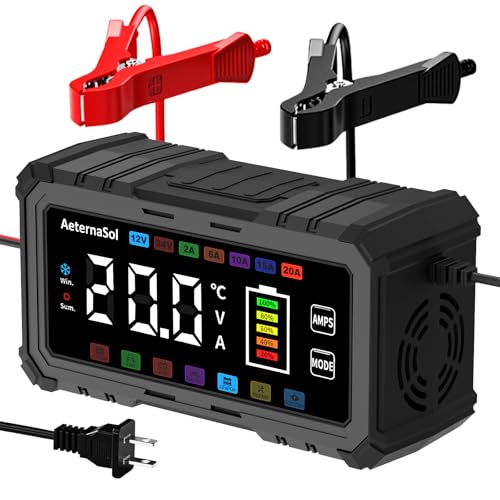
Choose this as a budget-friendly, practical option offering 20A max current for 12V and 24V. It supports common lead-acid chemistries and LiFePO4 with smart voltage detection and five manual current levels. The 200-second booster mode provides a quick surface charge to help with emergency starts, and its broad compatibility makes it a solid choice for mixed battery systems in cars, boats, and light trucks.
Limitation: The charger’s features are robust, but it may lack some advanced desulfation or wireless connectivity found in higher-end models.
Buying Guide
What should I look for in a 24V smart charger?
Key factors include voltage recognition (12V/24V auto-detect), compatible battery chemistries (LiFePO4, AGM, GEL, SLA, flooded), charging stages (bulk, absorption, float), and protection features (reverse polarity, short-circuit, over-current). If you maintain mixed fleets, prioritize models with automatic mode and robust maintenance options to prevent sulfation and extend battery life.
How much charging power do I need?
For small batteries or routine maintenance, 5–10A at 24V is often sufficient. For larger 24V packs or frequent use, 13–26A at 24V offers quicker cycles. If you operate multiple vehicles or heavy equipment, an adjustable or higher-output charger can reduce downtime.
What about safety and compatibility?
Look for ETL or equivalent safety certifications, multiple protection layers, and clear indicators for charging status. Ensure the charger supports your battery type’s BMS requirements. For lithium systems, verify compatibility with LiFePO4 and any safety features specific to lithium chemistries.
Is a booster mode important?
Booster or jump-start features can be helpful in emergencies for 12V batteries. They are generally less effective for deeply discharged or damaged packs. Use booster mode as a supplemental measure rather than a primary starting solution.
What installation considerations matter?
Consider connector options (XLR, alligator clips, or integrated leads), cord length, and environmental protection (waterproofing) for outdoor installations. If you need flexibility, choose a charger with multiple connection options and a long power cord or remote monitoring capabilities.
FAQ
- Can a 24V charger also charge 12V batteries? Yes, many 24V chargers auto-detect and adjust to 12V batteries, but verify the model’s auto-detect capability in the product details.
- Is LiFePO4 compatibility necessary for most vehicles? If you own LiFePO4 packs or mixed chemistries, yes, choose a charger labeled compatible with LiFePO4 to avoid improper charging.
- What is the purpose of desulfation modes? Desulfation helps restore sulfated lead-acid batteries, improving charging efficiency and extending life.
- Do these chargers include maintenance mode? Most listed models include a float/maintenance mode to keep batteries topped off during storage.
- Should I use booster mode regularly? Booster mode is intended for emergency starts, not routine charging. Rely on standard charging for daily maintenance unless troubleshooting a weak battery.