Choosing a 3D printer with exceptional resolution requires considering resin vs. filament technologies, layer accuracy, and reliability. Below are five top options that emphasize high definition, precise detailing, and consistent results for professional or enthusiast use. Each product is evaluated for its native resolution capabilities, calibration features, and build quality to help you pick a model that delivers crisp surfaces and intricate features.
| Product | Technology | Build Volume | Key Benefit |
|---|---|---|---|
| ELEGOO Saturn 4 Ultra 16K | Resin | 8.33 × 4.66 × 8.66 in | Ultra-high 16K resolution for fine details |
| ELEGOO Centauri Carbon | FDM (CoreXY) | 10 × 10 × 10 in | High-speed yet high-detail with enclosed chamber |
| FLASHFORGE Adventurer 5M | FDM | 8.7 × 8.7 × 8.7 in | Automatic leveling and high-speed printing |
| FLASHFORGE AD5X | FDM | 8.7 × 8.7 × 8.7 in | Multi-color capability with fast speeds |
| Creality K2 Combo | FDM | 10.2 × 10.2 × 10.2 in | Multi-color expansion with CFS units |
ELEGOO Saturn 4 Ultra 16K Resin 3D Printer

The ELEGOO Saturn 4 Ultra specializes in ultra-high resolution with a claimed 16K monochrome LCD, designed to render smooth surfaces and intricate textures on resin prints. Its smart tank heating maintains resin at an optimal 30 °C to improve layer adhesion and reduce defects such as bubbles. An AI camera with built-in lighting provides real-time monitoring and alerts for print progress, enabling day or night checks and easy time-lapse capture. The system emphasizes precision and detail for figurines, miniatures, and high-fidelity prototypes, supported by a large 8.33 × 4.66 × 8.66-inch build area.
ELEGOO Centauri Carbon 3D Printer
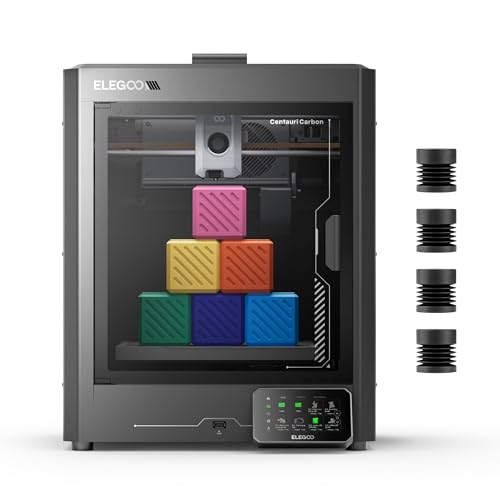
The ELEGOO Centauri Carbon is a CoreXY filament printer designed for rapid, high-detail builds. It arrives fully assembled and pre-calibrated, reducing setup time. An auto bed leveling system and a high-flow hotend support consistent first layers and reliable adhesion. The printer positions itself as a high-speed yet precise option with a 256 × 256 × 256 mm build volume, suitable for drones, automotive prototypes, and other parts requiring a strong balance of dimension accuracy and print speed. The enclosed chamber helps maintain stable printing conditions for advanced filaments.
FLASHFORGE Adventurer 5M 3D Printer

The Adventurer 5M Series focuses on ease of use with one-click automatic bed leveling and rapid total printing speeds. Its 600 mm/s travel speed and 20,000 mm/s² acceleration enable rapid prototyping, while a 280 °C direct extruder supports a range of materials. A stainless, all-metal coreXY structure contributes to stable high-speed performance and repeatable results. The printer includes a robust dual-sided PEI platform and a quick nozzle change system, making it suitable for both beginners and professionals seeking efficiency without sacrificing print quality.
FLASHFORGE AD5X Multi-Color 3D Printer

The AD5X enhances multi-color capabilities with up to four colors simultaneously and a CoreXY structure that supports high-speed printing up to 600 mm/s. A 300 °C direct drive extruder, combined with a 220 × 220 × 220 mm build volume, enables precise multicolor parts and rapid iterations. The 1-click auto-leveling feature ensures consistent bed calibration, reducing failed prints and enabling reliable batch production for creative projects or education settings seeking vibrant, multi-material designs.
Creality K2 Combo 3D Printer

The Creality K2 Combo combines a streamlined, plug-and-play experience with multi-color expansion through a CFS high-precision system. It supports up to 16 colors when paired with up to four CFS units, enabling vibrant, multi-color prints without post-processing. The printer emphasizes an ultra-quiet operation and a build volume of 260 × 260 × 260 mm, making it suitable for classrooms and home studios that require both quality and quiet performance. It ships pre-assembled, offering quick setup for immediate printing with PLA, PETG, and other common filaments.
Buying Guide: Key Purchase Considerations For High-Resolution 3D Printing
- Print technology and resolution: Resin printers typically deliver higher surface detail and smooth finishes at the cost of post-processing and handling liquid resin. FDM/FFF printers rely on filament and can achieve high-resolution layer detail with proper nozzle and layer height settings, though generally not as fine as resin in small features.
- Layer height and accuracy: Look for printers offering adjustable layer heights (low micron ranges for resin, tens of microns for filament). Inflation in resolution can come from monochrome LCDs in resin printers and from tightly tuned extrusion in filament systems.
- Calibration and ease of use: Auto-leveling, auto-calibration, and enclosed chambers simplify setup and improve first-layer adhesion. Consider whether you need one-touch bed leveling or manual adjustments.
- Build volume vs. detail: Larger build volumes are convenient for bigger parts, but may require compromises in resolution. If high detail is critical, prioritize printers with proven high-resolution capabilities in your target size range.
- Material compatibility: Resin printers are texture-focused and suited for miniatures and detailed prototypes; filament printers cover a broader range of mechanical parts and functional prototypes. Check nozzle temperature and supported materials for your projects.
- Color capabilities: For multi-color design work, consider printers with multi-color support and compatible toolheads or modules. Two-color or multi-color workflows can improve prototyping and visual communication.
- Ease of maintenance and safety: Resin systems involve chemical handling and post-processing steps; filament printers tend to be safer and easier to maintain for households and schools. Enclosures help with safety, odors, and temperature control.
- Workflow and software: Evaluate the compatibility of slicer software, presets for your target materials, and community support. A strong user community can help with profiles and troubleshooting.
- Price of consumables and replacement parts: Resin tanks, filters, and resin cost can accumulate. Filament spools also add cost, and replacement parts like nozzles and PTFE tubes should be considered for long-term use.
These considerations help balance the need for ultra-high detail with practical factors such as maintenance, safety, and total cost of ownership. The selected models provide a mix of resin and filament options to address different project requirements, from tabletop miniatures to functional prototypes with sharp features and clean surfaces.