Looking for a low-cost 3D printer that still delivers solid performance? This guide highlights affordable options that balance price, features, and reliability. Each pick below is designed to help hobbyists, students, and small teams get reliable prints without breaking the bank. Read on to compare capabilities, build volumes, and key features that matter when choosing a budget-friendly 3D printer.
| Product | Brand | Build Volume | Notable Feature | Build Type |
|---|---|---|---|---|
| FLASHFORGE Adventurer 5M | FLASHFORGE | 220x220x220 mm | Fully Auto Leveling, high-speed coreXY | Direct Extruder |
| FLASHFORGE AD5X Multi-Color | FLASHFORGE | 220x220x220 mm | Multi-color printing, auto leveling | Direct Drive |
| Portable 3D Printer | Generic | 100x100x100 mm | Beginner-friendly, included filament and videos | FDM |
| AOSEED X-MAKER JOY AI+ | AOSEED | Various, 1500+ models supported | AI-powered creativity, auto-leveling | FDM |
| ELEGOO Centauri Carbon | ELEGOO | 256x256x256 mm | Auto calibration, high-speed CoreXY | CoreXY |
FLASHFORGE Adventurer 5M 3D Printer

The Adventurer 5M series emphasizes ease of use alongside high-speed capabilities. Its one-click automatic bed leveling ensures a consistent first layer, reducing manual adjustments and improving reliability for beginners and pros alike. The CoreXY layout supports rapid travel and precise motion, helping users achieve smoother surfaces and fewer failures during batch production or rapid prototyping. A detachable nozzle and a direct 280°C extruder contribute to versatile material options, while a sturdy all-metal frame supports stable performance at higher speeds.
FLASHFORGE AD5X Multi-Color 3D Printer

The AD5X stands out for multi-color capability combined with high-speed performance. With CoreXY mechanics, it can reach speeds up to 600 mm/s and rapid accelerations, enabling rapid prototyping and batch runs. Auto-leveling provides consistent bed calibration, while a 300°C direct drive extruder expands material options to include tougher composites. The printer’s four-color printing feature allows complex parts and vibrant prototypes without frequent color swaps.
Portable 3D Printer — Compact and Beginner-Friendly

This compact model is designed for newcomers and quick, simple projects. It ships with a removable build plate and includes 10 meters of filament, along with a quick-start video guide. Its plug-and-play assembly reduces setup time, and the 0.4 mm nozzle paired with a 0.05–0.3 mm layer height range helps deliver detailed parts efficiently. Filament compatibility includes PLA and flexible TPU, expanding beginner-friendly use cases for school projects, toys, and home decor.
AOSEED X-MAKER JOY AI+ 3D Printer

This AI-powered printer is designed for homes and classrooms, pairing one-tap printing with built-in AI guidance. The AI features help transform prompts into printable models, and the device supports voice and mobile app control for a hands-on learning experience. Auto-leveling, fast Wi-Fi, and a quick-release nozzle simplify ongoing use. Printing speeds reach up to 400 mm/s in bursts, with reliable 0.05 mm precision for many everyday projects. The enclosed build area emphasizes safe, kid-friendly operation.
ELEGOO Centauri Carbon 3D Printer
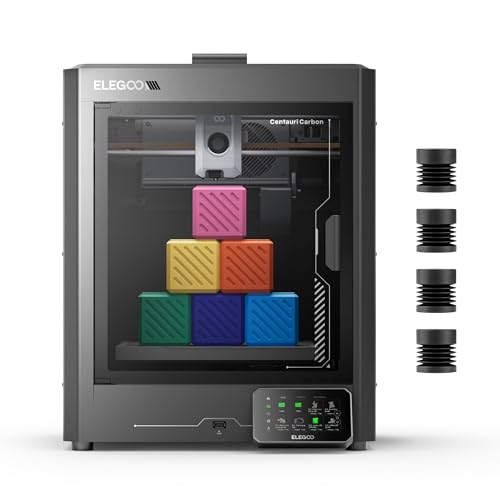
Centauri Carbon is positioned for users seeking high-speed capability without sacrificing print quality. Its auto-calibration feature minimizes manual setup, while the CoreXY motion system supports stable, quiet operation at elevated speeds. A 320°C brass-hardened nozzle accommodates a range of advanced filaments, and the built-in camera enables real-time monitoring. The printer arrives ready to print out of the box with a generous 256x256x256 mm build volume for mid-sized parts and prototypes.
Buying Guide: Key Considerations When Choosing a Budget 3D Printer
- Print speed vs. reliability: Fast printers can reduce production times, but ensure the model includes solid motion control and good cooling to avoid quality drops at high speeds.
- Autocalibration and leveling: Auto-leveling reduces setup time and first-layer issues, which is especially valuable for beginners and classrooms.
- Build volume needs: Choose a size that matches your typical projects, with a margin for growth if you plan to scale prototypes.
- Material compatibility: Look for printers that handle common filaments like PLA and PETG; consider higher-temperature nozzles if you plan to explore specialty materials.
- Safety and enclosure: Enclosed or partially enclosed designs improve safety and print reliability, particularly for younger users or shared environments.
- Software and ecosystem: A user-friendly interface, good slicer support, and firmware updates matter for long-term usefulness and learning.
- Cost of ownership: Assess nozzle replacements, bed surfaces, and replacement parts; consider total cost of ownership beyond the sticker price.
- Support and community: A strong user community and responsive manufacturer support help with troubleshooting and learning.